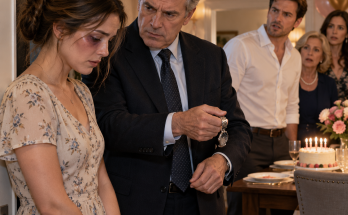
The plea hearing took place almost nine months after my birthday.
By then, the bruise had disappeared so completely that sometimes I touched my cheek and wondered how something invisible could have rearranged an entire life.
The criminal case had narrowed into specific charges supported by the strongest evidence.
Financial fraud.
Identity-related offenses.
Unlawful surveillance.
Conduct connected to the medication.
Forgery.
The assault.
Other allegations were dismissed, merged, or preserved for sentencing context according to the agreement.
I learned not to interpret dismissal as disbelief.
Legal systems sorted conduct differently than memory did.
Mara explained that more than once.
The prosecutor did too.
The plea did not erase the conduct surrounding the charges.
Much of the larger pattern would be described to the court.
That mattered to me.
The hearing room was fuller than I expected.
Reporters.
Court staff.
Attorneys.
A few strangers.
Dad sat beside me.
Linda sat three rows behind Derek’s counsel.
She had asked through the victim advocate whether I objected to her attending.
I said no.
Not invitation.
Not reconciliation.
Simply no objection.
Derek entered.
Nine months changed him.
He looked older.
Hair shorter.
Weight lost.
No polished suit.
No easy social confidence.
Still Derek.
That surprised me.
Part of me expected consequences to transform his face into somebody recognizable as dangerous.
They did not.
He remained the man who once made pancakes on Sundays.
The man who researched me before meeting me.
Both could be true.
That was one of the hardest lessons.
The judge reviewed the agreement.
Questions.
Rights.
Understanding.
Voluntariness.
Derek answered yes.
His voice sounded calm.
Then came the factual basis.
The prosecutor summarized conduct.
Funds moved through Northgate without my informed authorization.
Documents created or executed using false identity materials.
Surveillance arranged without my knowledge.
Prescription medication obtained through a false identity and given to me without disclosure.
Physical assault.
The fake Frank affidavit.
Cynthia’s impersonation.
The judge asked Derek whether he disputed the essential facts supporting the plea.
His attorney whispered to him.
Derek said, “No.”
One word.
No argument.
No explanation.
For years, he had demanded that I explain myself endlessly.
Now the court required only that he answer.
Yes.
No.
Did you understand?
Did you do this?
No room for speeches until later.
The pleas were accepted.
Sentencing would occur after reports and victim statements.
I thought that would be the emotional moment.
It wasn't.
The difficult part came weeks later.
Derek submitted a written statement through counsel.
Not an apology exactly.
A sentencing statement.
Mara asked whether I wanted to read it.
“No.”
Then I changed my mind.
“Yes.”
Choice could change.
She handed me the document.
Derek wrote that he had loved me “too intensely.”
I stopped there.
Dad saw my expression.
“What?”
I handed him the page.
He read the sentence.
His face hardened.
“No.”
Exactly.
I took it back.
Derek described fear of abandonment.
He described controlling behavior as attempts to preserve the marriage.
He described the surveillance as “misguided reassurance.”
The financial manipulation as “poor judgment.”
The treatment planning as “desperate concern.”
The medication as “a catastrophic boundary violation committed while trying to help my wife rest.”
Every phrase transformed action into emotion.
Love.
Fear.
Concern.
Desperation.
Words that made him sound swept along by feelings instead of making choices.
I kept reading.
He admitted that hitting me was wrong.
That part was direct.
Then the next paragraph explained that our argument had been “highly charged.”
There it was.
The shadow of blame.
Not enough to say I caused it.
Enough to remind the reader there had been two people in the room.
I set the statement down.
Dad said nothing.
Mara waited.
Finally I asked, “Can I respond?”
“Yes.”
“In my victim statement?”
“Yes.”
I began writing that night.
Then deleted everything.
The first draft was angry.
Too much Derek.
Too much explaining him.
The second tried to prove every detail.
Too much court.
The third sounded inspirational.
I hated it.
I went to therapy.
“I don't know what to say.”
My therapist asked, “What do you want the judge to understand?”
I thought.
“That his feelings aren't the same as my consent.”
She nodded.
There.
I went home.
Started again.
I wrote about the difference between love and ownership.
Not philosophically.
Practically.
Love asks.
Ownership assumes.
Love can hear no.
Ownership treats no as an obstacle.
Love does not need fake signatures.
Love does not need trackers.
Love does not need a dead man’s prescription identity.
Love does not need a second version of your wife built from documents.
I wrote about fear too.
Derek feared I would leave.
Maybe true.
But fear did not move eighty-six thousand dollars.
Fear did not create Cynthia’s fake ID.
Fear did not install a recorder.
People made those choices.
I wrote about the slap.
One visible act.
Not the whole story.
I wrote:
The easiest version of what happened is that my husband hit me and my father saw the bruise. That is true, but incomplete.
Then I described the rest.
Not every item.
Enough.
The judge needed the shape.
I did not ask for a specific number of years.
That surprised the prosecutor.
She asked whether I was sure.
“Yes.”
“Some victims prefer to request a sentence.”
“I know.”
“You're entitled to.”
“I know.”
“But?”
“I spent too long being told what outcome I should want.”
She nodded.
I continued.
“You make the recommendation. The judge decides. I’ll explain the harm.”
That felt right.
Dad read the statement only because I asked him.
He finished slowly.
Then removed his glasses.
“Your mother would be proud.”
I looked at him.
“You're allowed to say you're proud.”
He smiled.
“I am.”
“Better.”
The sentencing hearing came six weeks later.
The prosecutor spoke first.
She described the pattern.
Planning.
Escalation.
Use of third parties.
Fabrication.
Financial control.
Medication.
Surveillance.
The abuse of systems designed for legitimate purposes.
Lawyers.
Doctors.
Banks.
Treatment facilities.
Transportation.
Documentation.
Derek had tried to turn ordinary institutions into extensions of his authority.
The defense spoke about his lack of prior criminal convictions.
His cooperation.
His acceptance of responsibility.
Family history.
Employment.
Counsel argued that he had ultimately provided access to the encrypted archive and assisted investigators.
All true.
Truth did not need to be one-sided.
Then Linda spoke.
I had not known she would.
Her statement was short.
She did not ask mercy.
She did not ask punishment.
She said:
I believed my son when believing him was easier than asking whether he was dangerous. My failure to ask harder questions gave him room. I cannot change that.
I looked at her.
She did not look back.
Maybe deliberately.
Maybe respectfully.
Then it was my turn.
I walked to the lectern.
The room seemed smaller from there.
Derek sat at the defense table.
I did not look at him immediately.
I looked at the judge.
My hands did not shake until I began.
That was fine.
A shaking voice could still tell the truth.
I described the birthday.
Dad seeing the bruise.
Derek minimizing it.
I described how quickly the case widened.
Forgery.
Surveillance.
Medication.
The psychiatric plan.
The fake version of me.
I said:
The harm was not only that Derek hurt me. The harm was that he spent years trying to arrange a world in which my own objections would no longer count.
The room was silent.
I continued.
He has described much of this as love, fear, and concern. Those feelings may have been real to him. They did not create permission.
My voice steadied.
I do not ask this court to decide whether he loved me. I ask the court to judge what he did.
Then I reached the sentence that mattered most.
For years, Derek prepared everyone to doubt my choices. I am here because my choices belong to me again.
I finished.
Sat down.
Dad took my hand.
Derek was given an opportunity to speak.
I looked at him then.
He stood.
His attorney beside him.
For one second, his eyes met mine.
I expected persuasion.
The old voice.
Em.
Listen to me.
We can fix this.
Instead he said, “I was wrong.”
Nothing else for several seconds.
Then:
“I kept telling myself I was protecting something. I was controlling it.”
That sentence landed differently.
No romantic language.
No excuse yet.
Maybe counsel had advised him.
Maybe consequences had finally forced accuracy.
He continued.
“I hurt Emily. I lied to her, about her, and for her. I used her trust.”
My chest tightened.
Then he said:
“I’m sorry.”
The apology did not repair anything.
But it was at least shaped correctly.
No because.
No if.
No you made me.
Just sorry.
The judge imposed sentence.
Not the maximum sought by some observers.
Not the minimum requested by defense.
A substantial custodial term followed by supervision, restitution obligations, and restrictions consistent with the convictions.
I listened.
Specific years.
Conditions.
Financial restitution.
No contact.
The exact number mattered less to me than I expected.
The structure mattered.
The record mattered.
He had been judged for conduct, not emotion.
Outside, reporters gathered near the steps.
I did not speak to them.
Dad and I walked past.
One shouted, “Emily, do you forgive him?”
I stopped.
Dad stopped too.
Mara looked at me.
I could keep walking.
I almost did.
Then I turned.
Not toward a camera specifically.
Toward the question.
“Forgiveness isn’t a sentence reduction or a press release.”
The reporter raised the microphone.
I continued.
“And it isn't something I owe on anyone else's schedule.”
Then I walked away.
Dad waited until we reached the car.
“That was good.”
I laughed.
“You're biased.”
“Extremely.”
We drove home.
Not to the serviced apartment.
To my new place.
Small townhouse.
Two bedrooms.
Front windows facing a park.
No hidden cameras.
No shared accounts.
No history with Derek.
I had moved in three weeks earlier.
Dad helped assemble a bookshelf and complained about the instructions.
That evening, we ordered dinner.
No celebration banners.
No champagne.
I did not want Derek’s sentencing to become a holiday.
Instead, after Dad left, I sat by the window.
Mom’s sapphire ring on my hand.
Phone on the table.
Door locked once.
I noticed the urge to check again.
Then let it pass.
At eleven, a message arrived from Linda.
No request.
No explanation.
Just:
I heard what you said today. I am sorry I did not listen sooner.
I read it.
Then set the phone down.
For the first time, I realized that I no longer needed every apology to become a relationship.
Some apologies could simply arrive.
Click here to continue reading: PART 27: A Year After My Birthday, I Returned to the Porch Where Everything Changed and Finally Understood What My Father Had Given Me
My Father Walked Into My Birthday Dinner, Looked at My Face Once, and Asked Everyone Else to Stop Talking
Part 26 of 28