The final accounting took another seven months.
Not the criminal case.
Not every civil dispute.
Those would continue.
The accounting.
Karen called it reconciliation.
I hated the word at first.
Reconciliation sounded emotional.
Marriage counselors used it.
Families used it.
People asked whether Mark and I might attempt it.
But accountants meant something simpler.
Every known dollar assigned a source.
Every transfer traced as far as records allowed.
Every recovered asset categorized.
Every unresolved amount identified honestly.
Nothing invented to make the columns balance.
I came to like that definition.
Karen scheduled the final review for a Thursday afternoon.
Mark attended.
Rachel.
Mr. Sterling.
The independent trust administrator.
I attended only because some transactions involved my identity and the house.
The meeting lasted four hours.
Robert’s original trust.
The secondary reserve.
The third reserve.
Barbara’s property-services company.
Richard’s hidden account.
Melissa’s transfers.
Diane’s false notarizations.
Anne’s shell entities.
The apartment.
The fraudulent credit card.
The attempted $75,000 line of credit.
The $48,000 transaction.
The $22,000 trust-related transfer.
The $34,000 supposed bonus.
The $50,000 down-payment contribution.
Years of numbers finally placed beside explanations.
The total amount improperly diverted, manipulated, concealed, or falsely documented across the connected structures exceeded the million-dollar threshold we had suspected.
Not every dollar represented permanent loss.
That mattered.
Some transfers were internal movements.
Some money had been recovered.
Some assets had appreciated.
Some amounts had been counted temporarily while investigators determined ownership.
Karen refused dramatic totals.
“I’m not putting a headline number on a spreadsheet if it creates a misleading impression.”
Mark smiled.
“Sarah likes you.”
“I do.”
Karen ignored us.
The confirmed net loss to Mark-related trusts was lower than the gross movement but still substantial.
A meaningful portion had now been recovered or frozen.
More might return later.
Some never would.
Then Karen reached the line that began everything.
$3,800.
Mark’s paycheck.
Barbara had transferred it the following business day into the property-services account.
From there, $3,500 went toward the audit shortfall.
Three hundred remained temporarily in Barbara’s personal account before being used for ordinary expenses.
No apartment deposit.
No landlord.
No application fee.
No lease.
Nothing.
Mark stared at the line.
“That’s it?”
Karen looked at him.
“What did you expect?”
“I don’t know.”
He leaned back.
“That night felt like the biggest financial disaster of my life.”
“It wasn’t,” Karen said.
“No.”
He looked at me.
“It was the smallest number.”
Not literally.
There were smaller transfers.
But I understood.
The $3,800 mattered because it made the invisible visible.
“What about the seventy-five-thousand credit line?” I asked.
“Never funded.”
“Because I froze my credit.”
“Yes.”
A decision made in the middle of the night had prevented another large loss.
“What about the fraudulent card?”
“Resolved against Sarah. Restitution claim remains against responsible parties.”
“House?”
“Clean.”
“Ethan?”
“Protected.”
“Mark’s trusts?”
The administrator answered.
“Stabilized, independently governed, recovery ongoing.”
“Third reserve?”
“Frozen assets traced. Litigation continuing.”
“Richard?”
Rachel answered.
“Separate proceedings. His cooperation issues remain relevant.”
“Barbara?”
“Restitution obligations remain.”
I nodded.
There would never be one afternoon where every loose thread vanished.
That was not how complicated harm ended.
It narrowed.
It became managed.
It stopped expanding.
Karen closed the main binder.
“That completes the reconciliation of all presently known transactions.”
Presently known.
Lawyers and accountants loved protective language.
But the sentence still felt enormous.
Mark stared at the binder.
“Can I ask something stupid?”
Karen sighed.
“You usually do.”
“How much money did Mom actually spend on herself?”
Karen considered.
“Define on herself.”
“Clothes. Travel. Living expenses. Things she personally consumed.”
Karen turned several pages.
“Less than you might expect.”
“How much?”
She gave a range.
Significant.
But nowhere near the total moved.
Mark frowned.
“So where did it go?”
“Property.”
“Covering previous shortages.”
“Payments to facilitators.”
“Richard.”
“Administrative expenses.”
“Transfers designed to disguise other transfers.”
“Some lifestyle spending.”
“Some legitimate expenses.”
“And money returned into structures it originally came from.”
Mark stared.
“She stole money to cover money she stole.”
“In part.”
“And then needed more money to cover that.”
“Yes.”
He rubbed his forehead.
“That’s insane.”
Karen shrugged.
“It is also common in long-running financial misconduct. Once concealment becomes necessary, preserving the concealment consumes resources.”
I thought about Barbara’s emergencies.
They had multiplied because the system itself needed feeding.
Every lie created maintenance costs.
Every forged document required another explanation.
Every hidden transfer needed another account.
Every stolen amount created another shortage.
Barbara had not built security.
She had built a machine that demanded more money simply to keep existing.
Mark looked at me.
“And you were doing the opposite.”
“What?”
“Trying to make everything simpler.”
I thought of our household budget.
Mortgage.
Food.
School.
Insurance.
Savings.
“I suppose.”
“Mom always made money mysterious.”
“Yes.”
“You made it boring.”
“I take that as praise.”
“It is.”
The meeting ended.
Mr. Sterling handed me one final packet.
“Keep this.”
“What is it?”
“Closing summary for your matters.”
“How long?”
“Twelve pages.”
“That’s beautiful.”
He laughed.
“No binders?”
“No.”
“No supplemental exhibits?”
“Not unless something new happens.”
“Don’t say that.”
“Fair.”
Outside the building, Mark and I stood beneath an awning while rain fell.
Neither of us had brought an umbrella.
Some things did not improve.
“Do you know what I’m going to do?” he asked.
“What?”
“Pay off my student loans.”
I stared.
“You still have them?”
“A little.”
“The loans you shouldn’t have needed because your father sent college money?”
“Yes.”
“That feels appropriate.”
“My adviser says financially there might be better uses for the cash.”
“But?”
“I want them gone.”
“Then make your own decision.”
He smiled.
“That still feels strange.”
“Practice.”
“What are you going to do?”
“With what?”
“Now that this is mostly over.”
The question was larger than money.
“I don’t know.”
And for once, not knowing did not frighten me.
Mark nodded.
“Good.”
“Why good?”
“You always had a plan.”
“Someone had to.”
“Exactly.”
Rain hit the pavement harder.
He looked toward the parking lot.
“I’m sorry you had to be that person.”
I almost told him not to apologize.
Then realized this apology contained new information.
He understood something different now.
“I was good at it,” I said.
“You were.”
“Too good.”
“Probably.”
We smiled.
Then ran separately through the rain toward our cars.
That weekend, I cleaned the cabinet.
Tax records stayed.
Insurance stayed.
House documents stayed.
Appliance warranties stayed.
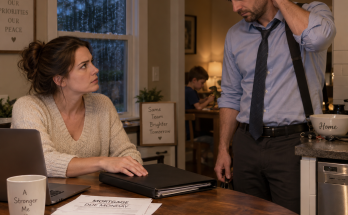
The black accordion folder came out.
I placed it on the kitchen table.
The same table.
The same seat.
Different life.
I opened every section.
Three years of transfers.
Old screenshots.
My handwritten $62,000 calculation.
The false lien.
Credit dispute copies.
Notes about Barbara’s emergencies.
Mark’s transfer records.
Printouts from the first investigations.
Some documents still needed legal retention.
I scanned those.
Backed them up.
Stored certified originals securely.
Then I began shredding duplicates.
Page after page disappeared.
The shredder overheated twice.
Ethan came downstairs.
“What are you doing?”
“Cleaning.”
“That folder?”
“Yes.”
“Is that the one you showed Dad?”
“Yes.”
He touched the cover.
“Can I see?”
I hesitated.
Then opened it to the first calculation.
Numbers.
Nothing too adult.
“What’s sixty-two thousand?”
“What I first calculated Dad had given Grandma over several years.”
His eyes widened.
“That’s a lot.”
“Yes.”
“Was it really more?”
“Yes.”
“How much?”
I closed the folder.
“You don’t need that number.”
“Why?”
“Because it isn’t your debt.”
He thought about that.
“No debts at the cabin.”
I smiled.
“Exactly.”
He ran upstairs.
I returned to shredding.
At the bottom of the folder, I found a receipt.
Orthodontist.
The installment due the Wednesday after Mark gave away his paycheck.
I had paid it.
Of course.
I had forgotten.
Ethan’s teeth had moved into place while our family moved apart.
Such a mundane piece of paper.
I kept it.
Not as evidence.
As perspective.
The crisis had felt endless.
Meanwhile children grew.
Teeth shifted.
Refrigerators broke.
Seasons changed.
Life continued while adults argued over money.
A week later, Mark came for Ethan.
He saw the empty folder on the table.
“You’re throwing it out?”
“Mostly.”
He touched the accordion edge.
“That thing terrified me.”
“It should have.”
He laughed.
“Fair.”
I pulled out the first $62,000 page.
“Remember this?”
“Yes.”
“You said I was exaggerating.”
“I remember.”
“You said some transfers were gifts.”
“I remember.”
“You said I didn’t understand your relationship with your mother.”
“I remember.”
I slid the page across the table.
Again.
The gesture was almost identical to that first night.
But this time Mark smiled sadly.
“I was wrong.”
“Yes.”
No argument.
No defense.
No explanation.
I took the page back.
Then fed it into the shredder.
Mark looked surprised.
“You’re destroying it?”
“I have digital copies of anything legally needed.”
“But that was the first page.”
“I know.”
“Don’t you want to keep it?”
I thought.
“No.”
“Why?”
“Because I don’t need evidence to prove to myself anymore that I was right to leave.”
His face changed.
That sentence affected him more than I expected.
He nodded.
“Okay.”
I shredded it.
The blades pulled the sixty-two thousand into thin strips.
Mark watched.
Then said, “Good.”
I looked at him.
“You don’t mind?”
“No.”
He smiled.
“I don’t need it to punish myself either.”
That was probably healthy too.
Ethan thundered downstairs carrying his backpack.
“Ready!”
Mark picked it up.
“Cabin next weekend?”
Ethan looked at me.
I nodded.
“Yes.”
He cheered.
They headed toward the door.
Mark stopped.
“Sarah.”
“Yes?”
“No debts here.”
I smiled.
“No debts here.”
They left.
I returned to the folder.
One document remained.
The original credit alert I had printed after freezing my accounts.
2:43 p.m.
The inquiry that revealed something larger.
I almost kept it.
Then shredded that too.
By evening, the black folder was empty.
I stood over the trash bin filled with strips of old evidence.
The folder itself was still perfectly usable.
I considered throwing it away.
Instead I carried it upstairs.
Placed it on a shelf.
Empty.
Not forgotten.
Empty.
There was a difference.
Click here to continue reading: PART 31: One Year After the Paycheck Disappeared, We Returned to the Kitchen Table Where Everything Broke and Discovered What Had Actually Survived
My Husband Came Home Proud of Giving Away His Paycheck, Until He Realized I Had Stopped Asking Permission
Part 30 of 31