By late March, the snow had retreated into dirty ridges along the north sides of buildings, and Leo had begun leaving his winter coat unzipped despite my objections.
Sarah's restrictions remained.
She worked.
Attended counseling.
Made restitution payments.
Reported to supervision.
Completed every requirement family services placed in front of her.
Nothing about the process was fast.
That reassured me.
For years, our family had tried to solve difficult things quickly.
Need money? I sent it.
Need forgiveness? I gave it.
Need a lie repaired? Promise to fix it later.
Slow consequences were teaching all of us something speed never had.
Sarah's unsupervised visits with Leo increased from two hours to four.
Then to most of a Saturday.
The first time she was permitted to take him to her apartment, I barely slept the night before.
I trusted the rules.
I trusted Ms. Evans.
I trusted Sarah more than I had six months earlier.
But trust was no longer a light switch.
It was a dimmer.
A little brighter.
Then wait.
See what happens.
Saturday morning, Sarah arrived exactly at ten.
She remained at the curb.
Leo ran outside carrying his backpack.
Before getting into her car, he turned and waved.
I waved back.
Sarah did too.
She did not approach the house.
Four hours later, they returned.
Leo came inside talking so quickly I understood only half of it.
They had made grilled cheese.
Sarah burned one side.
They watched an airplane documentary.
Her apartment had a terrible shower.
There was a bakery downstairs.
Mom had no television.
That last detail surprised me.
Sarah once considered a large television practically a household necessity.
Now she apparently owned none.
"She says she'll buy one when she can pay cash."
I looked through the window.
Sarah's car was already leaving.
"That's sensible."
Leo shrugged.
"I told her yours is bigger anyway."
"Please don't advertise my television."
He laughed.
The following week, Sarah called me.
Not during an emergency.
Not crying.
Not asking for money.
She wanted to ask permission for something.
The phrase itself made me sit straighter.
"What?"
Leo's birthday was coming.
Sarah wanted to give him Michael's old pocketknife.
I knew the knife immediately.
Michael had carried it for twenty years.
After his death, I put it in the same cedar box as several personal things.
Sarah remembered it because Michael used it during camping trips.
"Why are you asking me?"
"Because it's yours."
Simple.
No argument that Michael was her father.
No assumption that she would inherit it.
No claim that Leo deserved it.
"It's actually Leo's eventually."
Sarah paused.
"Eventually isn't now."
I closed my eyes.
The old word.
But used differently.
"You're right."
She asked whether I thought ten was too young.
"Yes."
She laughed.
"I thought you might."
"Maybe when he's thirteen."
"Okay."
No pressure.
Then she asked whether she could buy him an inexpensive Swiss Army knife instead.
"That's between you and Leo."
She went quiet.
"What?"
"Nothing."
"Sarah."
"I'm still learning when I need permission and when I don't."
I understood.
For months, every decision had been supervised.
Every boundary explicit.
She was rebuilding her sense of ownership too.
"You don't need my permission to buy your son a birthday present."
"Right."
"But no motorcycle."
She laughed.
"I can't afford one."
"Excellent protection."
We both laughed.
After the call, I sat at the kitchen table for several minutes.
The conversation had been ordinary.
That was why it mattered.
Recovery was not only courtroom admissions and restitution.
Sometimes it was a daughter asking before touching something that belonged to her mother.
Sometimes it was a mother saying no without fearing the relationship would collapse.
Leo's birthday arrived on a bright Saturday.
Eleven.
We kept the celebration small.
Martha came.
Joanne brought a cake despite my warning that I had already ordered one.
Sarah attended under the current family-services arrangement.
She brought the Swiss Army knife.
Leo opened it and immediately began examining every attachment.
"Don't cut anything," three adults said simultaneously.
He rolled his eyes.
For a moment, everyone laughed.
Then Sarah looked at me.
There was sadness there.
Michael should have been at that table.
David should have been too, under different circumstances.
But grief did not destroy the moment.
It simply sat beside it.
After cake, Leo went outside with Martha's grandson.
Sarah helped me clear plates.
At one point, she reached automatically toward the cabinet where I kept storage containers.
Her hand stopped.
"May I?"
The question was almost ridiculous.
She had opened that cabinet a thousand times.
"Yes."
She took out a container.
Neither of us commented.
But I noticed.
Later, she stood in the entryway preparing to leave.
Her old brass key remained in the ceramic bowl.
I had never moved it.
Sarah saw it.
So did I.
For several seconds, neither spoke.
Then she looked away.
She did not ask.
That mattered even more.
After she left, Joanne noticed the key.
"Are you ever giving that back?"
"I don't know."
"Good."
I looked at her.
"You approve of uncertainty now?"
"I'm evolving."
I laughed.
Then Joanne became serious.
"You don't owe her access because she's improving."
"I know."
"And keeping the key doesn't mean you're punishing her."
"I know."
"Okay."
"Joanne."
"What?"
"I know."
She smiled.
Two weeks later, family services scheduled a formal review of Leo's placement.
The possibility that he might eventually spend more time with Sarah had been expected.
Still, seeing the review date made my stomach tighten.
Ms. Evans met with me first.
She asked how Leo was doing.
Better.
Nightmares less frequent.
School good.
Counseling helpful.
Relationship with Sarah improving.
Then she asked what I wanted.
I hated that question.
"What does Leo want?"
"He wants more time with his mother."
That hurt.
Then immediately I felt ashamed.
Of course he did.
Sarah was his mother.
His love for her was not a rejection of me.
I knew that intellectually.
Emotionally, another part of me had become accustomed to being needed.
That realization embarrassed me.
For years, being needed had made me vulnerable to Sarah's demands.
Now I risked repeating the pattern with Leo from the opposite direction.
Love should not require dependence.
"I want whatever is safe for him."
Ms. Evans studied me.
"That's not quite what I asked."
I sighed.
"I want him here."
There.
Truth.
"Because you're worried about Sarah?"
"Partly."
"And partly?"
I looked toward the living room where Leo's model airplane sat on the shelf.
"Because I'll miss him."
Ms. Evans smiled gently.
"Those are different concerns."
Again, distinction.
So much of recovery was learning to separate things that once felt identical.
Need from love.
Help from control.
Forgiveness from trust.
Missing someone from needing to keep them.
I told her I would support gradual reunification if professionals believed Sarah was ready.
Saying it hurt.
I said it anyway.
At the review, Sarah did something I did not expect.
Her attorney could have requested immediate expansion toward overnight visits.
Instead, Sarah asked for a slower schedule.
She said Leo had finally become stable at my house.
She did not want him moved quickly simply because she wanted him back.
I looked at her.
She avoided my eyes.
Not performative.
Not seeking praise.
She was speaking to the panel.
Sarah requested one overnight every other weekend at first.
Then review.
Ms. Evans supported it.
Leo's counselor supported it.
The plan was approved.
The first overnight came three weeks later.
Leo packed as if leaving for a month.
Three shirts.
Two books.
Four pairs of socks.
His model airplane.
"Why are you taking that?"
"In case Mom wants to see it."
I helped zip the bag.
At the door, he hugged me.
Then stopped.
"Are you sad?"
"A little."
"Do you want me to stay?"
The question alarmed me.
"No."
He looked surprised.
"I want you to go have a good time with your mom."
"But you're sad."
"I can be sad and still want something good for you."
He considered that.
Then nodded.
Sarah waited at the curb.
Leo ran to her.
I watched the car disappear.
The house became impossibly quiet.
I stood in the hallway.
For months, I had dreamed of having my old peaceful house back.
Now I had it.
And hated it.
I called Joanne.
"Come over."
She laughed.
"That took twenty minutes."
"Bring wine."
"I thought you barely drink."
"Then bring pie."
"Now you're making sense."
We spent the evening watching a terrible movie.
I checked my phone too often.
No emergencies.
No requests.
No crisis.
At nine, Sarah sent one photograph.
Leo asleep on her sofa with his book open.
No caption asking whether she was doing well.
No request for reassurance.
Just a photograph.
I looked at it for a long time.
Then put the phone down.
The next afternoon, Sarah returned him six minutes early again.
Apparently punctuality had become part of her religion.
Leo ran inside.
"Mom makes terrible pancakes."
From the car, Sarah shouted through the open window.
"I heard that!"
I laughed.
So did Leo.
Sarah smiled.
Then she drove away.
That evening, Leo asked something unexpected.
"Can Mom come to Maine?"
My heart tightened.
The trip.
The summer trip I had booked for Joanne and myself.
Somewhere along the way, Leo had been added.
Now he wanted Sarah.
"I don't know."
"Why?"
"Because it's my trip."
He nodded.
I expected an argument.
Instead he said, "Okay."
The word was becoming safer.
Still, the question remained with me.
Maine was connected to Michael.
To the photograph on my refrigerator.
To the last good summer before illness.
Taking Sarah would mean opening a part of my life I had kept protected.
I was not ready.
That did not mean never.
It meant no now.
The next day, I told Leo exactly that.
"I'm not ready to invite your mom."
He looked disappointed.
"Maybe another time?"
"Maybe."
He accepted it.
Then, that afternoon, Sarah called.
"I heard about Maine."
I braced myself.
"Leo shouldn't have asked."
"He can ask."
"I told him you're allowed to say no."
I relaxed slightly.
Then Sarah said something that made me close my eyes.
"Please don't invite me because you feel guilty."
"I wasn't planning to."
She laughed.
"Good."
No manipulation.
No wounded silence.
No punishment.
Just a boundary surviving contact.
After we hung up, I walked to the ceramic bowl by the front door.
Sarah's key lay at the bottom.
I picked it up.
For months, it had represented betrayal.
Then caution.
Now it was simply a piece of brass.
I carried it into the garage.
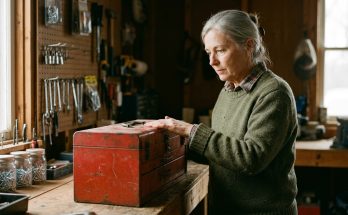
Michael's tool chest stood beneath the workbench.
I opened the small top drawer.
Inside were spare keys, washers, screws, and labels written in his handwriting.
I placed Sarah's key there.
Not returned.
Not thrown away.
Stored.
The front door remained locked.
But the key no longer needed to sit where I saw it every day.
That night, Detective Morales called unexpectedly.
The criminal investigation into David's other victims was nearing completion.
During a final review of the Union Station locker contents, technicians had recovered one additional audio file from the old recorder.
It had been damaged.
Now they could hear most of it.
Michael was speaking.
So was Sarah.
The recording was from the same week as Michael's medical emergency.
Morales warned me the conversation might be difficult.
I asked what it concerned.
She paused.
"Your husband was telling Sarah something he had never told you."
I gripped the phone.
"What?"
"It concerns why he changed part of his estate plan before he became ill."
I looked toward Michael's photograph.
For months, every recovered secret had pointed toward David.
This one apparently belonged to Michael.
And whatever he had changed, he had done it without telling me.
Click here to continue reading: PART 18: Michael’s Secret Estate Change Wasn’t About Money for Sarah, but the Promise He Made Her Explained a Silence That Lasted Beyond His Death
The Message My Daughter Sent at Night Made Me Finally Notice Everything I Had Quietly Been Paying For
Part 17 of 28