Sarah's sentencing process took longer.
Her case was different.
She had committed serious acts.
She had also cooperated.
She had returned access to hidden funds.
She had admitted conduct before being confronted with every piece of proof.
She was in treatment.
Working.
Complying with family services.
There were arguments for punishment.
Arguments for rehabilitation.
I did not want to make the decision.
Fortunately, no one asked me to.
The court did ask for another impact statement if I wished.
I declined.
Everything I needed to say had already been said.
Sarah knew what she did.
The court had the evidence.
I was finished performing pain to prove it existed.
Winter arrived.
Snow covered the yard.
Leo built a crooked snowman near the fence with Martha's grandson.
For several hours, the only emergency involved a missing carrot.
I watched from the kitchen window.
Life was returning in fragments.
Sarah's supervised visits gradually became longer.
Then, after recommendations from her therapist and Leo's counselor, some moved into community settings.
A library.
A café.
A park when weather allowed.
Always monitored.
Always structured.
Leo looked forward to them and dreaded them.
Both.
Again.
That word had become the shape of our family.
During one visit, Sarah brought him a small model rocket.
Afterward, Leo asked if I thought she was trying to buy his forgiveness.
I considered the question.
"Did she give you other things?"
"No."
"Did she ask whether you forgave her?"
"No."
"Then maybe it was just a rocket."
He seemed relieved.
Trauma had made him suspicious of generosity too.
That hurt.
I wanted him to learn boundaries without learning cynicism.
There is a difference.
At therapy, he worked on what his counselor called responsibility circles.
Things he controlled.
Things adults controlled.
Things nobody controlled.
He showed me the page.
Inside his circle:
Tell truth.
Ask for help.
Be kind.
Do homework.
Outside:
Dad's choices.
Mom's choices.
Grandma's money.
Court.
I nearly cried when I saw that last one.
Grandma's money.
He no longer believed family finances were his responsibility.
That alone felt like progress.
Sarah's attorney eventually informed us that prosecutors would recommend a sentence involving a combination of custody restrictions, probationary supervision, restitution, community service, and continued treatment.
The exact decision remained with the judge.
Sarah could still face incarceration.
She told me this during one of our supervised conversations.
"Are you scared?" I asked.
"Yes."
"Are you asking me to speak for you?"
"No."
That answer came quickly.
Then she added, "I want you to speak only if you want to."
Good.
I did not.
Sarah nodded.
"I understand."
There was sadness in her face.
But no manipulation.
The absence of pressure felt almost like a gift.
A week before sentencing, Thomas called.
The restitution process had recovered much of the money traced directly from fraudulent accounts.
Not everything.
But enough that the financial damage was beginning to feel measurable.
The credit-card issuers removed the fraudulent balances from my responsibility.
My credit reports were corrected.
The county fraud alert remained.
The house was secure.
The deed had never transferred.
The home-equity loan never funded.
I should have felt triumphant.
Instead, I felt tired.
Thomas seemed to understand.
"People expect resolution to feel dramatic."
"What does it usually feel like?"
"Administrative."
I laughed.
He was right.
Restoration came through letters.
Corrected balances.
Stamped documents.
Account confirmations.
No music.
No moment when the world announced that I had survived.
Just fewer problems in the mail.
Then he told me something better.
The prosecutor approved returning additional funds tied to Horizon Ridge.
Some would go to creditors.
Some to victims.
Some remained contested.
Sarah had waived personal claims to the portion investigators traced to me.
That decision reduced what she might have had available after the case.
I asked whether anyone had required her to waive it.
"No."
I sat quietly.
Returning what should never have been taken did not earn praise.
Still, she could have fought.
She did not.
Progress is often unimpressive from a distance.
Up close, it matters.
Sarah's sentencing took place in January.
The courtroom was less crowded than David's.
No reporters outside.
No other victims except me.
Joanne came.
Thomas came.
Leo did not.
Sarah stood before the judge.
Her attorney described her cooperation and the coercive dynamics in her marriage.
The prosecutor described her independent decisions.
The forged deed.
The stolen documents.
The hidden financial planning.
The use of Leo as leverage.
The judge listened.
Then he asked Sarah one question.
"At what point did you know this had stopped being help and become theft?"
The courtroom went silent.
Sarah looked down.
Her attorney did not answer for her.
Neither could I.
This was the question she had to own.
Sarah took a breath.
"The first time I used my mother's money for something she hadn't agreed to."
My chest tightened.
Four years ago.
The mortgage money redirected into David's business.
Not the forged deed.
Not the credit cards.
Not the loan.
The first lie.
The judge asked why she continued after recognizing it.
Sarah's answer came slowly.
"Because fixing it later seemed easier than admitting it then."
I looked at my hands.
That sentence could have described the entire family.
Michael withholding what he knew about David.
Me ignoring warning signs.
Sarah delaying truth.
David building lies to protect earlier lies.
Not equal harm.
But the same human weakness.
Delay discomfort.
Pay more later.
The judge spoke about responsibility.
About coercion not erasing agency.
About rehabilitation requiring more than regret.
Then he imposed sentence.
Sarah would serve a period of home confinement and intensive supervision rather than a long prison term, followed by probation, restitution obligations, treatment requirements, financial restrictions, and continued oversight connected to Leo.
There were consequences.
Real ones.
But also a path forward.
Sarah cried quietly.
I felt relief.
Then guilt for feeling relief.
Then irritation at the guilt.
I was allowed to want my daughter to have another chance without denying what she did.
Outside court, Sarah did not ask if I thought the sentence was fair.
She said, "I deserved consequences."
I nodded.
Then she said, "I'm grateful I can still work."
"You'll need to."
"I know."
Joanne later told me that my answer was brutal.
I disagreed.
It was practical.
Restitution did not pay itself.
Life continued.
Sarah returned to her apartment under strict restrictions.
She worked remotely at first.
Family services continued supervised contact.
Months of conditions lay ahead.
There was no clean reset.
That was probably healthy.
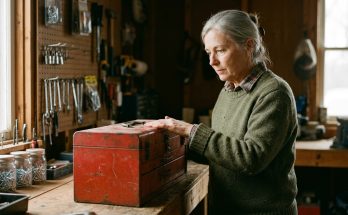
One afternoon, while helping Leo clean the garage, we found an old wooden toolbox Michael built when Sarah was twelve.
Her name was painted across the front in faded blue letters.
Leo ran his fingers over it.
"Mom's?"
"Yes."
"What was in it?"
"Nothing important. She used to build birdhouses with Grandpa."
Leo looked surprised.
"Mom built things?"
"Badly."
He laughed.
So did I.
Then I remembered Sarah at twelve.
Hair tied in two braids.
Hammering nails sideways.
Michael teasing her.
That child still existed in my memory.
The woman who signed the deed also existed.
One did not erase the other.
I had spent months trying to decide which Sarah was real.
The answer was both.
People are not one moment.
They are not absolved by their best moment.
They are not reduced entirely to their worst.
Accountability required holding the whole picture.
That evening, I called Sarah.
Not because she called first.
Because I chose to.
It was the first voluntary call I had made since her message telling me not to contact her.
She answered on the second ring.
"Mom?"
The surprise in her voice hurt.
"I found your old toolbox."
Silence.
Then a laugh.
"You still have that?"
"Apparently."
"Is the ugly birdhouse in there too?"
"No. Thank God."
She laughed again.
For thirty seconds, we were simply mother and daughter.
Then the silence returned.
Neither of us knew how to continue.
That was okay.
"I thought Leo might like the toolbox."
"Give it to him."
"Are you sure?"
"It's yours."
"No."
I looked at the faded name.
"It's yours."
Sarah went quiet.
Then she said, "I don't think I know how to tell what belongs to me anymore."
The sentence was partly a joke.
Partly not.
I answered seriously.
"You can start by asking."
She did not speak for several seconds.
"Can Leo have it?"
"Yes."
There.
Simple.
Permission.
The thing that had been missing.
That weekend, Leo sanded the toolbox with me.
We repainted his mother's name on one side.
Then added his beneath it.
SARAH.
LEO.
Two generations.
Not ownership.
History.
When Sarah saw a photograph during her next visit, she cried.
Leo rolled his eyes.
"Mom, it's a box."
She laughed through tears.
"I know."
No one asked me for money.
No one manipulated the moment.
It was only a box.
I was learning how precious ordinary could be.
In March, Leo's counselor recommended allowing Sarah brief unsupervised visits if family services agreed.
The possibility frightened me.
Not because I thought Sarah would abduct him.
Because trusting again felt like opening a door I had spent months locking.
Ms. Evans asked my opinion.
I told her the truth.
"I don't know."
"That's acceptable."
I appreciated her for saying that.
People often wanted certainty from me.
Forgive or don't.
Trust or don't.
Help or don't.
Real recovery lived between those categories.
The first unsupervised visit, if approved, would last two hours.
Public location.
Sarah would have no access to my house.
No financial discussions.
No transportation outside the approved area.
Structured.
Measured.
Nothing assumed.
I realized that trust could be rebuilt the same way.
Not by returning everything at once.
By testing weight.
A little at a time.
The visit was approved for the following month.
Leo was excited.
Then nervous.
Then excited again.
The night before, he asked if I trusted his mother.
"Some."
"That's weird."
"It is."
"Do you love her?"
"Yes."
"Even more weird."
I smiled.
"Families are complicated."
He rolled his eyes.
"Therapy says that."
"Therapy is right."
The visit went well.
They ate lunch.
Bought a used book.
Walked through a museum.
Sarah returned him six minutes early.
I noticed.
She did not come to my door.
She waited at the curb because that was the agreement.
Leo ran inside holding a book about airplanes.
He was happy.
I looked through the window at Sarah.
She did not wave.
She simply waited until she saw Leo enter safely.
Then drove away.
That small obedience moved me more than any apology.
Months earlier, Sarah had entered my home and taken documents because she believed family access did not require permission.
Now she remained at the curb because I had not invited her closer.
That was change.
That evening, I opened the drawer where I kept legal papers.
I still locked it.
I probably always would.
Then I noticed something.
The lock no longer made me angry.
It was simply a lock.
Protection does not have to mean fear.
Sometimes it is just good sense.
I went downstairs.
Leo was reading.
The house was quiet.
Then the mail slot clicked.
One envelope landed on the floor.
No return address.
I picked it up.
Inside was a handwritten letter from David.
Prison stationery.
I considered throwing it away.
Instead, I read.
He did not ask forgiveness.
He did not ask me to help Sarah.
He did not ask about money.
He wrote that he had begun a financial accountability program in prison.
He said one exercise required identifying the first lie that made later crimes possible.
His answer was not the forged loan.
Not the credit cards.
Not the deed.
It was the first time he took money intended for Sarah's mortgage and used it for his business while telling himself he would replace it before anyone knew.
Same beginning Sarah named in court.
I read the rest carefully.
Then I reached the final paragraph.
David wrote that there was one thing investigators had never found because he had hidden it outside every account, device, and safe-deposit box they searched.
Something belonging to Michael.
Something he took years ago after their argument in the garage.
He said he wanted to return it.
My hands went cold.
At the bottom, he wrote only:
Ask Detective Morales about Locker 317 at Union Station.
Click here to continue reading: PART 16: The Last Thing David Hid From Michael Revealed Why My Husband Had Feared Him Long Before Any Forged Loan or Stolen House
The Message My Daughter Sent at Night Made Me Finally Notice Everything I Had Quietly Been Paying For
Part 15 of 28