For fifteen years, my parents branded me an unemployed disappointment, never realizing what I actually did for work. I allowed them to believe it—until Grandma sent a coded message: “The blue bird stopped singing.” My blood turned cold. Thirty minutes later, I was standing at their door with two police officers. My mother whispered, “How did you know?” I met her eyes and said, “Because this is my job.”
For fifteen years, my parents believed I was a jobless failure surviving on luck and cheap coffee.
I never corrected them.
At every Thanksgiving dinner in their Portland home, my mother, Helen, would sigh and ask, “Maya, when are you going to get a real job?”
My father, Richard, always followed with, “Your sister bought a house at twenty-eight. You’re thirty-five and still renting.”
I would smile, pass the potatoes, and remain silent.
They had no idea I was a cybercrime investigator assigned to a federal task force. Much of my work was classified, and keeping secrets had become instinctive. I investigated financial abuse, identity theft, online exploitation, and fraud rings that targeted vulnerable people. I had arrested harmless-looking men, grandmothers running schemes from church basements, and sons who smiled while stealing from their own mothers.
My family believed I repaired old computers for cash.
Only one person knew the truth: my grandmother, Evelyn.
Grandma had done more to raise me than my parents ever had. She taught me chess, Morse code, and how to conceal fear behind steady eyes. Years earlier, after I helped recover money she had lost to a fake charity scam, she made me promise her something.
“If I ever send you the phrase ‘the blue bird stopped singing,’” she said, “come immediately. Don’t call first.”
I laughed at the time.
She did not.
On a rainy Tuesday afternoon, I was reviewing evidence from a fraud investigation when my phone vibrated.
It was a text from Grandma.
The blue bird stopped singing.
Cold rushed through my entire body.
I called her immediately.
She did not answer.
I checked the location of her emergency medical pendant through a private system I had installed for her. It showed that she was inside my parents’ house.
That made no sense.
Grandma hated visiting them.
I grabbed my badge, called Detective Luis Ramirez, and said, “I need two officers for a welfare check. Possible elder coercion.”
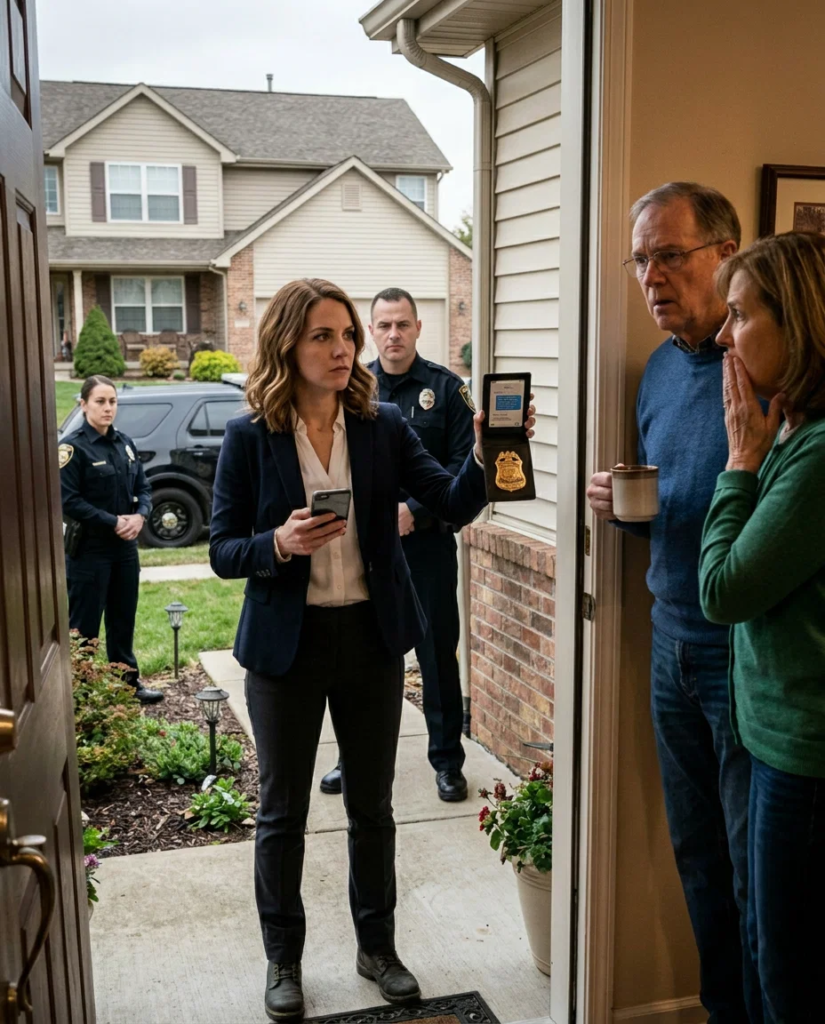
Thirty minutes later, I stood on my parents’ front porch with two officers behind me.
My mother opened the door and went still.
“Maya?” she whispered. “What are you doing here?”
I raised my badge.
“My job.”
From somewhere behind her, Grandma screamed my name.
Part 2
I moved past my mother before she could block me.
Detective Ramirez came in behind me, one hand close to his radio. The two uniformed officers followed. My father emerged from the hallway, his face flushed with fury.
“What is this?” he demanded. “You can’t just bring police into our home.”
“I can,” I said. “Especially when I receive a coded distress message from an elderly woman inside.”
Something flashed in his eyes.
Brief. Subtle. Guilty.
My mother twisted her hands together. “Your grandmother is confused. She’s been saying strange things.”
Then Grandma shouted again, her voice weaker.
“Maya!”
I hurried toward the back bedroom.
The door had been locked from the outside.
For half a second, everyone froze.
Then Detective Ramirez said, “Open it.”
My father stepped toward us. “She locks herself in sometimes.”
“The lock is on this side,” I said.
He said nothing.
One of the officers used a tool to force the door open. Grandma sat on the edge of the bed in her nightgown, trembling and pale. Her purse was missing. Her phone had been placed on the dresser across the room. Her medication bottles stood open, their labels removed.
I dropped to my knees before her. “Grandma, I’m here.”
She seized my hand with unexpected strength. “They made me sign papers.”
My mother immediately began to cry. “That’s not true.”
Grandma pointed toward the desk. “Your father said if I didn’t sign, he’d put me in a facility and tell everyone my mind was gone.”
Silence filled the room.
I turned toward the desk. A folder held legal papers, banking forms, and a draft power of attorney naming my father as the primary agent. A laptop sat beside them.
My laptop.
I had given it to Grandma the previous Christmas. Now it was open to her online banking account.
Detective Ramirez moved closer. “Mrs. Evelyn Carter, did you ask to be here?”
Grandma shook her head. “Richard said Maya was broke and couldn’t help me. He said I needed to transfer the lake property before I became a burden.”
My father erupted. “She’s old! She doesn’t understand money anymore!”
I slowly rose.
“Funny,” I said. “Because she understood enough to send me the one code you didn’t know.”
My father stared at me, deciding whether another lie would work.
Then my mother whispered, “Richard, just tell them we were protecting her.”
Grandma’s fingers tightened around mine.
And I understood that this was far bigger than a single afternoon.
Part 3
The officers separated everyone.
Grandma was transported to the hospital for an evaluation, not because she was confused, but because she had missed two doses of heart medication while trapped in that room. I rode beside her in the ambulance, holding her hand throughout the journey.
She repeatedly apologized.
“I didn’t want to bother you,” she whispered.
I bent closer. “You saved yourself. You did exactly what we planned.”
By that evening, the full story began to emerge.
My father had been buried in debt for nearly a year. Failed investments. Hidden loans. A business partnership that collapsed without my mother knowing. After discovering Grandma’s lake property was worth almost $900,000, he decided she was too old to “need” it. My mother knew enough to feel guilty, but not enough to stop him.
That wounded me almost as deeply.
For years, they had called me a failure while secretly attempting to rob the woman who had always believed in me.
The following morning, warrants were requested involving financial coercion, attempted elder exploitation, unlawful restraint, and fraud-related offenses. My father was not instantly dragged away in handcuffs like someone in a movie. Instead, his life collapsed quietly. His accounts were frozen. His attorney stopped taking his friendly calls. His neighbors watched police return to gather evidence from the house.
My mother called seventeen times.
I answered only once.
“Maya,” she cried, “we didn’t know what else to do.”
“You could have called me.”
“We thought you had nothing.”
Through the hospital window, I watched Grandma sleeping beneath a blue blanket.
“No,” I said. “You hoped I had nothing.”
Those were the last words I spoke to her for months.
After leaving the hospital, Grandma moved into my guest room. Her lake property was transferred into a protected trust. We revised her legal documents, replaced every password, and installed cameras she genuinely understood how to operate. She joked that she now felt like a spy.
“You taught me well,” I told her.
Three months later, during a family court hearing, my parents finally saw who I really was. Not the unemployed daughter they ridiculed. Not the quiet woman they looked down on. They saw the investigator whose testimony helped protect my grandmother from her own son.
My father could hardly meet my eyes.
My mother cried in the hallway and said, “We didn’t know who you really were.”
I looked directly at her and said, “That’s because you never cared enough to ask.”
Grandma gently squeezed my arm.
For the first time in fifteen years, I no longer felt any need to prove myself.
That evening, Grandma and I sat on my porch drinking tea. She smiled and said, “The blue bird is singing again.”
I laughed, though my eyes began to burn.
So tell me, if your family spent years calling you a failure, would you still protect them from the truth—or would you finally allow them to face what they had created?