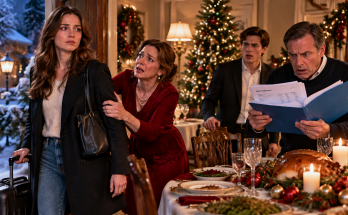
The boy was fifteen and carried a shame on his face that wasn’t his own.
“I didn’t know they hadn’t told you. I thought you were expecting us.”
I swallowed hard.
“I know, sweetheart.”
“I’m sorry.”
Now that was an apology.
Not because it fixed everything.
But because it didn’t come to open a gate.
It came to acknowledge a wound.
“Thank you, Matthew.”
He looked at his dad.
“Are we leaving?”
Charlie couldn’t answer.
Lauren furiously got into the car.
“Perfect. Let’s go. Let her stay all alone with her farm and her little notebook.”
I heard her.
And for the first time in years, the word “alone” didn’t scare me.
It gave me space.
David put away the bags of charcoal.
Melissa loaded the suitcases.
The kids got in quietly.
Charlie was the last.
Before getting into the car, he held up the notebook.
“Can I take it with me to read?”
“No.”
He stood still.
“But it’s about us.”
“That’s exactly why it stays with me. You’ve already taken too many things without asking.”
He lowered his hand.
“When can I come to talk?”
“When you come without a suitcase.”
He didn’t say anything else.
The cars drove off, kicking up dust.
The meat.
The coolers.
The laughter.
The entire family returning down the same road they had come, certain they would find a docile old woman and a key under a flowerpot.
When they disappeared, I sat on the porch bench.
My hands were shaking.
John approached.
“Miss Barbara, should I make you some coffee?”
“Yes.”
“Strong?”
“Strong enough to wake the dead.”
He smiled.
I did too.
But when he went to the kitchen, I cried.
Of course I cried.
I wasn’t made of stone.
I was a mother.
And a mother can set boundaries and still feel like her heart is breaking in two.
I cried for little Charlie.
For David climbing the apple trees.
For the Christmases with Joe grilling meat while I handed out plates.
For the Sundays when my children ran around the yard and I thought that joy would protect us from everything.
It doesn’t.
Love without respect becomes a habit.
And a habit, if not stopped, ends up looking a lot like abuse.
That afternoon, I opened the notebook again.
On the last page, I glued Joe’s letter.
I had read it so many times during the early morning that I could almost recite it by heart:
“Barbara:
If someday the boys forget that you are the root and not the shade, don’t give them the land to make them remember.
The farm isn’t valuable for what it costs. It’s valuable because it was our struggle.
Don’t confuse being alone with being without love. Sometimes, for them to truly look at you again, they first need to find a closed door.
Joe.”
Wise old man.
Stubborn old man.
My old man.
For two weeks, no one came.
There were messages.
Many.
Lauren saying I was manipulative.
David saying everything had spiraled out of control.
Charlie typing and deleting.
My nephews asking if they could stop by “just to pick up a cooler” they had forgotten months ago.
I didn’t reply to everyone.
I learned late that not every message deserves to open a wound.
The first one to return was Matthew.
He took a bus to town and then walked for half an hour under the sun. John saw him from the entrance and let me know.
“The boy is coming.”
I went outside.
Matthew didn’t have a suitcase.
He brought a bag with bread and cheese.
“Grandma, can I come in?”
I felt something warm welling up in my eyes.
“Yes.”
“My dad doesn’t know I came.”
“That’s between you and him.”
He sat with me in the kitchen.
He didn’t ask for the Wi-Fi.
He didn’t turn on any speakers.
He didn’t open the fridge as if it were his.
He just looked around.
“Did Grandpa write everything in that notebook?”
“Almost everything.”
“Can I read a part of it?”
I thought about it.
Then I opened to an old page, from when Joe wrote down how much the first lemon trees cost.
Matthew read slowly.
“We bought four saplings. Barbara says someday they will provide shade for the grandkids.”
The boy swallowed hard.
“They did.”
“Yes.”
“I don’t want to be like my dad.”
That sentence hurt me and made me glad at the same time.
“Then start by not despising what others built before you.”
Matthew came back several Sundays.
He learned to prune.
To clean the irrigation ditch.
To make coffee without making it too watery.
One day he asked me if he could copy some pages from the notebook for a school project on family history.
I said yes.
When Charlie found out, he came.
Alone.
Without Lauren.
Without coolers.
Without kids.
He knocked on the gate.
He didn’t yell.
He didn’t look for a key under the flowerpot.
He just knocked.
John looked at me.
“Should I open it?”
I took a deep breath.
“Open it.”
Charlie walked in slowly.
He looked older.
Or maybe, for the first time, he came without the costume of an owner.
He stood in front of me on the porch.
“Mom.”
“Charlie.”
His eyes were red.
“I’m not here to ask for the farm.”
“Good.”
“I’m here to ask you to show me the notebook.”
I didn’t answer right away.
He continued:
“Matthew read a part of it to me. The part about the lemon trees. I… I didn’t know Dad had written so much.”
“You didn’t ask.”
He lowered his head.
“No.”
“You also didn’t ask how much it cost me to maintain this place.”
“No.”
“Or if it hurt me when you all arrived without warning.”
“No.”
“Or if I wanted to cook for twelve people.”
He closed his eyes.
“No.”
The silence filled with the sounds of birds.
Then he said:
“I’m sorry I removed you from the group chat.”
I didn’t say anything.
“I’m sorry for saying you didn’t understand. You understood more than all of us. You understood what a house, a family, and an entire life cost.”
His voice broke.
“And I’m sorry for throwing the notebook in the trash.”
That apology did touch me.
I didn’t hug him right away.
I didn’t want him to think an apology erased years.
But I put the notebook on the table.
“Read.”
He read for hours.
Some pages in silence.
Others with his hand over his mouth.
When he got to the accounts of his loans, he cried.
“I always told myself they were small favors.”
“Because you weren’t the one paying for them.”
“Why did you never confront me about it?”
“Because I confused being a mother with never asking to be paid back.”
He looked at me.
“And now?”
“Now I don’t charge you with money. I charge you with respect.”
Charlie nodded.
“I want to be back in the group chat.”
I gave a small smile.
“I already made another one.”
He took out his cell phone.
The invitation came through.
The group was called:
“The Haven Farm – with Barbara’s permission.”
Charlie laughed through his tears.
“I deserve that.”
“Yes.”
Over time, some returned.
Not all in the same way.
Lauren took months. When she arrived, it was with a homemade cake, without her sunglasses on her head, and with an apology that cost her more than any amount of money.
David also came.
He signed an agreement to slowly pay back what he could from his old debts. Not because I needed every penny, but because he needed to learn that receiving help doesn’t mean leaving the receipt buried in his mother’s memory.
Weekends changed.
Twelve people no longer arrived unannounced.
They asked me.
Sometimes I said yes.
Sometimes I said no.
The first time I said no and Charlie replied “that’s fine, Mom,” I went to my room and cried as if I had won a small war.
The key never went back under the flowerpot.
Now it hangs in my kitchen, next to the notebook.
And everyone knows it is not to be touched without asking me for permission.
Not because I’ve become mean.
But because I finally became the owner out loud.
Today, when they ask me why I put my family through that embarrassment in front of the gate, I answer that the embarrassment already existed.
I just put a sign on it.
For years, my children arrived at the farm with meat, coolers, and suitcases, convinced that a mother’s love was a hidden key to use whenever they pleased.
But that morning they found a closed gate.
A sign.
And an old notebook.
The notebook that Charlie threw in the trash because he thought it only gathered dust.
He didn’t know that written inside was everything they had forgotten.
The cost of the well.
The price of the roof tiles.
The shade of the lemon trees.
The debts never repaid.
The weekends turned into work for a widow.
Joe’s handwriting protecting me from deep within the earth.
And my own voice, finally, saying:
“This house has a memory. And memory also closes doors.”
I didn’t lose my family by closing the gate.
I lost the habit of letting them walk all over me without looking.
And that, at seventy-six years old, was the first key that truly belonged to me.
I mailed my husband divorce papers while he was sitting with the woman he chose over me. Hours later, I was rushed to a hospital carrying the twins we’d prayed years to have.
Part 2 of 2