“This week?” I asked.
My voice didn’t come out like a voice. It came out like air.
Lara breathed deeply on the other end.
“There’s an appointment scheduled for tomorrow at ten. It says ‘signature verification.’ And there’s an address in Rome, Georgia.”
I stood by the bed, staring at the new door the locksmith had just installed. The shiny lock seemed to mock me. I had locked the house, but Emmett had been opening drawers in my life for months.
“Don’t touch anything,” I said.
“Valeria, there are police outside. Emmett is screaming that I robbed him.”
“Don’t touch anything,” I repeated. “Tell them that folder is mine. Tell them I’m on my way.”
I put on jeans, a sweatshirt, and sneakers without socks. I grabbed my purse, my ID, the keys, and the pepper spray I’d bought once out of fear of public transit and never used. Before leaving, I looked at my living room.
For the first time, I saw it as a crime scene.
The gap in the bookshelf where my grandmother’s box used to be. The desk drawer left slightly ajar. The envelope where I kept my pay stubs, now empty.
My eyes burned.
Not because of Emmett.
Because of me.
Because of all the times I left his hands near my things, believing that love was trust, while he was learning my routines the way one studies a lock.
I drove back to my house in Coyoacán.
The early morning was cold. I passed by a nearly empty Central Avenue, by shuttered market stalls, by a popcorn vendor pushing his cart like a ghost with a whistle. Chicago at that hour seemed enormous and lonely, as if every window hid a tragedy that no one could quite tell.
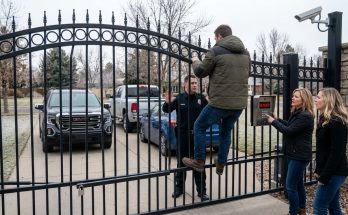
When I reached Lara’s street, there was a squad car, an ambulance, and three neighbors in bathrobes pretending to water their plants.
Emmett was sitting on the curb.
Not sprawled out.
Not passed out.
Sitting.
Wrapped in a thermal blanket, wearing the victim face he always pulled out when someone confronted him. When he saw me, he tried to stand up.
“Val, finally. Tell them it’s a misunderstanding.”
A police officer stopped him with a hand.
“Stay seated.”
Emmett looked at me as if I were the one to blame for his public shame.
“Are you seriously going to do this?”
I walked past him.
I didn’t answer.
Lara opened the door before I could knock. Her hair was half-pulled back, her face scrubbed of makeup, her eyes red. She didn’t look like the femme fatale I had imagined so many nights while Emmett smiled at his phone.
She looked like another fool waking up with a jolt.
“He’s in the living room,” she said.
I went in.
The boxes I had left were open. Emmett’s clothes were scattered on the floor—sneakers, cables, colognes, papers. On a low table lay the gray folder.
My name written in black marker:
VALERIA MONTES RIVERA.
I felt nauseous.
Lara handed me some plastic kitchen gloves.
“I didn’t know what to do. I didn’t want to get anything dirty.”
I looked at her for the first time without hatred.
“Thank you.”
I opened the folder.
There were copies of my ID, front and back. My Social Security number. Utility bills. Bank statements. Pay stubs. Photos of my signature taken from old documents.
And the application.
$48,000.
Personal loan.
A finance company I didn’t recognize.
My supposed signature on every page.
My hands shook, but I kept checking. Behind it was a promissory note. Then an authorization form for a credit bureau inquiry. Then a beneficiary sheet where Emmett appeared as my “trusted contact.”
I let out a dry laugh.
“How thoughtful.”
Lara brought her hand to her throat.
“There’s more.”
She took out the blue velvet box.
I recognized it before I touched it.
It was my grandmother’s. An old, soft box with a loose golden clasp. She kept it in her closet with mothballs and holy cards. When she died, my mom told me, “It isn’t worth much in money, but it’s worth a lot in history.”
There it was.
Open in the house of a stranger.
The garnet earrings were missing.
The wedding ring was missing.
The gold medal of the Virgin was missing.
Only two thin bracelets and a flower-shaped brooch remained.
Underneath were pawn receipts.
Three of them.
One from downtown. One near the university. Another from the suburbs.
The dates cut through me.
The first pawn was two weeks after Emmett took me to dinner in Lincoln Park and told me he wanted to “build a serious future with me.”
My grandmother paid for that future.
I sat down on Lara’s sofa.
The fury came late, but it came in full.
“That wretch sold my dead grandmother’s jewelry.”
Lara started to cry.
“He told me he was separating from you. He said you owed him money. He said he was helping you because you were impulsive with shopping.”
I looked at her.
“And you believed him?”
She lowered her head.
“I wanted to believe him. That’s different.”
I didn’t have the strength to hate her.
Outside, Emmett screamed my name.
“Valeria! Don’t sign anything! Don’t talk to her!”
A police officer told him to calm down.
“That’s not civil status, nor is it permission,” the officer said.
That sentence held me up better than a chair.
We went to the District Attorney’s office that same night.
Lara went with me.
Not as a friend.
As a witness.
I rode in my SUV with the documents in a sealed bag. The police cruiser followed us through sleeping streets, past blinking traffic lights and trees dripping with drizzle. Passing a bakery firing up its ovens, the smell of fresh bread drifted through the window, filling me with an absurd sadness.
Life was still making mornings.
Mine was just coming out of the fire.
At the police station, the coffee tasted like metal. There were plastic chairs, an old fan, and a poster about economic violence that, in the past, I would have read as if it were about other women.
Now, it was about me.
I testified to everything.
The text.
The boxes.
The folder.
The jewelry.
The loans.
The pawn receipts.
The agent took my phone and saved screenshots. Lara handed over her conversations with Emmett. In one of them, he had written:
“If Valeria gets difficult, I have a way to prove she’s losing her mind.”
I read that line and felt the love I once had for him die without a funeral.
Nothing was left.
Not affection.
Not nostalgia.
Not the stupid hope that there was a human explanation.
At six in the morning, my mom answered the phone.
“Honey?”
I couldn’t speak.
I just cried.
She arrived at seven, her hair messy, a coat over her pajamas, and a bag of sweet bread because Mexican mothers can reach the end of the world, but they never arrive empty-handed.
She hugged me in the middle of the hallway.
“Did he hit you?”
“No.”
“Did he threaten you?”
“I don’t know yet.”
“Then let’s find out.”
My mom had never liked Emmett.
She used to say he was “too polished for someone who never looks you in the eye.” I used to get angry when she said it. Now, I remembered every warning like little candles I had blown out myself.
At nine, while the agent was still filing papers, another call came into Lara’s phone.
She showed me the screen.
Emmett.
The agent raised an eyebrow.
“Put it on speaker.”
Lara obeyed.
“Where are you?” he asked.
His voice didn’t sound drunk anymore.
It sounded clean.
Dangerous.
“At the DA’s office,” Lara said.
Silence.
Then Emmett let out a low laugh.
“With Valeria?”
I didn’t say anything.
“Listen to me, Val,” he continued. “That folder doesn’t prove anything. You signed. You gave me your papers. And you gave me the jewelry.”
My mom squeezed my hand.
The agent started recording.
“Give back what is mine,” I said.
“Yours? Everything you had with me belonged to both of us.”
“My grandmother wasn’t ‘both of us’.”
There was a pause.
When he spoke again, his voice cracked just a little.
“You don’t know what you’re getting into. That money is already tied up.”
The agent leaned toward the phone.
“With whom?”
Emmett hung up.
That click was worse than a confession.
Because it confirmed he wasn’t alone.
The investigation uncovered the rest within two days.
Not by magic.
By receipts.
By cameras.
By Emmett’s arrogance, because he kept everything, believing that one day he could twist it to his advantage.
He had online gambling debts. He had taken out small loans using my information to test if they’d get approved. He had tried to open a digital account with my address and a fake email, but using my name. The $48,000 loan was the big hit.
The Rome appointment wasn’t to verify anything.
It was to see me trapped.
According to the finance company, I was supposed to show up with ID, and a “friend” of his would validate my signature. If I didn’t go, Emmett would bring a forged power of attorney saying I was ill.
Lara had been holding the suitcase because he planned to leave that very afternoon for another state.
With my money.
With my jewelry.
With my name turned into debt.
At 11:00 AM, we went to the apartment with the police.
My apartment.
The new lock was still intact, but the doorbell camera showed Emmett trying to get in at 5:00 AM, after leaving the precinct with the help of a lawyer. He was holding an old key and wearing a tired smile.
He couldn’t get in.
For the first time, a door of mine did its job.
Inside, the agent and I checked every drawer. We found more gaps: a tax folder, my passport, a notebook where I used to write down old passwords. Everything had been moved.
In the kitchen, the vegetables from the night before were still in the pan.
Black.
Bitter.
As if dinner had also understood that someone needed to burn so I could wake up.
My mom turned off the stove, even though it was already off. Then she threw everything into the trash.
“You don’t eat leftovers from that man anymore,” she said.
I wanted to laugh.
A sob came out instead.
That afternoon, we went to the bank, the credit bureau, and everywhere they sent us. I made disclaimers, freezes, reports, applications. I signed so many papers my hand hurt. Each transaction was slow, cold, desperate.
But every stamp was one more stone on Emmett’s grave.
The trial wasn’t quick.
Nothing important ever is.
Emmett changed his story three times. First, he said I gave him permission. Then, that Lara had orchestrated everything. Then, that he was desperate and “didn’t realize the gravity.” The judge wasn’t moved by that elegant word used to name trash.
Realize the gravity.
As if forging signatures, stealing documents, and pawning memories were a calculation error.
At the hearing, he watched me from the other table.
He had grown a beard, wore a white shirt, and had that look of a man who still believes a woman should break when she sees him.
I didn’t break.
“Valeria,” he said when we walked into the hallway. “We could have worked this out.”
I stopped.
The hallway smelled of sweat, paper, and coffee. Outside, the city kept roaring.
“That’s what you tried to do,” I replied. “Work it out between you and my name.”
He clenched his jaw.
“You never really loved me.”
Before, that phrase would have destroyed me.
Now, it seemed pathetic.
“I did love you,” I said. “That was the problem. You confused love with access.”
I walked away without looking back.
Months later, Lara reached out.
I didn’t answer the first time.
Or the second.
On the third, she sent a message:
“I found something else. I don’t know if you want to see it.”
I went to see her at a cafe near the city center, where the street musicians played under the trees and tourists bought churros as if the world were innocent. She arrived with an envelope.
Inside was a photo.
Emmett and me in Lake Tahoe.
The same one I had put in the box.
But on the back, in my handwriting, was a phrase I wrote when I still believed:
“May this be our first life.”
I didn’t remember writing it.
Lara looked down.
“I found it among my books. I didn’t want to keep it.”
I looked at the photo for a long time.
Then I tore it into four pieces.
Lara didn’t say anything.
“Thanks for calling that night,” I said.
She started to cry.
“Sorry for opening the door to him.”
I put the photo pieces into a napkin.
“I opened it to him, too.”
We didn’t become friends.
Life doesn’t need to dress every wound in reconciliation.
But we said goodbye without poison.
That was enough.
I drove back to Lincoln Park, driving slowly. On the avenue, there was a line at the taco stand, hungry office workers, students laughing, couples holding hands without yet knowing what they could do to each other if they don’t learn to respect what isn’t theirs.
I went up to my apartment.
The new lock shone under the hallway light.
Inside, it smelled of coffee and lavender soap. I had rearranged the furniture. I threw away the chair where he used to leave his jacket. I bought yellow curtains. I put a plant in the corner where his console used to be.
My house no longer felt empty.
It felt returned.
That night, I opened my grandmother’s blue box.
There was little left.
Two bracelets.
A brooch.
The recovered medal.
And a space where the ring should have been.
I put a copy of the police report inside—not out of sadness, but out of memory. So I would never forget how expensive it is to ignore the first sign of disrespect.
Then I put the box in a locked drawer.
My phone rang at three in the morning again.
Unknown number.
For one second, my body remembered the fear.
Then I breathed.
I didn’t answer.
I watched the screen fade to black on its own.
Outside, a truck passed by on the wet street. In some apartment, someone was laughing. In another, a dog barked twice. The city was alive, brutal, beautiful, indifferent.
So was I.
Emmett wrote to me that he would be sleeping with another woman to humiliate me.
He ended up sleeping in a holding cell, while two women compared his lies under a dawn light.
He thought I had left his life on Lara’s doorstep.
No.
I left his boxes.
He had stolen his life from others.
Mine, finally, stayed with me.