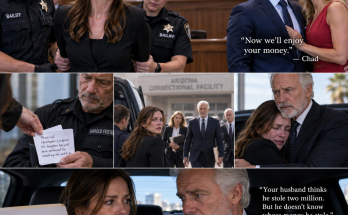
My father took me to court over my grandfather’s $11 million inheritance. “Your Honor, she’s only a waitress,” my father said. The judge smirked: “A waitress handling millions?” People laughed. Then I stood up and said, “I am…” And the judge went silent. “
“It means I am the person who has been managing my grandfather’s private portfolio for the last four years.”
No one laughed.
Not one person.
The courtroom became so still that even the air conditioner seemed to lower its voice.
Judge Harrison looked back down at the memo.
Attorney Sterling’s confident posture cracked by half an inch.
My father’s hand froze on his tie.
I continued before anyone could interrupt.
“And before that, I assisted him for three years in tracking dividend positions, commercial property income, tax-loss harvesting notes, and liquidity planning.”
Sterling stepped forward.
“Your Honor, this is absurd. If Ms. Whitaker had any formal role—”
“I did,” I said.
My voice did not rise.
It did not need to.
I opened the folder and removed the notarized document from my grandfather’s will file.
“Exhibit A. A signed advisory authorization dated four years ago, witnessed by Mr. Paul Renner, the estate attorney.”
Sterling’s mouth tightened.
He reached for the paper, but the judge lifted one hand.
“I’ll review it first.”
That irritated Sterling.
Men like him were used to touching the documents before the people they dismissed were allowed to explain them.
Judge Harrison read.
Then read again.
His face changed in slow, humiliating degrees.
The smirk disappeared first.
Then the impatience.
Then the faint superiority he had worn when he said the words serving coffee.
By the time he reached the second page, he was no longer looking at me like a waitress.
He was looking at me like a mistake he had made on the record.
“Ms. Whitaker,” he said carefully, “this document names you as financial records assistant and portfolio continuity designee.”
“Yes, Your Honor.”
Sterling let out a sharp breath.
“That title is ceremonial.”
I turned to him.
“No, Mr. Sterling. Ceremonial titles don’t come with quarterly reporting obligations, investment committee notes, secure account access logs, and signed performance reviews.”
A murmur moved through the gallery.
This one was different from the first.
Not mockery.
Interest.
Fear, perhaps, from people who had laughed too early.
I handed another packet to the clerk.
“Exhibit B. Four years of quarterly portfolio summaries prepared by me and reviewed by my grandfather.”
The clerk passed it to the judge.
Sterling’s eyes darted toward my father.
My father was staring at the table now.
Not with shame.
With anger.
That was my father’s truest emotion.
Not regret for underestimating me.
Not grief for disrespecting his own child.
Anger that I had made underestimating me inconvenient.
Judge Harrison flipped through the first pages.
“These summaries are extensive.”
“Yes.”
“These include real estate cash flow, brokerage diversification, municipal bond maturity schedules, charitable disbursement tracking…”
“Yes.”
He looked up.
“You prepared these?”
“I did.”
Sterling laughed once.
A desperate little sound.
“Your Honor, anyone can prepare a spreadsheet.”
I looked at him.
“Not everyone can explain why my grandfather shifted out of two overleveraged real estate investment trusts in Q2 before their dividend cuts hit public guidance.”
Sterling went silent.
I continued.
“Not everyone can explain why he increased laddered municipal exposure after his tax position changed in 2021.”
Judge Harrison leaned back.
“And can you?”
“Yes, Your Honor.”
“Briefly.”
I nodded.
The courtroom waited.
Not to laugh this time.
To see whether the waitress could speak the language they had assumed belonged only to men in suits.
“My grandfather’s taxable income structure changed after he sold a minority stake in a warehouse partnership. His ordinary income exposure rose, and his prior bond allocation was not optimized for his bracket. He wanted stability without overexposure to market volatility because he was preparing the estate for transition. The municipal ladder gave predictable tax-advantaged income, kept liquidity staged, and reduced reinvestment risk.”
Judge Harrison did not blink.
Attorney Sterling looked at the floor.
I glanced once at my father.
He looked furious.
Good.
Let him be furious.
He had brought me to court to prove I was too small to inherit.
Now he had to sit there while I explained the financial architecture of the estate he wanted to control.
Judge Harrison cleared his throat.
“Continue.”
I pulled out the next document.
“Exhibit C. A sealed letter from my grandfather, addressed to the court in the event my competence was challenged by any family member.”
My father’s head snapped up.
“What?”
His voice cracked through the courtroom.
Sterling put a hand on his arm.
“Arthur.”
My father ignored him.
“There’s no letter.”
I looked at him.
“You mean there was no letter you found.”
His face reddened.
For a moment, I saw him as he had been my entire life.
A man who believed anything outside his control was an insult.
Judge Harrison took the sealed envelope.
The wax seal had already been opened by the estate attorney and copied for filing, but the original remained intact in a protective sleeve.
The judge read the front.
For the Court, should my granddaughter Cassandra Whitaker be challenged as unfit.
My grandfather’s handwriting.
Strong.
Slanted.
Unmistakable.
The judge opened the copy and began to read silently.
The courtroom watched his face.
I watched my father.
He no longer looked relaxed.
He looked cornered.
Good.
My grandfather had once told me that cornered people reveal strategy or character.
My father revealed both.
“Your Honor,” he said, rising halfway, “this is manipulation.”
Judge Harrison looked over his glasses.
“Sit down, Mr. Whitaker.”
My father sat.
Not because he respected the court.
Because everyone had seen him told to.
Judge Harrison read the letter aloud.
“Judge, if this letter is before you, then someone in my family has done exactly what I predicted.”
The room tightened.
“My granddaughter Cassandra has been underestimated her entire life because she works with her hands, speaks carefully, and refuses to decorate herself with credentials for the comfort of insecure men.”
My throat closed.
I had not read that line before.
The attorney had told me the letter existed.
He had told me it would help.
But he had not told me what my grandfather wrote.
Judge Harrison continued.
“She began assisting me with financial records at twenty-three. By twenty-five, she was reviewing investment reports more carefully than professionals I paid substantial fees to impress me with words. By twenty-seven, she had identified errors in tax estimates, unnecessary management fees, and a conflict of interest involving my son Arthur’s proposed business partners.”
My father’s face drained.
There it was.
The real reason.
Not concern.
Not competence.
Exposure.
The judge read on.
“Cassandra did not ask me for money. She did not flatter me. She did not assume my estate should belong to her. She asked questions. She listened. She remembered. She worked. If she still chooses to work in a coffee shop, that is because honest work has never embarrassed her. It should not embarrass this court.”
My eyes burned.
I looked down.
Not because I was ashamed.
Because if I looked at anyone else, I might break.
Judge Harrison’s voice lowered.
“I leave my estate to Cassandra Whitaker not because she is the only person who needs it, but because she is the only person who respected the labor behind it.”
A woman in the back row exhaled audibly.
Sterling’s face had gone stiff.
The judge turned the page.
“My son Arthur will likely object. He will call her inexperienced. He will suggest she is simple. He may point to her work as a waitress. If he does, ask him why he attempted to pressure me into investing estate assets into the Northbridge Development Fund after being informed that the fund’s controlling partner was carrying undisclosed debt.”
My father stood.
“Your Honor, I object.”
Judge Harrison did not even look at him.
“You may object when counsel asks a question, Mr. Whitaker. At the moment, I am reading.”
My father sat again.
His jaw worked like he was chewing glass.
The judge continued.
“Ask him why he wanted Cassandra removed from financial review after she identified the risk. Ask him why he called her a stubborn little coffee girl when she saved me from a seven-figure mistake.”
The words landed like a hammer.
A seven-figure mistake.
Now the room understood.
My father had not dragged me into court because I was unqualified.
He dragged me into court because I had once proven I was not.
Judge Harrison placed the letter down.
For several seconds, he said nothing.
No one did.
Then he looked at Sterling.
“Counsel, are you aware of the Northbridge matter referenced here?”
Sterling’s mouth opened.
Closed.
“My client has not briefed me on that matter in detail.”
My father turned sharply.
“Sterling—”
The attorney lifted a hand, no longer polished, no longer in full control.
“Arthur, not now.”
That might have been the first honest advice he had given all morning.
Judge Harrison looked at me.
“Ms. Whitaker, do you have documentation regarding this Northbridge issue?”
“Yes, Your Honor.”
Sterling nearly flinched.
I removed another file.
This one was thicker.
I had not wanted to use it.
I had hoped my grandfather’s letter would be enough.
But my father had taught me early that hope without backup was just a polite form of risk.
“This includes emails my father sent my grandfather encouraging investment into Northbridge Development Fund, my written analysis of the fund’s leverage exposure, records of my grandfather declining the investment, and public filings showing the project defaulted eleven months later.”
The clerk took the file.
My father whispered something under his breath.
I heard only one word.
Ungrateful.
That word carried thirty years of history.
Ungrateful when I refused to quit college to help at his office.
Ungrateful when I would not move home after Mom died.
Ungrateful when I visited Grandpa more than I visited him.
Ungrateful when I chose work he could mock instead of dependence he could control.
I turned and looked directly at him.
“For what, Dad?”
The courtroom went still again.
He blinked.
I should not have spoken to him directly.
I knew that.
But the word had pulled something old out of me.
“You said ungrateful,” I said.
“So tell me. For what?”
Judge Harrison did not stop me.
Maybe he should have.
Maybe he wanted the answer too.
My father’s face hardened.
“For pretending you built anything on your own.”
There it was.
The root.
Not money.
Not competence.
Ownership.
He believed anything I became must have passed through him first.
I nodded slowly.
“Grandpa built the estate.”
“Yes.”
“And I helped him preserve it.”
My father laughed bitterly.
“You served him coffee.”
“No,” I said.
“I served coffee to everyone.”
“Then I sat with him after my shift and learned what you were too arrogant to ask him to teach you.”
His eyes flashed.
“He was my father.”
“And he chose me.”
The sentence struck him like a slap.
For one second, I saw pain.
Real pain.
Then pride covered it again.
“He was old.”
“He was clear.”
“You manipulated him.”
“I listened to him.”
“You poisoned him against me.”
“You brought yourself to him already poisoned.”
Sterling stood.
“Your Honor, this is becoming personal.”
Judge Harrison looked at him with a dry expression.
“Counsel, your entire petition is based on the personal assertion that Ms. Whitaker is incompetent because she is employed as a waitress.”
Sterling sat down.
My father’s face darkened.
The judge turned back to the documents.
He reviewed the Northbridge summary.
Then the account logs.
Then the quarterly reports.
Minutes stretched.
No one moved.
The people who had laughed earlier now seemed deeply committed to silence.
Finally, Judge Harrison spoke.
“The petition before this court requests an immediate freeze of estate assets on the basis that Ms. Whitaker lacks competence to manage or oversee the inheritance.”
He looked at Sterling.
“Based on what has been presented by the petitioner, that argument relied heavily on Ms. Whitaker’s employment in a service position.”
Sterling’s expression tightened.
“Your Honor, we also raised concerns regarding formal credentials.”
“And yet the documents before me indicate Ms. Whitaker performed substantial financial review and recordkeeping duties for the decedent over multiple years.”
“Yes, but—”
The judge lifted a hand.
“They also indicate the decedent anticipated this exact challenge and addressed it in writing.”
Sterling said nothing.
“Further, the Northbridge documents raise questions regarding the petitioner’s motives and prior financial judgment.”
My father leaned forward.
“Your Honor—”
Judge Harrison cut him off.
“I am not finished.”
My father shut his mouth.
The judge’s voice became colder.
“At this stage, I see insufficient grounds to freeze the estate based on Ms. Whitaker’s alleged incompetence. I see substantial grounds to question whether this petition was brought in good faith.”
The words seemed to echo.
Not brought in good faith.
Sterling’s face went pale.
My father looked stunned.
For the first time that morning, he looked like a man who had entered a room expecting to judge someone else and found himself on the stand.
Judge Harrison continued.
“The petition for emergency freeze is denied.”
My hands did not move.
I did not smile.
I simply breathed.
“The court will, however, order a review of the petitioner’s claims and the Northbridge-related materials for potential relevance to any future challenges or objections.”
My father turned toward Sterling, furious.
Sterling stared forward.
“The estate will proceed according to the will as filed, under the executor’s existing supervision, pending ordinary probate administration.”
The gavel struck once.
“Next matter.”
Just like that, the room moved again.
Papers shuffled.
People stood.
The gallery murmured.
Sterling gathered his files too quickly, dropping one sheet onto the floor.
My father did not move.
I placed my documents back into the folder carefully.
Methodically.
My grandfather had taught me that.
When money makes people emotional, keep your papers in order.
I turned to leave.
“Cassandra.”
My father’s voice stopped me.
Not because it was warm.
Because it was the first time that day he had used my name.
I looked at him.
He stood near the table, his expensive suit untouched by the public embarrassment he had tried to place on me.
“Do you think this is over?”
There was the father I knew.
Not sorry.
Not ashamed.
Threatening.
I looked at him calmly.
“No.”
His eyes narrowed.
I stepped closer.
“I think this is the first time you understand it started before you walked in.”
Sterling appeared beside him.
“Arthur, stop talking.”
But my father’s pride was bleeding now, and pride hates bandages.
“You wouldn’t have any of this if not for my father.”
I nodded.
“That is true.”
He looked satisfied for half a second.
Then I added:
“And you would still have a relationship with him if you had treated him like more than a signature.”
His face changed.
Something like grief moved through him.
Then rage crushed it.
“You self-righteous little—”
Sterling grabbed his arm.
“Arthur.”
This time, my father stopped.
Not because of me.
Because two people in the gallery had turned to watch.
Image.
Always image.
I walked out first.
The hallway outside the courtroom was brighter than I expected.
Sunlight poured through tall windows onto the marble floor.
People in suits moved past me carrying briefcases and bad news.
I stopped near a bench and sat down because my knees had finally remembered they were human.
For months, I had prepared for that hearing.
For the petition.
For Sterling’s insults.
For my father’s strategy.
For the photographs.
I had known he would use the coffee shop.
I had known he would call me unqualified.
I had even known the judge might enjoy it.
What I had not prepared for was my grandfather’s letter.
Not fully.
I opened the copy again with shaking hands.
Cassandra did not ask me for money. She did not flatter me. She did not assume my estate should belong to her. She asked questions. She listened. She remembered. She worked.
I pressed the paper to my chest.
The courthouse hallway blurred.
For the first time that morning, I cried.
Not loudly.
Not dramatically.
Just enough for the grief to escape through one narrow opening.
Grandpa had been gone for six weeks.
And I had spent most of that time defending what he left instead of mourning who he was.
I missed him suddenly with such force that it felt physical.
The paper cup of coffee in his hand.
The legal pad.
The way he tapped his pen when thinking.
The way he never made me feel foolish for asking a question.
The way he saw me.
A woman in a gray suit sat two benches away and pretended not to notice me crying.
Then, after a moment, she reached into her purse and offered me a tissue without looking directly at me.
I took it.
“Thank you.”
She nodded.
Sometimes strangers are kinder than blood.
My phone buzzed.
A message from Leo.
The coffee shop owner.
How did it go?
I stared at the screen.
Then typed:
They laughed at the apron. The apron won.
His reply came almost immediately.
Damn right it did. Your shift is covered. Take the day.
I laughed through tears.
Leo had known more than most people.
Not everything.
But enough.
He had watched my grandfather sit in the back corner for years.
He had brought him refills without charging.
He had once told me, “That old man is either training you or secretly plotting a bank heist.”
I had said, “Probably both.”
The next message came from Mr. Renner, my grandfather’s estate attorney.
Excellent result. Come by when ready. There is more to discuss.
Of course there was.
With my grandfather, there was always more.
I wiped my face, stood, and walked out of the courthouse.
Reporters were not waiting.
No cameras.
No dramatic steps.
Just cold air and city noise.
Real life rarely gives you background music after a victory.
It gives you traffic and a parking meter about to expire.
I walked three blocks to the coffee shop.
Not because I had to work.
Because I needed to remember who I was before a courtroom tried to turn it into an insult.
The bell over the door rang.
Leo looked up from behind the counter.
He took one look at my face and came around without a word.
I handed him the folder.
He did not open it.
“Did you win?”
“For today.”
He nodded.
“Good enough.”
Then he made me a coffee.
Black.
No sugar.
The way Grandpa drank it.
I carried it to the back corner table.
His table.
For a moment, I almost saw him there.
Coat folded over the chair.
Pen in hand.
Eyes sharp behind his glasses.
Asking me why a company with falling revenue was increasing dividends.
Asking me what debt did to pride.
Asking me whether I knew why people were careless with inherited money.
“Because they confuse receiving it with understanding it,” I had answered once.
He smiled that day.
“That’s my girl.”
I sat down and opened the folder.
The courtroom had heard enough to stop the freeze.
But Mr. Renner’s message meant there was another layer.
There always was.
At four that afternoon, I met him in his office.
Paul Renner was eighty-one, tall, thin, and moved like every joint had filed a complaint.
He had been my grandfather’s attorney for thirty years and had the patience of an oak tree.
When I entered, he stood.
“Cassandra.”
“Mr. Renner.”
“You did well.”
I sat across from him.
“My grandfather did well. I just carried the paper.”
He smiled faintly.
“He would have liked that answer.”
Then his expression changed.
“There is a reason your father moved quickly.”
“I assumed it was because of the estate.”
“Yes.”
“But not only the estate.”
My stomach tightened.
Renner opened a drawer and removed another file.
This one was red.
My grandfather had used red folders for danger.
Always.
I remembered that from the coffee shop.
Blue for income.
Green for property.
Yellow for tax.
Red for people.
Mr. Renner placed it in front of me.