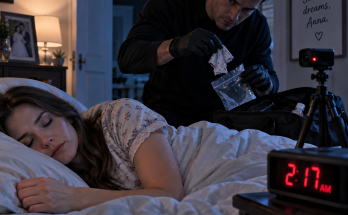
I slept that night in a furnished temporary place with three suitcases, my laptop, my jewelry case, and the framed photo from my first office leaning against the wall. The room had a mini-fridge that hummed too loud and a lamp with a shade that sat slightly crooked on its base. The sheets smelled faintly of institutional laundry. I slept better there than I had slept beside Ethan in weeks.
People tend to believe the hard part is the leaving. In my experience the hard part is the period just before the leaving, when you understand what is happening clearly enough to act but have not yet acted, when clarity and inertia exist in the same body at the same time. The leaving itself, when it finally comes, tends to be quiet. The hard part is behind you by then.
The next morning Ethan sent one more message. It was shorter than the others and different in tone, without the anger or the performance. You made your point, it said.
I looked at those four words for a while. Then I forwarded them to the attorney along with everything else, because lessons have a way of requiring maintenance, and I was done translating my evidence into emotional language for a man who only understood power when it was removed from his reach.
The legal process moved through the weeks that followed with the unglamorous methodical rhythm of legal processes. The transfers were reviewed. The property remained in my name. The family Ethan had tried to install in my home learned from documents, rather than from me, that he had offered them something he did not have the authority to give. Lily sent one more message three days after everything, two words: I’m sorry. I wrote back: Me too. That was the extent of what I owed her, and it was genuine, and it was complete.
I did not owe Ethan’s parents an explanation for their son. I did not owe Ethan a final conversation in the kitchen where he could stand on my floor and perform his version of accountability on his own terms. Some people believe that closure requires a confrontation, a scene, a moment where everything is said out loud in a room where both parties can hear it. I have found that closure is more often a document than a conversation. A deed. A wire confirmation. A frozen account and an attorney who answers on the first ring.
Weeks later I went back to the house with my attorney’s instructions in a folder and a locksmith scheduled for the afternoon, and I stood in the kitchen where all of it had happened. The neighbor’s flag was still moving by the mailbox. The pool was still and clear. The marble was still cold in the way of good stone that holds its temperature.
The house felt different. Not lighter, exactly, which is the word people reach for in these situations. More accurate, maybe. More like itself. The life that had filled it for those brief weeks had been partly mine and partly a story Ethan was telling about his own importance, and with the story removed, what remained was the house I had actually bought: clean lines, good light, and the kind of quiet that is not emptiness but potential.
I stood where he had stood and said the words that were still somewhere in the air of the room. This house is mine.
He had been right that one time. He had simply been confused about which one of us he was talking about.
I walked through the rooms without inventory, without documentation, without anything more required of me than simply being present in a space that had always been mine and always would be. The echo was still there, but it sounded different now. Not like absence. Not like a question going unanswered. It sounded like a room waiting for the right person to fill it, which is perhaps the best thing a room can do.
I had spent ten years building something from nothing, through cracked windows and cereal dinners and the particular loneliness of being competent in a world that kept asking who was actually in charge. I had done all of it before Ethan arrived and I had continued doing it after he left, and the house, like the company before it, had exactly one name attached to its origin.
Mine.
Not as a correction. Not as a declaration that needed to be repeated until someone believed it. Simply as a fact that had always been true and that no amount of confident standing near it had ever changed.
I locked the front door behind me with my own key.
The afternoon was warm. The flag moved in the breeze. The pool filter hummed through the glass doors in the soft, expensive way of a house where everything was running exactly as it should.
I drove away without looking back, because there was nothing behind me that I had not already accounted for.