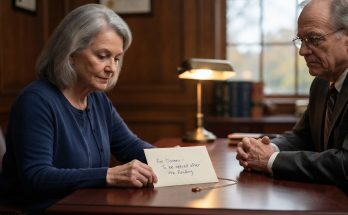
That afternoon didn’t end in the park, but at the police precinct, among hard plastic chairs, slow paperwork, and clerks who looked bored to death. Danny made his statement. He gave names. Addresses. A stash house where they kept stolen bikes before selling them online.
And that’s where the case blew up. Because my bicycle wasn’t the only one. That same night, using the intel Danny provided, they found nine more bikes in an abandoned lot behind a tire shop. There was a blue girl’s bike with butterfly stickers. A delivery bike. Two mountain bikes. A red one with a baby seat.
The next day, my granddaughter’s video went viral. I didn’t want it to. But it did. “Taekwondo Grandma recovers stolen bike and busts theft ring,” a headline read. Grandma. Again. But oh well. At least this time it sounded respectful.
People started coming by my house. First, a lady thanking me because they recovered her son’s bike. Then a delivery boy with a box of pastries. Then a man who wanted to sign up for classes “if his wife let him.” Even the owner of the local hardware store gave me free paint for the dojang.
My granddaughter, who at first said I was crazy, was the first to make a sign: ROBERT’S DOJANG — SELF DEFENSE & STRONG HEARTS
—”Robert’s?” I asked her when I saw it. She smiled. —”Well, he started the helping, so let him keep at it.” I didn’t say anything. I just hugged her.
Three weeks later, the old place smelled of sweat, Pine-Sol, and hope again.
Danny showed up on time from day one. With his baseball cap, but without the fake gold chain. He swept. He painted. He fixed the door. He fixed Mrs. Mabel’s bike, the butcher boy’s bike, and even mine—though I told him not to fix the scars on my bike, because those were memories, too.
Leo started tagging along when he was feeling up to it. He’d sit in a chair by the wall, with his notebook, taking down the names of the kids. Sometimes he rang the bell to signal the change of drills. The off-pitch little bell from my bicycle.
Theresa brought iced tea on Fridays. The cops dropped by every now and then. The gray-haired one, Officer Miller, ended up signing his granddaughter up. —”So she doesn’t let anyone push her around,” he told me. —”And so she doesn’t push anyone around either,” I replied. Because that was the very first thing I taught. You don’t learn how to punch just to feel big. You learn to defend yourself so you can walk without fear. And also to know when not to strike.
It took Danny a while to hold his head up. The first few days he walked around like everyone was pointing at him. And yes, some did. Neighborhoods have long memories when they want to, and short ones when it suits them. But he kept showing up.
One afternoon, after class, I found him standing in front of the photo of Robert I had hung by the entrance. In the picture, he was young, apron covered in flour, flashing that good-man smile he never bragged about.
Danny had the keychain in his hand. —”Do you think he would have forgiven me?” he asked. I stood next to him. —”Robert would have.” —”And you?”
I took a moment to answer. Because forgiveness isn’t a blanket you just throw over yourself and that’s it. Forgiveness is sewn together. Stitch by stitch. With actions.
—”I’m learning,” I told him. Danny nodded. —”Me too.”
Two months passed. The agreement was being honored. Danny handed over a cut of what he made from repairs. He helped recover other bikes. He cut ties with the crew that got him in trouble. He didn’t turn into a saint—because saints only exist on prayer cards—but he started to become someone who could look in the mirror without lowering his eyes.
One Sunday, I went to the farmers market on my bike. The same one. With the loose basket, the patched seat, the scratched Virgin Mary, and a brand new chain Danny put on “so nobody swipes it this time, ma’am.” I bought tomatoes, onions, cheese, and cilantro.
On my way out, I stared at the pole where they had stolen it. I didn’t feel angry anymore. I felt something else. As if the empty space from that day had been filled with something I hadn’t expected. A story. A painful one, yes. But a living one.
When I got to the dojang, the kids were already lined up. My granddaughter was at the front, trying to get them in order. Danny was setting up the mats. Leo rang the little bell. Ding. Off-pitch. Perfect.
Everyone went quiet when I walked in. —”Master Betty,” Danny said, standing up straight, “ready.”
Master. Not granny. Not lady. Master.
I felt that Robert, wherever he was, was laughing softly to himself. I left my cane by the door. The same cane I didn’t need, but now kept as a souvenir of the day an old bicycle gave me back something much bigger than an object.
I stood in front of the students. Kids, mothers, a cop with a belly, a lady from the market, a boy who had been a thief and was now learning to stand tall.
—”Alright,” I said. “Today we are going to practice balance.” A little girl raised her hand. —”So we don’t fall down, Master?” I smiled. —”For that too. But mostly, to learn that when life shoves you, you don’t always have to strike back. Sometimes it’s enough to plant your feet firmly… and decide who you want to be.”
Danny looked down, but this time not out of shame. Out of respect. I took a step forward. The same step as always. Firm. Precise.
And as everyone followed my lead, I heard my bicycle outside leaning against the wall, its little bell barely chiming in the wind. Ding. As if Robert was telling me: —“Well done, Betty.”
And without turning around, I answered him in silence: —“I know, old man. But don’t get too excited. He still needs to learn how to sweep the corners right.”
6 years ago, my brother stole the love of my life — the woman i was about to propose to. now, at our father’s funeral, he walked in holding her hand and said, ‘some guys just finish first.’ i just smirked, turned to him, and said, ‘you still working that office job?’ then my wife stepped out of the limo… and when he saw who she was, he nearly dropped her hand…
Part 2 of 2