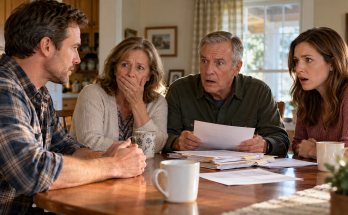
Because it was one thing to discover that my daughter had robbed me.
It was something entirely different to discover that my dead husband had had enough of a pulse to bury me.
I sat on a plastic chair next to the juice stand. The woman was squeezing oranges as if the world hadn’t just split in half. The glass filled with yellow foam, the knife thumped against the cutting board, and trucks roared down the avenue.
Paula and Tyler were arguing near the car.
I stared at Brenda’s slip of paper.
“Don’t just look into your death certificate. Ask about Sam Mendez.”
The name burned in my hand.
Sam.
The man who walked out one day with a backpack, saying he was going to head north. The man I had held novenas for, for whom I had lit candles at St. Dominic’s, for whom I had endured people calling me “the widow without a certificate.”
Twenty years of praying to a living man.
I felt like throwing up.
Paula approached, her eyes red and her mouth set in a hard line.
“Mom, let’s go home. We’ll talk there.”
“No.”
Tyler smiled without showing his teeth.
“Don’t be difficult, mother-in-law. People are just getting you confused here. That girl back there doesn’t even know what she’s talking about.”
I looked at him.
For the first time, I really saw his clean shoes, his new watch, his pressed shirt. All of that while my grandkids sometimes came to my house begging for eggs because “there wasn’t any food in ours.”
“How much do you owe?” I asked.
Paula looked down.
Tyler clenched his jaw.
“That’s none of your business.”
“If you were planning to sell my house, it is my business.”
“The house isn’t even well-maintained,” he spat. “And you’re too old to live alone.”
I laughed.
A tiny, joyless laugh.
“I’m so alone that people were actually able to kill me off on paper, and nobody even noticed.”
Brenda came out of the office at that moment. She no longer had her laptop, just her crossbody bag and the face of someone who knows they got into trouble for doing the right thing.
“Ms. Mendez,” she said, “come with me.”
Paula stepped forward.
“Where are you taking her?”
Brenda didn’t shrink back.
“Wherever she decides to go.”
She turned to me.
“My aunt works near the County Clerk’s office in Gary. She can’t solve everything, but she can guide you. And from there, you need to go to the police station. Do not go back to your house alone.”
Tyler let out a loud, mocking laugh.
“The police? Why? Because some lady got confused in the computer system?”
Brenda looked at him with pure disdain.
“Because a living person is showing up as deceased, someone has been collecting checks in her name, and there is a purchase agreement for her home. That doesn’t sound like a ‘confusion’ to me.”
Paula started crying again.
“Mom, I didn’t want to.”
“But you did it.”
“It was Tyler.”
He turned quickly.
“Shut up!”
And there, in front of everyone, he raised his hand to her.
He didn’t get a chance to hit her.
I stood up.
I don’t know where the strength came from, but I shoved my grocery bag into his chest and pushed him back.
“Don’t you touch my daughter.”
Tyler froze. Paula did, too.
Maybe that’s why it hurt even more. Because even though she had robbed me, my body still moved to protect her before I could even think about it.
Brenda grabbed my arm.
“Let’s go.”
I got into a taxi with her. Paula tried to follow, but Tyler dragged her back toward their car. I watched her through the window—small, crying next to the yellow folder. I wanted to get out. I wanted to hug her. I wanted to ask her at what moment her heart had broken enough to turn her own mother into a piece of paperwork.
But I didn’t get out.
The taxi drove through streets full of dust, fruit stands, and social program banners hanging from telephone poles. We passed near a massive, gleaming statue—a guardian watching over a city where poor women disappear even while sitting in their own kitchens.
Brenda didn’t talk much.
I was grateful for that.
There are some pains that don’t need comfort; they need witnesses.
In Gary, her aunt received us in a small office with an old fan and stacks of files. Her name was Teresa, and she had the face of someone who had heard too many tragedies.
She reviewed my papers. She typed in my Social Security number. Then she took off her glasses.
“There is a death certificate registered here from three years ago. County: Lake. Informant: Samuel Mendez Ortiz.”
My hands went numb.
“Is he alive?”
Teresa looked at me with care.
“According to the system, yes. And he appears as a witness on other filings after that.”
“Where does he live?”
“I can’t give you that information just like that. But I can print out the directions for you to contest the certificate and request a correction from the Vital Records office and the SSA. You also need to file a police report. This won’t be fixed in one trip.”
She handed me a copy.
There was my full name.
Sharon Mendez.
Date of death.
Cause: Respiratory failure.
Place: Home.
I felt a surge of rage.
They didn’t even have the imagination to kill me properly.
They had killed me in my own house, the same one where I was sitting that very day, mending grade-school uniforms.
“I was alive,” I said.
Teresa lowered her voice.
“That is exactly why you are going to fight like you’re alive.”
We headed to the police station on a busy avenue. Brenda insisted on going in with me. I told her she could get in trouble.
“My grandmother says that when you see an injustice and act oblivious, you’re just as guilty,” she replied.
I didn’t know what to say to that.
At the station, it smelled of burnt coffee, sweat, old paper, and fear. There were women with sleeping children on their laps, a boy handcuffed to a bench, a lady arguing because they wouldn’t take her report. The whole of America fits into a waiting room when nobody has money for a lawyer.
I waited four hours.
In the late afternoon, when they finally called me, I told them everything.
The benefits card.
My daughter as the representative.
The fake death.
The purchase agreement.
Sam.
The officer at first wrote as if his fingers were made of lead. But when I said that I was showing up as deceased in the system, he looked up.
“You’re the deceased person?”
“Well, that’s what they say. But I walked in here on my own two feet.”
Brenda let out a nervous laugh.
I didn’t.
They took my statement. They asked for copies. They sent me to provide follow-up documentation. They gave me a case number. They talked to me about fraud, perjury, identity theft, and whatever else might be uncovered.
Whatever else might be uncovered.
What a grim phrase.
As if misfortune were a pot, and we still didn’t know just how much it was going to boil over.
That night, I didn’t go home.
Brenda took me to her cousin’s place, a woman who rented out rooms and let me sleep on a mattress next to a window. I paid her with the little money I had left. She didn’t want to take it all.
“Save it for copies,” she told me.
I slept with my purse hugged to my chest.
I dreamed I was walking through the neighborhood and no one could see me. I knocked on doors and everyone said, “Sharon died years ago.” I dreamed Paula walked past me with my grandkids and wouldn’t turn her head.
I woke up sweating.
The next day, I went to the Social Security office.
They confirmed the worst.
The card existed.
There were deposits.
There were withdrawals.
Always at ATMs nearby: Gary, Hammond, once in Chicago. For two years and eight months, someone had been collecting in my name while I kept working until my fingers were crooked with arthritis.
I asked for statements.
They didn’t give me the full records immediately.
But the manager, a serious man with a graying mustache, looked at me for a long time.
“Ma’am, file the police report and bring me the official letter. Do not authorize anyone as a representative. Do not give your ID to anyone. And if your Social Security status is flagged as deceased, we have to correct that first.”
Dead to the system.
Alive to keep paying the electric bill.
That was my life for that month.
Vital Records.
Copies.
District Attorney’s office.
Social Security.
The Bank.
The office.
The line.
Another line.
A clerk at a window told me I needed patience.
“I’ve been patient for sixty years,” I replied. “Now I need you to give me back my life.”
Five days later, Paula came looking for me.
She found me outside the County Clerk’s office, a new folder under her arm. She was alone. No makeup. A wrinkled blouse and a small bruise near her wrist.
I felt something shatter.
“Mom,” she said.
I didn’t hug her.
“Where’s Tyler?”
“He left.”
“With the money?”
She looked down.
“With the car. And the papers.”
“Which ones?”
She cried.
“Copies of your property deed. My birth certificate. The kids’ papers. A power of attorney he made me sign.”
I leaned against the wall.
People were walking by with birth, marriage, and death certificates. Papers to prove one arrived in the world, joined someone, or left it. I was there trying to prove I hadn’t left.
“And Sam?” I asked.
Paula covered her mouth.
“He came back four years ago.”
I felt no surprise.
Only an ancient sadness standing up.
“Did you see him?”
She nodded.
“He found me on Facebook. He said he wanted to meet his grandkids. He said he left because he couldn’t support us, and he was too ashamed to come back. I… I wanted to believe him.”
“And then?”
“He met Tyler. They became friends. They started with ideas. That you weren’t ‘using’ the house. That since you never signed up for benefits, we could move things around. That if you showed up as deceased, it would be easier to pull old records, collect money, and sell the house before you realized what was happening.”
I felt sick.
“Did you sign?”
Paula was crying with a twisted face.
“Yes.”
“Did you know they declared me dead?”
She didn’t answer.
“Look at me.”
She raised her eyes.
“At first, no. Later, yes.”
That answer pierced me more than Sam’s betrayal.
Because Sam had been a ghost for twenty years.
But Paula had eaten from my table the Sunday before.
“Why?”