Part 1
“My daughter-in-law invited me at 8:30 for a dinner that actually started at 6, and when I arrived, only the bill was left; my son mocked me, saying ‘always so lost, Mom,’ but when I called the manager over and they discovered who I was in that restaurant, the color completely drained from their faces.”
—“You’re late, mother-in-law… but just in time to pay the bill,” my daughter-in-law said, raising her empty glass as if she were raising a toast to my humiliation.
My son laughed along with her. —“Oh, Mom, always so clueless. How does it even cross your mind to show up when we’re already done?”
I stood frozen at the entrance of the Ivy Garden restaurant in Brooklyn, my brown purse clutched tightly against my chest, my heart pounding as if it wanted to burst out. It was 8:30 in the evening. Not a minute late. Not a minute early.
I wasn’t late. I had arrived at the exact time Valerie had sent me over WhatsApp.
I pulled out my phone with a trembling hand and opened the message. “Anniversary dinner, 8:30 p.m., Ivy Garden. Don’t miss it, mother-in-law.”
There it was. Clear. Cold. Perfectly typed.
But the table at the back was already destroyed: empty plates, wine-stained glasses, crumpled napkins, remnants of lobster, steak, expensive desserts, champagne bottles, and 9 people staring at me as if I were the grand finale of the show.
Valerie was sitting next to my son, Sebastian, wearing a tight black dress, her hair styled in perfect waves. Her mother, Mrs. Patricia, wore fake pearls and an expression of pure triumph. Her sister, Rachel, was there too, along with 2 cousins, an aunt, and 3 people I barely even recognized.
Nobody stood up. Nobody greeted me. Nobody asked if I wanted dinner.
The waiter appeared at my side holding a small black folder. —“The bill, ma’am.”
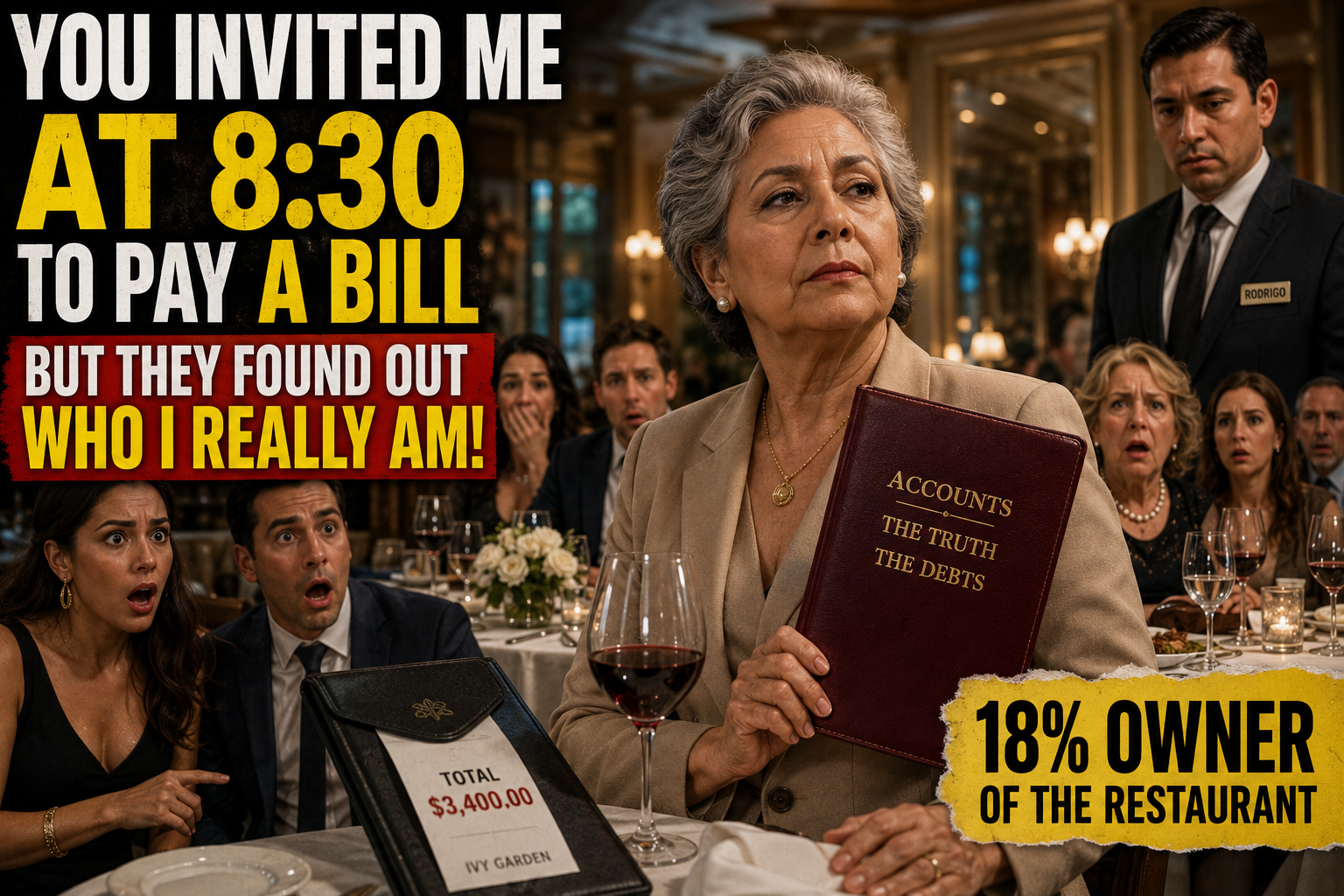
I opened it. $3,400.
I felt the air grow heavy. They had ordered the most expensive items on the menu: French champagne, imported cuts of meat, lobster, appetizers I couldn’t even pronounce, berry desserts, and several bottles of wine.
Valerie watched my face with a tiny, delightful, cruel smile. —“Don’t worry, mother-in-law,” she said. “Sebastian told us you always help out. Besides, that’s what family is for, right?”
My son lowered his gaze. He said nothing. And that silence hurt far more than the mockery.
My name is Eleanor Robles. I am 68 years old. I was a senior accountant for nearly 40 years at an auditing firm in Manhattan. I raised Sebastian entirely on my own after my husband, Arthur, died of cancer when our son was 13.
I paid for his tuition. I paid for his uniforms. I sold my gold earrings when he went to college. I worked weekends so he could complete his graduate specialization. I went without vacations, without new clothes, without a life of my own, because I believed a mother should sustain her son until she saw him standing firmly on his own two feet.
And that night, sitting across from me, my son was not a man standing on his own feet. He was a man hiding behind his wife’s smile.
—“Are you going to pay or not?” Valerie asked, feigning sweetness. “Based on the time, we’ve already wrapped up dinner and we have to get going.”
That was when I understood everything. It hadn’t been a mistake. They had booked the reservation for 6:00. They ate for more than 2 hours. And they invited me for 8:30 so I would arrive when nothing was left but the bill and the shame.
I took a deep breath. Very deep. And something that had been dormant inside me for years finally woke up.
I didn’t pull out my credit card. I didn’t open my wallet. I raised my hand and called the manager over. —“Rodrigo, can you come here for a moment?”
Valerie stopped smiling. Only for a second. But I saw it.
Rodrigo Santillán, the manager of the Ivy Garden, approached in his sharp navy blue suit, impeccable as always. I had met Rodrigo when he was just a busboy, many years ago. His mother, Mercedes, worked with me at the accounting firm. When she fell ill, I helped Rodrigo organize their accounts, pay off debts, and save the small family restaurant that later turned into one of the most elegant spots in the area.
—“Good evening, Mrs. Eleanor,” he said, bowing his head with genuine respect.
The entire table went dead silent. Valerie blinked. —“You two know each other?”
I didn’t answer her. I looked at Rodrigo. —“Tell me, please, what time was this table reserved for?” —“6:00 p.m., ma’am.”
The silence fell like a stone. Rachel stopped laughing. Sebastian snapped his head up instantly.
—“And what time did they tell me to arrive?” I asked, showing him the text message. Rodrigo read the screen. —“8:30 p.m.” —“Thank you.”
Valerie tried to step in. —“Oh, it was just a misunderstanding, Eleanor. Let’s not make a scene.”
Rodrigo didn’t budge. —“Furthermore, Mrs. Eleanor, your private table has been ready since 6:00, as always. We were expecting you in the side lounge.”
Valerie’s mother frowned. —“Her private table?”
Rodrigo responded with flawless calm: —“Of course. Mrs. Eleanor has been a minority partner in this restaurant for 11 years. She holds an 18% stake in the Ivy Garden.”
I watched the color completely drain from Valerie’s face. Sebastian sat with his mouth half open. —“A partner?” my son muttered.
I sat down slowly in the empty chair they had left for me—left more as a mocking throne than an actual place at the table. I opened my purse and pulled out a wine-colored notebook.
The exact same notebook where, for 3 years, I had written down everything. Every loan. Every promise. Every lie. Every single humilitation I had swallowed just so I wouldn’t lose my son.
—“I am not paying this bill,” I said.
Valerie let out a nervous juice. —“What do you mean you’re not?”
I opened the notebook. —“Because tonight I didn’t come to pay. I came to settle accounts.”
Sebastian swallowed hard. —“Mom, please…”
I lifted my eyes. —“No, Sebastian. Tonight, it’s my turn to speak.”
And as every pair of eyes at that table locked onto that notebook, I realized that for the first time in a very long time, I wasn’t trembling with fear. I was trembling with strength.
Because what they didn’t know was that this $3,400 bill was a mere crumb compared to what I had already uncovered. They couldn’t possibly imagine what was about to happen next…
Part 2
For 3 years, Valerie made me believe I was part of her family, while she slowly drained me dry. First, it was the wedding: “Just help us with a portion, Eleanor, we’ll pay you back later.”
I paid $16,000 for a venue in Long Island because Sebastian looked at me with those boyish eyes that I still didn’t know how to say no to. Then came the honeymoon to Key West: $3,700 “borrowed” that never returned. After that, Valerie wanted to open an online boutique and asked me for $9,000. She signed a paper with a return date.
The boutique never existed. Later, she invented a “medical” surgery that turned out to be cosmetic. Then credit cards, trips, supposed emergencies, back rent, a down payment on a car. I wrote it all down. Date, amount, reason, and promise. $32,000 in 36 months. And yet, the money wasn’t the worst part.
The worst part was when they moved into my house “for two months” because their apartment had water damage. They stayed for a year. Valerie changed my curtains, threw away a tablecloth embroidered by my mother, packed away Arthur’s photos in boxes I never found again, and turned my kitchen into her personal territory. One afternoon, I found the engagement ring Arthur gave me at Central Park in the trash can, covered in food scraps. “I thought it was just old costume jewelry,” Valerie said, without a single shred of remorse. Sebastian merely muttered, “Mom, don’t overreact.” From that moment on, I began to wake up.
I hired a private investigator, Julian Martinez, a serious and discreet former detective. What he found tore away my last blindfold. Sebastian and Valerie had $20,500 tucked away while they kept begging me for more. She was buying designer bags, jewelry, expensive dinners, spa treatments. I found chats where Rachel wrote: “Your mother-in-law is an ATM with legs.” Valerie replied: “She never says no.” And the worst of it: a written plan to convince me to put my house in Brooklyn under Sebastian’s name “for tax purposes” and then sell it. Estimated value: $700,000.
The planned distribution: a new apartment, a car, Patricia’s debts, Rachel’s business, and the rest for them. My life was already carved up in their imaginations as if I were already dead. That’s why, when Valerie invited me for 8:30 at the restaurant, I already knew the truth. And that’s why Rodrigo was prepared. Over the table, I opened the notebook and began to read aloud: “May 12th: $16,000 for the wedding. Promise of payment: 18 months. Paid: zero. August 4th: $3,700 for the trip. Paid: zero. November 10th: $9,000 for a nonexistent boutique. Paid: zero.” Valerie’s smile vanished completely. Sebastian turned beet red. I pulled out the printed chats and laid them next to the bill. “ATM with legs,” I read in a clear voice. Rachel looked away. Mrs. Patricia tried to get up, but Rodrigo stepped closer, asserting his presence. “We are not finished,” I said. Then I placed the plan for my house on the table.
Sebastian turned pale. “Mom, I didn’t know all of this…” I looked at him with sadness. “But you knew enough.” Valerie slammed her hand on the table. “This is an invasion of privacy! We are family!” I leaned toward her. “Family doesn’t invite an elderly woman to the end of a dinner just to humiliate her and hand her the bill. Family doesn’t plot to take away her home. Family doesn’t turn love into a credit card.” Rodrigo placed a card reader in front of them. “The bill must be settled tonight. Mrs. Eleanor did not authorize any charges to her account.” Mrs. Patricia whispered, “Valerie, you said she would pay.” That’s when the real embarrassment began. They had to split the bill across four credit cards. One was declined. Another didn’t have enough limit. Rachel cried from pure frustration. Sebastian couldn’t even look at me. Before leaving, I slid a manila envelope in front of my son. “There is the civil lawsuit for $32,000 plus interest. You have 15 days to sign a payment agreement. Also, tomorrow you move out of my house. If I find a single item of yours after 6:00 p.m., I am calling the police.” Sebastian stood up, crying. “Mom, don’t do this.” “No, son,” I said. “You all did this. I just stopped helping you hide it.” I walked out of the restaurant with my purse in my hand and the notebook pressed against my chest. Outside, the cool New York night air hit my face like a blessing. But while I thought I had seen the worst, I was still waiting for a call the next morning—one that would reveal exactly why Valerie was in such a hurry to sell my house.
Part 3
The next morning, they returned to my house with a moving truck. Valerie stormed in, furiously throwing things into boxes, muttering that I was a bitter old woman. Sebastian looked like a man who had just woken up in the middle of a life he no longer recognized. I stayed at the entrance with Carmen, my neighbor, and Andrew Salgado, my lawyer, who already had copies of everything. When Valerie tried to pack away a china set that belonged to my mother, Andrew stopped her: “That is not your property.” She spat out a curse. Sebastian said nothing. For the first time, he didn’t defend her. By 5:40 p.m., they were gone.
At 6:00 p.m., I locked the door and changed the deadbolts. I walked through my home like someone inspecting a wounded body: scuffed walls, empty drawers, hidden photos, empty spaces where memories used to hang. In the study, I found a notebook Valerie had forgotten under a folder. There lay the reason for her rush: she owed over $45,000 across credit cards, personal loans, and money her mother had demanded for a failed imported clothing business.
There were also messages from a man named Ethan, whom she had been seeing for months. He wrote to her: “As soon as you sell the old woman’s house, we’re moving to Miami.” I sat on the floor. I didn’t cry. I had no tears left for her. What hurt was Sebastian. My son had lost his mother, his marriage, and his dignity for a woman who didn’t even love him. Even so, I didn’t pick up the phone. A mother’s love doesn’t mean rushing to rescue an adult from the consequences they chose. Twelve days later, Sebastian signed the payment agreement: $1,400 a month for nearly two years.
He sold his car, canceled his cards, moved into a tiny apartment in Brooklyn, and started therapy. Valerie refused to sign anything at first. She threatened to sue me, to blast me on social media, to claim elder abuse. Andrew responded by sending her legal counsel a complete file of our evidence along with a countersuit ready for filing. She signed the next day. Three months later, Sebastian showed up at my front gate. He was thinner, with dark circles under his eyes, holding a small bag of pastries. “I’m not asking to come in,” he said. “I just wanted to tell you that I’m getting a divorce.” I took a slow breath. “Why?” He let out a broken laugh.
—“Because when your money ran out, so did her patience. And because I found messages with another man. Everything was true, Mom.” I wanted to unlock the gate and hug him like he was a little boy again. But a part of me—the part that had finally learned to protect itself—held the lock firmly shut. “I’m sorry,” I told him. “Truly. But I still can’t welcome you back just yet.” He nodded, tears streaming down his face. “I understand. I just wanted you to know that I’m paying it back. And for the first time in years, I see what I let myself become.”
The months passed. Every payment arrived right on time. Sometimes with a brief note attached: “Month 5 paid. Still in therapy.” “Month 11 paid. I’m so sorry for calling you clueless.” “Month 18 paid. I didn’t deserve your patience.” I kept every single note in a box, right next to Arthur’s old letters. With a portion of the recovered money, I remodeled my kitchen.
I hung the family photos back up. I rescued my plants. I adopted a golden retriever mix named Bella. And, for the first time in my life, I traveled alone to Savannah. I walked through the markets, bought local art, ate fine meals without looking at the price tag, and cried on a park bench because I finally understood that living for yourself isn’t selfish: it’s a resurrection. A year later, Sebastian finished paying off the debt. He texted me: “Mom, I just made the final deposit. I don’t expect things to go back to how they were. I would just love to grab a coffee with you sometime, if you’re open to it.” It took me three days to reply.
On the fourth day, I sent him an address: a quiet little coffee shop in Brooklyn. We met on a Sunday. There were no hugs at first. Just silence, coffee, and two people trying to figure out how to rebuild something after so much shame. Sebastian asked for my forgiveness without shifting any blame onto Valerie. That was the first thing that made me truly listen to him. “I let it happen,” he said. “I laughed along. I used you. I allowed them to view you as a bank account instead of my mother.” He cried. I did, too.
I didn’t fully forgive him that day, but I left a window cracked open. Sometimes justice isn’t about destroying someone. Sometimes it’s about forcing them to look at exactly what they did without giving them a place to run. Today, my house is still mine. My study smells of fresh coffee and lavender. Bella sleeps right under my desk. My wine-colored notebook no longer records debts, but ideas for a small video channel where I share stories of women who learned to say enough is enough. Sebastian comes to see me twice a month. Slowly.
With respect. Without asking for a dime. Without ever bringing up the inheritance. Valerie moved to Miami with Ethan, who later walked out on her when he discovered the depth of her debts. I felt no satisfaction. Nor did I feel pity. Some people only learn when the mirror stops lying to them. I learned something else: boundless generosity eventually becomes a cage, and a love that requires you to erase yourself isn’t love—it’s abuse dressed up in sweet words. That night at the restaurant, they thought I had arrived to pay a bill. But in reality, I arrived to collect the most important one: the bill for my dignity. And that one, at long last, has been paid in full……..