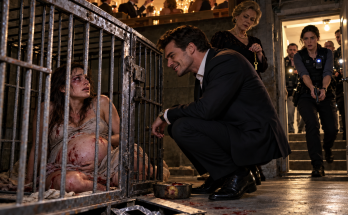
I’m a waitress. Last night, a billionaire came into my restaurant. He ordered wine. When he reached for his glass, I saw his wrist—a tattoo. Small red rose with thorns forming infinity. I froze. My mother has the exact same tattoo. Same design. Same wrist. I said, “Sir, my mother has a tattoo just like yours.” He dropped his wine glass. It shattered. He asked my mother’s name. I said it, and he went pale.
I’m a waitress. Last night, a billionaire came into my restaurant. He ordered wine. When he reached for his glass, I saw his wrist—a tattoo. Small red rose with thorns forming infinity. I froze. My mother has the exact same tattoo. Same design. Same wrist. I said, “Sir, my mother has a tattoo just like yours.” He dropped his wine glass. It shattered. He asked my mother’s name. I said it, and he went pale.
The first time I saw the tattoo, I almost dropped the wine bottle.
At Chipriani, you learn very quickly not to react. Not to stare, not to ask questions, not to act impressed when movie stars walk in wearing baseball caps they think make them invisible, and not to flinch when hedge fund men spend more on dessert than you paid for groceries that week. The whole job depends on controlled invisibility. Smile at the right time. Move quickly. Anticipate. Never insert yourself into anyone else’s evening.
I had gotten good at it.
I was 24 years old, living in a one-bedroom apartment in Queens, working double shifts as a waitress in one of the most expensive restaurants in Manhattan, and every waking hour of my life had narrowed into a single purpose: keep my mother alive as long as money could keep her alive.
Three months earlier, the doctors had told us her breast cancer was stage 4.
That was the language they used. Clean. Numbered. Clinical. As if the right staging could make catastrophe sound orderly. By the time they found it, the cancer had already spread to her lymph nodes and liver. The first oncologist, a man with a voice so gentle it made me want to slap him, told us there were treatment options but no guarantees. The second doctor gave us a timeline more honestly.
A year, maybe.
Less, if the chemo didn’t hold.
More, if we got lucky.
The word lucky became offensive after that.
My mother, Julia Rossi, had worked as a housekeeper for almost my entire life. She cleaned apartments on the Upper East Side and brownstones in Brooklyn Heights and Tribeca penthouses owned by people who tipped badly and liked to call her sweetheart without ever learning her name. She had always smelled faintly of bleach, lavender detergent, and tiredness. She worked 6 days a week when I was growing up, sometimes 7. She left the apartment before sunrise and came home with her back aching, her fingers raw, and cash tucked carefully into envelopes labeled for rent, Con Edison, MetroCard, groceries, school shoes, winter coats.
She never complained.
Not once.
When I was a child, I thought that made her invincible.
When I got older, I realized it only meant she had learned very young that complaining did not change the price of survival.
Once the cancer took her strength, I became the one working.
I picked up every shift I could get. Breakfast service when somebody called out. Lunch when tourists overran the place. Dinner when the reservation book filled with names worth pretending not to recognize. On a good night, I brought home $400 in tips. On a bad night, half that. It was never enough. Even with insurance, the co-pays for treatment, medication, scans, parking, anti-nausea drugs, and the thousand hidden costs of dying in America arrived like a second disease.
By late October, I was permanently tired.
That particular Friday had already lasted too long by the time Josh, the floor manager, came striding toward me with his clipboard tucked under his arm and that tight expression that meant a high-maintenance table had just been seated.
“Lucia,” he said, lowering his voice. “Table 12. VIP. Asked for privacy and the best server we have.”
I gave him a deadpan look. “And by miracle of scheduling, that’s me?”
He almost smiled.
“That’s you.”
“Who is it?”
“Adrien Keller.”
I actually paused then.
Everybody knew the name.
If you paid attention to money, tech, or the kind of glossy media stories that treat billionaires like complicated weather systems, you knew Adrien Keller. He was worth $4.2 billion, had built a software empire out of some startup story journalists loved because it made concentration of wealth sound like evidence of genius rather than obsession. German-born. Self-made. Private. On every list. In every magazine. Always photographed looking slightly uncomfortable beside his own success.
“He’s alone?” I asked.
Josh nodded. “Private corner. No fuss. Just perfect service.”
I picked up a water pitcher and headed toward table 12.
He was seated with his back to the wall, facing the room the way people with too much money or too much experience being looked at often sit. Mid-40s, maybe older if you counted the exhaustion around his eyes instead of the smooth tailoring of his charcoal suit. No tie. No bodyguards visible. No date. No entourage. Just a man sitting alone in one of the most expensive restaurants in New York on a Friday night, reading something on his phone with the expression of a person trying very hard not to feel anything in public.
“Good evening, sir,” I said. “My name is Lucia. I’ll be taking care of you tonight. Can I start you with something to drink?”
He looked up.
His eyes were tired. Not in the way wealthy men sometimes fake exhaustion to suggest importance. Really tired. Hollowed out a little.
“Red wine,” he said. “Whatever you recommend.”
“The Barolo is excellent.”
“That’s fine.”
His voice was soft and distracted. I poured his water, set down the bread, took his food order—filet mignon, medium rare, asparagus, nothing elaborate—and moved the way I always moved at tables like that: efficiently, invisibly, professionally.
I remember thinking, before everything changed, that wealthy people eating alone always made me a little sad. What was the point of all that money if your Friday night still ended in a quiet corner with a steak and a skyline and no one to talk to?
I turned to leave after taking his order.
That was when I saw his wrist.
His left hand rested on the table, sleeve drawn back slightly as he reached for the water glass. On the inside of his wrist was a small tattoo. Delicate. Intimate almost. A red rose, its stem and thorns twisted into the shape of an infinity symbol.
The room disappeared.
Not literally, of course. The restaurant still glowed around me. Glassware still clinked. Someone at table 7 laughed too loudly. Josh barked something at a busser across the room. But all of it moved to the edges of my perception because I knew that tattoo. I knew it with the bone-deep certainty of a daughter who has seen her mother’s hands every day of her life.
My mother had the exact same tattoo.
Same rose.
Same thorns.
Same infinity curve.
Same wrist.
I had been asking her about it since I was 7.
I could still see the first time clearly. She was stirring tomato sauce at the stove, and I was sitting at the kitchen table coloring in a cheap princess book from the corner pharmacy. Her sleeve slid up when she reached for the salt, and I saw the faded red lines on her skin.
“Mama, what’s that?”
She glanced at it once. “A tattoo.”
“What does it mean?”
She smiled, but not fully. “It means love is beautiful, but it hurts and it lasts forever.”
I remember thinking that sounded like something from a fairy tale translated badly.
“Did someone give it to you?”
“No.”
“Then why do you have it?”
“It’s from before you were born, tesoro.”
“Did you love someone?”
She looked down into the pot too long before answering.
“Once,” she said quietly. “A long time ago.”
“Was it my father?”
Her face changed then, just slightly. A door shutting.
“He’s gone,” she said. “Now go finish your picture.”
That was as much as I ever got.
If I asked later, she changed the subject.
If I pushed, she smiled too brightly and offered me food.
If I brought up my father at all, she became a woman made of closed curtains.
By the time I was 16, I had stopped asking. I told myself whatever story existed there belonged to her. People have a right to their buried things.
But now, here in Manhattan, on an exhausted Friday night, a billionaire I had never met before was wearing the same mark on the same wrist.
He noticed me staring.
“Is something wrong?”
I should have apologized and walked away.
I know that.
The rules of the job were clear. Boundaries. Professional distance. No personal questions. Especially not for people like him. But grief and exhaustion weaken the walls people build between impulse and action, and something about seeing that tattoo felt less like curiosity and more like being struck by a truth that had been waiting 24 years for a room in which to appear.
“I’m sorry,” I said. “I shouldn’t say anything. It’s not professional.”
He waited.
And then I heard myself ask, “My mother has a tattoo exactly like yours. What does it mean?”
The transformation in his face happened so fast it was frightening.
His hand froze around the stem of the wineglass. His shoulders locked. The air between us changed in an instant from indifferent service interaction to something much stranger and far more dangerous.
“What did you say?”
“My mother,” I said, suddenly aware of how insane I sounded, but unable to stop. “She has the exact same tattoo. Same design. Same wrist. I’ve asked her about it my whole life. She never explains.”
He set the wineglass down too carefully, as if even the movement required thought.
“What is your mother’s name?”
That question made my heart pound.
“Julia,” I said. “Julia Rossi.”
The glass slipped from his hand.
It hit the edge of the table and shattered against the floor, red wine spilling across the white linen like a fresh wound. Nearby tables turned at the sound. Josh glanced over. I automatically reached for napkins, crouched down, started trying to manage the mess because motion is the body’s first answer to shock.
“I’m so sorry,” I said. “Let me get someone—”
He wasn’t looking at the glass.
He was staring at me.
“How old are you?”
“I’m 24.”
His face lost all color.
“Twenty-four,” he repeated, not to me exactly, but to some internal arithmetic already underway.
“Sir, are you okay?”
“Where is she?”
“What?”
“Julia. Where is she?”
My mouth went dry.
“She’s in the hospital.”
Something in him broke then, not loudly, not visibly to anyone else in the room, but unmistakably. He stood so abruptly the chair legs scraped back.
“I have to go.”
“Your dinner—”
“Keep it.”
He pulled out his wallet, threw down five $100 bills onto the table without looking, and backed away as if remaining in the room one second longer might kill him.
Then he turned and left.
Just like that.
Through the restaurant.
Past the maître d’.
Into the Manhattan night.
I stood there surrounded by broken stemware, red wine, and $500 in cash, with no idea what had just happened except that I had somehow reached into the buried center of a stranger’s life using only my mother’s name.
When I got home at 2:00 a.m., I texted my mother immediately.
Mama, do you know someone named Adrien Keller?
No response.
The medication usually knocked her out by then.
I should have slept, but instead I sat on my bed with my shoes still on and Googled him.
There were the usual things. Forbes profile. Tech magazines. Conference photos. Articles about leadership, innovation, wealth. He looked serious in all of them. Reserved. Controlled. Not handsome in the easy Hollywood way, but striking. The kind of face built more by thought and disappointment than vanity.
And I noticed something else.
He was always alone.
No wife.
No girlfriend.
No scandalous exes.
No children.
No long-term partner ever mentioned.
One profile from 5 years earlier quoted him answering a question about why he had never married.
“I was in love once,” he had said. “It didn’t work out. I’ve never found that again.”
I stared at the words until the room felt too small.
Then I looked at one of the photographs again.
There, at his left wrist, was the tattoo.
My mother’s tattoo.
The next morning, I went to the hospital.
Part 2
My mother was sitting up in bed when I arrived, sunlight falling pale and thin through the hospital window onto her blanket.
There are 2 kinds of seeing your parent sick. There is the first shock of it, the original rupture, when the person who raised you suddenly looks breakable in ways your body does not know how to process. Then there is the second seeing, the repeated version, which can be worse because you are no longer stunned enough to avoid the details.
That morning she looked small.
Her head was bald from chemo, covered by the soft cotton cap she only wore when strangers were around. Her cheekbones had sharpened in ways that made her look both older and younger at once. The skin on her hands was thin and bruised from IVs. But when she saw me, she smiled.
That was my mother too.
Pain first.
Love immediately after.
“Tesoro,” she said. “You didn’t have to come so early.”
“I always come Saturday mornings.”
I kissed her forehead, sat beside the bed, and let us talk for a few minutes about ordinary things because when someone is dying, ordinary things become a kind of courtesy. Her nausea. The nurse she liked. The fact that the hospital coffee tasted like burnt cardboard. The weather. My shift.
Then I said, as gently as I could, “Mama, do you know someone named Adrien Keller?”
Everything in her body went still.
Not dramatic stillness. Not movie-scene revelation. The much more terrible kind: the body remembering before the mind has decided what to say.
“Why do you ask that name?”
“He came into the restaurant last night.”
The color drained from her face.
“He has the same tattoo,” I said. “The exact same one.”
Her hand went to her wrist automatically, fingers touching the faded rose as if the skin there had suddenly become exposed.
“Adrien,” she whispered. “He was there?”
“You know him.”
It wasn’t really a question anymore.
She looked at me for a long time, and then the tears came. Quietly. Not dramatic. Just the sort of tears that begin somewhere very old and have been waiting decades for permission.
“He found me,” she said.
I moved closer in the chair.
“Mama, who is he?”
She closed her eyes.
“When I knew him, he wasn’t Adrien Keller the billionaire. He was just Adrien.”
And then, slowly, with stops and breaths and long silences between some truths, she told me.
They met in 1999.
They were both young.
She was 23, in New York for work, cleaning apartments during the day and taking English classes at night.
He was ambitious and restless and brilliant and poor in the way smart young men often are before the world discovers they can make fortunes for it.
They fell in love fast.
That part didn’t surprise me.
I had never seen my mother live in a way that seemed to allow for a love story, but hearing her speak his name, even after 25 years, I understood something essential at once. She had once been a completely different version of herself. Not the sick woman in the hospital bed. Not the endlessly practical mother stretching dollars across rent and groceries and school supplies. Not the silent keeper of an untold past.
A young woman in love.
They got the tattoos together a week before she left for Italy.
“My mother—your nona—had a stroke,” she said. “I had to go back. It was supposed to be 6 months. Adrien said the tattoo would prove that even when we were apart, what we had was real. That it had happened.”
“And then?”
“I found out I was pregnant after I got there.”
The room seemed to narrow around the words.
I stared at her.
She looked away, ashamed not of the truth itself, I think, but of having kept it from me this long.
“I was 6 weeks along.”
“Why didn’t you tell him?”
“International calls were expensive then. I tried to write. I did. I wrote letters, but Nana was sick and everything was chaos and I thought…” She took a shaky breath. “I thought I would tell him when I came back. In person.”
She came back in January 2000.
Seven months pregnant.
Alone.
Terrified.
She went to his apartment.
He was gone.
The landlord told her he had moved in December. No forwarding address. Phone disconnected. She searched for 2 weeks, as much as a heavily pregnant 23-year-old woman with no money and no real support could search. Then she stopped.
“I thought he had moved on,” she whispered. “I thought if he wanted me, if he loved me enough, he would have found a way.”
I sat there trying to hold too many emotions at once.
Pity.
Shock.
Grief for the life that never happened.
Anger at timing itself.
And underneath all of it, a new and dizzying thought that had not yet fully formed into language.
“What about my father?” I asked finally.
She looked at me, and in her eyes I saw the answer before her mouth moved.
“There was no man in Italy,” she said softly. “I told you that because I didn’t know what else to say.”
I was quiet for a long time.
I should say here that I was not angry in the simple way people expect adult children to be when they discover some foundational truth about their own life has been withheld. There was hurt, yes. Confusion. The strange hollow sensation of realizing your origin story has shifted under your feet and you must now stand on unfamiliar ground.
But anger requires somewhere stable to land. And looking at my mother in that bed, bald and weak and full of old grief, I could not summon anger in any useful form. She had been 23. Alone. Pregnant. Broke. Heartbroken. She had made the best decisions she could with bad information and no safety net.
“I’m not angry,” I said.
That made her cry harder.
“I’m just sad,” I told her. “For all of us.”
She reached for my hand.
“Tesoro, I am so sorry.”
I squeezed back.
“You did your best.”
“Did I?”
“Yes.”
I believed that. Even with the ache of what had been lost, I believed it.
Not long after that conversation, the restaurant called.
Josh sounded breathless. “Lucia, someone is here asking for you. Says his name is Thomas Beck. He’s Adrien Keller’s attorney.”
That sentence did not belong in my life, and yet there it was.
“Can you send him to Mount Sinai?”
“He says he’ll be there in 30 minutes.”
He arrived in 29.
Thomas Beck was in his 50s, neat gray suit, expensive but understated watch, kind face. That last detail mattered because lawyers around billionaires often look like they have spent years learning how not to appear human in front of ordinary people. He did not.
We met in the hospital cafeteria, where the coffee was bad and the fluorescent lighting made everyone look like they had already received terrible news.
“Ms. Rossi,” he said, sitting across from me. “Mr. Keller asked me to find you.”
“Is he okay?”
He hesitated.
“He has not been okay for a long time.”
Then he asked me everything.
My mother’s full name.
Her condition.
What room she was in.
Whether she had recognized Adrien’s name.
What she had said.
When I told him the broad version—that they had been in love, that she had gone to Italy, that she came back and couldn’t find him—Thomas shut his eyes briefly like a man watching 25 years of frustration collapse into a single brutal piece of timing.
“He spent 5 years looking for her,” Thomas said.
I frowned. “What?”
“After she disappeared, he looked everywhere. He thought she stayed in Italy. Thought she chose family over him. He never stopped believing there had been a reason, but after enough time, absence starts to look like a decision.”
The tragedy of it hit me then in its full absurd shape.
They had both looked.
They had both loved.
They had both assumed the other had let go.
And in the gap created by a missed month, a forgotten forwarding address, a landlord too old to remember, and the poverty of international communication in the late 1990s, an entire life had been erased before it began.
“He wants to see her,” Thomas said. “Today, if she’ll allow it.”
“She wants to see him too.”
He nodded, once, sharply, as if some internal calculation had just resolved.
“I’ll bring him this afternoon.”
He did.
Click Here to continuous Read Full Ending Story👉Part2:I’m a waitress. Last night, a billionaire came int…
I’m a waitress. Last night, a billionaire came int…
Part 1 of 2