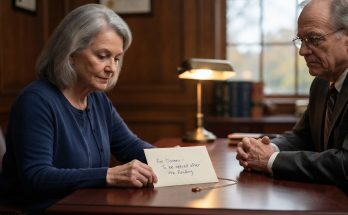
He handed them two sealed envelopes—personal notes from Evelyn—and told them to read them outside.
My parents left without touching me.
Without reclaiming me.
Good.
They didn’t own me anymore.
And I had paperwork to prove it.
After they were gone, the room felt strangely larger—and also heavier. Not because of my parents, but because now there was nothing between me and the reality of fourteen million dollars.
My lawyer and the estate attorney explained the trust: the house held inside it, conservative income distributions, protections so I wouldn’t become an ATM for opportunists. No rushed decisions. Just information.
And then my lawyer slid one more document forward.
A fund Evelyn had set up quietly—two million dollars—meant for kids who aged out of foster care or were kicked out by their families. Housing. Therapy. Scholarships. Legal help.
She’d made me the primary advisor.
Because she said I would understand.
A short letter followed. Simple. Direct. Evelyn’s voice on paper.
Money could repeat the patterns that broke us—or break them for someone else.
I left the building that day with grief in my chest and steadiness in my spine.
Three days later, my mother texted from an unknown number, calling it “cruel,” saying family was family, warning me my father wouldn’t let it go.
I forwarded everything to my lawyer. I didn’t answer.
Then I did what Evelyn taught me to do.
I corrected.
I met with shelters. Social workers. Underfunded programs. People who knew what it meant to be handed a suitcase and no plan. I started small—quiet grants, direct help, no plaques, no attention—just beds, counselors, bus passes, textbooks.
My parents kept trying for a while—blocked numbers, letters with no return address.
Then the messages slowed.
And one day, by accident, I ran into them in a grocery store. My father tried to demand respect. My mother tried to pull “family” out like a key that would open a door they’d already slammed.
I didn’t argue.
I didn’t explain.
I just said the truth:
They lost the right to claim me the night they left me on a porch.
And money didn’t make me superior.
Showing up did.
I walked away.
Two years later, I stood on a small stage at a community college under a banner that read Hart Outreach Foundation. Twenty students received full scholarships—tuition, books, living support—because someone believed they deserved more than survival.
A nervous nineteen-year-old asked what to do if his parents showed up again someday.
I told him what I’d learned the hard way:
“They might. Or they might not. Either way, they’re not in charge anymore. You are.”
Later, at home—my home—I sat on the porch with tea and listened to the quiet street.
That porch had once held a thirteen-year-old girl with a suitcase.
Now it held a woman with boundaries, a future, and a trust that couldn’t be touched.
My parents came looking for ownership.
They found consequences.
And the part they could never take wasn’t the money.
It was the response Evelyn taught me to choose.