I Flew Home For Thanksgiving And No One Showed Up. Not Even A Text. Two Days Later, Mom Said: ‘Your Sister’s Baby Shower Is $500 A Person — You’re Paying.’ I Sent Her 50 Cents With The Note: ‘Good Luck.’ That Night, I Closed Every Family Account — By Morning, My Brother Was Beating On My Door.
Part 1
Somewhere over Montana, wedged in the middle seat between a guy who smelled like beef jerky and a woman who kept sighing loudly at the seatback screen, I realized how pathetic my optimism looked from the outside.
Thirty-one years old, a tech job in Seattle, a decent apartment, a life I built from scratch—yet here I was flying home for Thanksgiving like a kid who still believed a holiday could reset a whole family’s operating system.
My name’s Logan Carter, and I hadn’t been back to my hometown in almost three years. Not because I hated it. Not because I forgot. Mostly because every time I tried, the details “shifted” without anyone thinking to tell me. The date changed. The plan changed. The location changed. And by the time I showed up with a suitcase and a hopeful expression, I was either early, late, or not on the list.
This year, I decided to remove every excuse.
Two weeks earlier, I texted my mom my flight number and arrival time. I even offered to pick up dessert. She replied with a thumbs-up emoji. Not a sentence. Not a “can’t wait.” Just that little yellow thumb, floating in digital silence like a shrug.
I should’ve taken it as a warning. Instead, I told myself it meant she was busy. Turkey. Gravy. Chaos. My mom had always made “busy” sound like proof of love.
When the plane landed, I called her. No answer.
I sent a text: Just landed. On my way.
Nothing.
I grabbed my rental car and started the hour drive from the airport. The roads were familiar in the way childhood nightmares are familiar—same curves, same pine trees, same gas stations with flickering signs. I stopped at a bakery outside town and bought a pumpkin pie because I didn’t want to arrive empty-handed. I wanted to contribute, to be useful, to give them no excuse to act like I was an outsider.
As I turned onto our old street, the air got heavier. The houses were smaller than I remembered, or maybe I was just bigger now. I pulled into the driveway of the faded beige two-story with the cracked mailbox that still read THE CARTERS in peeling black letters.
No cars.
No lights.
No smoke from the chimney.
No smell of turkey or cinnamon or anything remotely resembling a holiday.
I sat there with the pie on the passenger seat like a prop and stared at the dark windows. My chest did that slow, sinking thing it always did right before disappointment turned into humiliation.
I got out anyway. Walked up the porch steps. Rang the doorbell.
Nothing.
I knocked. Tried the handle. Locked.
I called again. Straight to voicemail.
“Hey, Mom,” I said, forcing a light tone that cracked halfway through. “It’s me. I’m here. Where is everyone?”
I hung up and stood on the porch in the cold, staring at my own reflection in the glass storm door. Thirty-one, and somehow still waiting to be welcomed.
I left the pie on the porch bench, because what else do you do when you’ve brought dessert to an empty house? Then I drove around the block like maybe I’d missed a parade of cars heading somewhere else. I checked the usual places—my aunt’s street, the grocery store, the church parking lot. Nothing.
Finally, I parked in a nearly empty lot behind a closed strip mall and sat there for almost an hour, scrolling through my phone like an idiot, refreshing messages that weren’t coming.
Nobody texted.
Nobody called.
The silence wasn’t just quiet. It was a choice.
At some point, I caved and called my sister, Jenna.
She picked up after two rings.
“Logan?” Her tone wasn’t annoyed. It was confused, like I’d dialed her by mistake.
“Yeah,” I said. “Where are you guys?”
A pause. In the background, I heard laughter. Plates clinking. The muffled sound of a TV playing football.
My stomach tightened.

“Thanksgiving,” I said carefully. “I’m at Mom’s house.”
“Oh,” Jenna said, like she’d forgotten I existed for a second and was now trying to place me. “We’re doing it at my place this year.”
“Did Mom tell you I was coming?” I asked.
Another pause. This one longer.
“I mean…” Jenna started, then sighed like she was dealing with a minor inconvenience. “We figured you probably wouldn’t come. You’re always busy. You’re always… Seattle.”
“I literally texted Mom the flight number,” I said, voice low.
“Well, it’s kind of late now,” she said. “We already ate.”
There are sentences that don’t sound dramatic until they land in your body.
We already ate.
It wasn’t just that they started without me. It was that no one thought to check. No one thought to ask, Hey, where’s Logan? No one thought I mattered enough to wait.
“You could’ve texted,” I said. “Just once.”
Jenna made a small, impatient noise. “Logan, don’t make this a big thing. It’s Thanksgiving. Don’t be weird.”
Don’t be weird. Like expecting basic communication was a personality flaw.
“Okay,” I said, because if I said anything else, I was going to say too much.
I hung up before she could end the call on her own terms.
That night, I checked into a cheap motel off the highway. The room smelled like old carpet and lemon cleaner. I ate vending machine crackers for dinner and watched a sitcom rerun I didn’t like because the laugh track made the silence less sharp.
The next day passed. Then the next.
No one called.
Not my mom.
Not my dad.
Not Jenna.
Not my brother, Mason.
I kept telling myself it didn’t matter. That I was an adult. That I could leave town and never come back. But the truth was uglier: it wasn’t about a holiday dinner. It was about being forgotten. It was about realizing I wasn’t a person in their lives, just a role they assigned when it benefited them.
On the third morning, my phone buzzed.
Mom.
For a second, my heart did something stupid—hope.
I opened the text.
Hey sweetie. Quick question. Jenna’s baby shower is next month. It’s $500 a person for the venue, catering, and decorations. You’re paying, right?
I stared at the screen until the letters blurred.
No sorry.
No explanation.
No how are you.
Just a bill, delivered like an afterthought.
And something in me—something that had been bending for years—finally snapped into a straight line.
Part 2
I laughed out loud. Not the fun kind. The kind that sounds like you’ve lost your grip on reality, because reality just slapped you in the face and then asked for your credit card.
I typed back: $1500 for what? A royal wedding?
Mom replied instantly: Don’t start. It’s your sister’s special day. Everyone’s contributing. Family supports family, Logan.
Family supports family.
That phrase was my mother’s Swiss Army knife. She used it for everything.
When I was seventeen and working evenings at a grocery store, she used it to “borrow” my savings because the water heater broke. When I was twenty-one, she used it to guilt me into co-signing a “temporary” credit card for household expenses. When I was twenty-four, she used it to pressure me into wiring money for their mortgage because Dad’s bonus was “late.”
Family supports family always meant: you give, we take.
And somehow, I’d spent my entire adult life trying to earn the part of the phrase that never came: we support you, too.
I opened my banking app.
I could’ve sent nothing. I could’ve written a long message about how being excluded from Thanksgiving and then invoiced for a baby shower was psychotic behavior. I could’ve called and screamed.
Instead, I sent her fifty cents.
Not fifty dollars. Not five. Fifty cents.
In the note field, I typed: Good luck.
Then I set my phone face-down on the motel bed like it was a live animal.
Two hours later, my screen lit up like a slot machine.
Mom calling.
Jenna calling.
Mason calling.
A group text titled Family 
Messages poured in.
Are you serious right now?
Don’t be petty, Logan.
Mom’s crying.
You’re embarrassing us.
What’s wrong with you?
You’ve changed.
The funniest part was that no one asked why. Not really. No one said, Hey, we messed up Thanksgiving. No one said, Are you okay? They went straight to outrage, like my job in the family was to fund the machine and not ask questions.
I muted the group chat and went for a walk.
The air was cold and sharp. The sky was the flat gray color of a TV screen on standby. I walked past chain restaurants and empty lots and thought about how far I’d flown just to be treated like an inconvenience.
That night, around eleven, an email from my bank popped up.
Unusual activity detected.
My stomach tightened as I logged in.
Someone had tried to access an old joint account—one I’d kept open “for emergencies.” It was technically in my name, but my mom still had authorization because years ago I’d believed her when she said it was safer “in case something happens.”
There were pending transfers—small amounts at first, like someone testing the water.
Then another notification: a shared family card attempt.
Mason had tried to charge $700 for something labeled BABY SHWR DEPOSIT.
I sat on the edge of the motel bed and stared at the screen until my eyes burned.
That was the moment it hit me: they weren’t asking anymore. They were taking. Quietly. Confidently. Like they assumed access to me was permanent.
Something in my chest went cold—not rage, exactly. Clarity.
I opened every financial account that had even a dusty thread connecting me to them.
The joint savings: closed.
The “emergency” checking: closed.
The shared family card: canceled.
The streaming subscriptions I’d been paying for since college because “it’s easier if you just keep it on your card”: canceled.
The phone plan add-on I’d covered when Mason “forgot” to pay: removed.
I changed passwords. Updated security questions. Turned on two-factor authentication everywhere. Replaced my old security email with a new one. Requested new cards. Locked down access like my life depended on it, because apparently it did.
By the time I finished, my hands were steady.
That surprised me.
I’d always imagined this kind of moment would be dramatic—tears, shaking, a big speech. Instead, it felt like cleaning a wound. Painful, necessary, finally.
I turned off my phone and slept better than I had in months.
The next morning, pounding hit my door hard enough to rattle the cheap wall art.
Not a knock.
A beating.
“Logan!” a voice barked. “Open the door right now!”
Mason.
I froze, barefoot on the motel carpet, staring at the door like it might start bleeding.
He wasn’t supposed to know where I was. Then my brain caught up: the family group chat.
I’d left location sharing on months ago because Mom liked to “know everyone’s safe.” I’d muted the chat, not left it. I’d basically handed them a tracking device.
Mason slammed his fist again.
“I know you’re in there!”
I took a slow breath. My heart thumped hard, but my mind stayed strangely clear.
This wasn’t a family argument anymore.
This was about control.
And I had just taken it away from them.
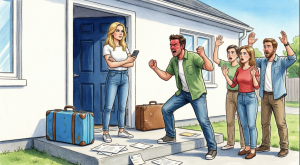
I opened the door a few inches, keeping the chain on.
Mason stood there in a worn leather jacket, jaw clenched, eyes bright with anger that looked more like panic.
“You serious?” he snapped. “You froze Mom’s card. She couldn’t even pay for gas.”
“That’s not her card,” I said quietly. “It’s mine.”
Mason scoffed. “We’re family.”
“Exactly,” I said. “And you just tried to spend seven hundred dollars on a baby shower deposit without asking me.”
His face twisted. “It was for Jenna. She’s pregnant. Mom’s stressed. You humiliated her with that fifty-cent thing. She cried all night.”
I stared at him.
“You know what I did the last two nights?” I asked.
He blinked, thrown off.
“I sat alone in a motel room,” I said, “because you all had Thanksgiving without me and didn’t bother to send a text.”
Mason’s mouth opened, then closed.
“That was a miscommunication,” he said, defaulting to the family script.
“No,” I replied. “That was a message.”
He leaned in, voice low and sharp. “You think you can just cut us off? You owe us an explanation.”
I felt something solid settle in my chest.
“I don’t owe you access,” I said. “I don’t owe you money. And I don’t owe you the version of me that keeps saying yes because I’m afraid of being the bad guy.”
Mason’s eyes narrowed. “You’ve always thought you’re better than us.”
That one stung, because it was the lie they used to explain my boundaries.
I didn’t answer. I didn’t have to.
Mason stared at me a beat longer, then backed away, shaking his head like I was the unreasonable one.
“This isn’t over,” he muttered.
He walked off down the motel walkway, and I closed the door, slid the chain into place, and leaned my forehead against the wood.
My hands were shaking.
But I wasn’t shaking from fear.
I was shaking from the realization that I’d finally stopped participating in my own exploitation.
Part 3
Later that afternoon, my phone buzzed again. I didn’t need to look to know it was my mom. When I finally did, there were voicemails stacked like bricks.
I listened to the first one.
“Logan,” Mom said, voice tight and trembly in the way she used when she wanted to sound wounded and righteous at the same time. “I don’t know what’s gotten into you, but you can’t do this. Family doesn’t punish family. Call me back.”
Punish.
As if I’d been handed a choice between being used or being loving, and I was cruel for stepping off the treadmill.
The second voicemail was Jenna. Her voice had that sing-song edge, the one she used when she wanted to sound calm while poking a bruise.
“I don’t know why you’re acting like this,” she said. “It’s literally a baby shower. And you know Mom’s been working so hard. Don’t make this about you.”
Don’t make this about you.
Because nothing was ever about me unless they needed something from me.
Then there was Mason again, shorter, angrier: “Dude, fix this.”
I didn’t respond. I drove into town for coffee, because I needed to be around humans who didn’t share my last name.
At the coffee shop, I saw Jenna’s latest Facebook post. A photo of her holding her baby bump, surrounded by pastel balloons and cupcakes, captioned: Can’t wait for my special day. Family means everything.
Below it, Mom commented: So proud of my beautiful daughter. Some people forget where they came from.
Some people.
Aimed like a dart. Sugar-coated. Public.
My mother’s manipulation was rarely loud. It was quiet and strategic, delivered in phrases designed to make you sound insane if you called them out.
I tried calling Dad that night. He answered after a few rings, voice tired.
“Hey, son,” he said.
“Hey,” I replied, swallowing the lump in my throat. “I’m trying to understand what’s happening. Why is everyone acting like I committed a crime because I’m not paying for a baby shower?”
Dad sighed. “You know how your mom is. She just wants everything perfect for Jenna.”
“And Thanksgiving?” I asked. “Nobody even told me dinner wasn’t at the house.”
A pause. Long enough to feel like a confession.
“That was… a miscommunication,” Dad said softly.
“Dad,” I said, voice tight. “I sat outside an empty house for an hour.”
“I told your mother to call you,” he murmured, like that absolved him.
“So it’s my fault again,” I said, the words tasting bitter.
“No, I didn’t say that,” he replied quickly, but he didn’t offer anything else either. No apology. No anger at Mom. No concern for me. Just the usual: keep the peace.
My dad had spent his whole life believing that avoiding conflict was the same as solving it. It wasn’t. It just handed the steering wheel to whoever was willing to drive recklessly.
Before we hung up, he said, “Just talk to your mother, okay? She loves you.”
I stared at the motel wall after the call ended, feeling like I’d been told to apologize for having feelings.
The next morning, Mom texted: We’re coming over to talk this out.
I didn’t reply.
Three hours later, there was a knock. Softer than Mason’s pounding, but heavier somehow. The kind of knock that assumes it has the right to be answered.
I opened the door.
Mom stood in the motel hallway wearing her “pleasant” face—neat hair, careful makeup, perfume that smelled like my childhood. Behind her was Jenna in a white coat, one hand resting dramatically on her belly like she was performing pregnancy for an audience.
“Hi, sweetheart,” Mom said, smiling.
“Mom,” I replied flatly.
“Can we come in?” she asked, already stepping forward.
I let them in because I didn’t want a scene in the hallway, and because part of me wanted to look at them without a screen between us, to see if they had any shame.
Mom scanned the room like it offended her. “You’re still staying here?” she said. “I thought you’d pick somewhere nicer.”
“I’m not here for vacation,” I said.
Mom set her purse down and folded her arms. “Logan, this has gone too far. I don’t know what’s gotten into you, but you can’t just cut off the family.”
“I didn’t cut you off,” I said. “I cut off access to my accounts.”
Jenna rolled her eyes. “Oh my God. You act like we’re stealing.”
“You were,” I said, meeting her gaze. “The card was for emergencies. Not baby showers. Not gas. Not deposits you didn’t even ask me about.”
Mom’s smile faltered for half a second. Then she leaned into the script. “We’re family. Family shares.”
“Then why didn’t family share Thanksgiving with me?” I asked.
The room went still.
Jenna scoffed. “You’re so dramatic. You’re mad you weren’t the center of attention.”
I felt my jaw tighten. “I flew across the country. I told Mom I was coming. Nobody texted me. Nobody answered the phone. And then you all asked me for money like nothing happened.”
Mom’s eyes hardened. “Logan, you make everything about money.”
I stared at her, stunned by the audacity.
“You’re right,” I said quietly. “Because money is the only way you acknowledge me.”
Mom exhaled, voice sharp. “Don’t be cruel. Your sister’s been through enough.”
“Enough what?” I asked. “Enough not getting the exact party she wants unless I pay for it?”
Jenna’s cheeks flushed. “You don’t understand,” she snapped. “Pregnancy is stressful.”
“And being treated like a walking ATM isn’t?” I replied.
Mom stepped closer, lowering her voice like she was being reasonable. “Just send the money and we’ll forget this happened.”
I laughed—short, dry, humorless. “You really think that’s how this works.”
Mom’s expression flickered—something like guilt, maybe, or fear that she was losing control. But it vanished quickly.
“You always overthink,” she said. “You always twist things. You were such a sweet boy. I don’t know what Seattle did to you.”
There it was—the implication that my independence was corruption.
“I’m not twisting anything,” I said. “I’m seeing it clearly.”
Mom snapped her purse shut. “Fine,” she said, voice icy. “Remember this, Logan: family always comes first.”
She said it like a threat.
Then she walked out. Jenna followed, casting one last look over her shoulder like I was a disappointing employee.
The door clicked shut, and the motel room felt suddenly quiet again.
I thought that was the end.
It wasn’t.
That night, I got a text from an unknown number. A photo of my childhood home, lights blazing inside. The caption read: You’ll regret what you did today.
I stared at it, pulse steadying into something cold.
I zoomed in. The angle looked like it was taken from across the street—exactly where Mason used to park. The timestamp matched a time when I knew he’d be home.
It wasn’t a random threat.
It was family—using intimidation the moment guilt stopped working.
I barely slept. And in the morning, my bank app greeted me with a message that made my stomach drop:
Your access is temporarily restricted due to suspicious activity.
The representative confirmed it: multiple failed login attempts from my hometown. Different devices.
Someone was trying to break into my accounts.
A line I’d assumed they wouldn’t cross had been crossed without hesitation.
And just like that, the story stopped being about hurt feelings.
It became about survival.
Part 4
I called Dad again. He picked up, and before I could speak, I heard Mom in the background, sharp and impatient.
“Logan?” Dad said cautiously. “What’s going on with the accounts?”
“My accounts?” I repeated. “Someone tried to log into them from your house.”
A pause. Then Dad exhaled like he was bracing for impact.
“Your mother said… she just needed to check something.”
My grip tightened on the phone. “Check what?”
Dad hesitated, and I could hear Mom’s voice rising, closer now.
“Give me the phone,” she snapped.
Dad murmured something I couldn’t make out. Then Mom was on, her tone forced calm.
“Logan,” she said. “Don’t be dramatic. We just needed to check something because your sister is struggling and you’re sitting on money doing nothing.”
My vision narrowed. “You tried to log into my accounts.”
“It’s not stealing when it’s family,” she said, like it was a rule of nature.
That sentence did something final inside me. Like a door locking.
“Yes,” I said quietly. “It is.”
I hung up.
I didn’t argue. I didn’t plead. I didn’t explain. Because explanations were oxygen to her. She’d twist them into guilt and use them to pull me back.
Instead, I started documenting everything.
Screenshots of texts. Bank notifications. Dates and times. The invoice from the baby shower company that showed up in my email later that day—a local event planner had sent me a bill under my name because Mom told them I’d pay.
She’d put my name on a contract.
Not metaphorically.
Literally.
I called the company and told them, in a voice so calm it surprised me, that my mother had committed fraud and they needed to pause all processing immediately. The woman on the phone sounded startled, then nervous, then apologetic. She promised to freeze the contract until there was “clarification.”
I didn’t want clarification. I wanted proof.
I forwarded everything to my friend Adam, a lawyer from college who’d once told me, half joking, that I had “lawsuit energy” because of how patient I was until I wasn’t.
Adam called me back within an hour.
“Logan,” he said slowly, “are you telling me your own mother tried to open accounts in your name and access your finances?”
“Yes,” I replied.
“Then stop treating this like family drama,” he said. “This is identity theft. You need a paper trail. You need to protect yourself.”
Hearing the phrase identity theft out loud made it real in a new way. Not just toxic. Not just unfair. Criminal.
That night, I drove back toward my childhood neighborhood—not to confront them, but to look at the house one last time and remind myself why I’d left. I parked a few houses down and watched the living room window. Mom paced. Jenna sat on the couch. Mason stood with his arms crossed like a bodyguard.
A family meeting, probably about me.
My phone buzzed. Mom calling. Then Jenna texting: Come talk like an adult.
The same people who couldn’t text me the Thanksgiving location now wanted an “adult conversation.”
I drove away.
Two days later, I flew back to Seattle early. I didn’t tell anyone. I just left, like my presence in my hometown had become a liability.
When I got home, I made the security moves Adam recommended like I was following a checklist in a disaster manual.
Credit freeze with all three bureaus.
Fraud alert.
New passwords everywhere.
Two-factor authentication on everything.
Bank accounts moved to new numbers.
Old email addresses updated.
Location sharing turned off and removed from every family group.
Then I did the emotional move that took more courage than any financial one: I stopped checking their messages. I stopped reading their posts. I stopped trying to understand why.
Because understanding was another form of bargaining—another attempt to make their behavior make sense so I could blame myself less.
A week later, Mason showed up at my apartment building in Seattle.
I saw him through the peephole—same leather jacket, eyes bloodshot, jaw tight. He pounded on the door like the hallway belonged to him.
“Open up!” he shouted. “We need to talk!”
I didn’t move.
“You didn’t have to make it legal!” he yelled. “Mom says you’re trying to ruin everything!”
I cracked the door just enough to speak through the chain. “Why are you here?”
Mason’s eyes darted, and for the first time I saw something beneath the anger: fear.
“She’s talking to a lawyer,” he said quickly. “About the house. About repayment. She thinks you owe her for college.”
I stared at him. “Repayment?”
Mason rubbed his face. “She’s serious, dude. And… check your credit.”
Then he turned and walked away like he’d delivered a weather report.
My pulse spiked as I logged into my credit monitoring.
Two new inquiries.
A department store card application.
A personal loan application.
Both from my hometown.
Both in the last forty-eight hours.
I sat down hard on the couch, feeling the world tilt. My mother wasn’t just mad. She was escalating. She was trying to punish me by digging into the one thing adults are terrified of losing: financial identity.
That was the moment I stopped seeing her as someone I needed to appease.
I saw her as someone I needed to stop.
I called Adam and told him everything.
He was quiet for a long moment, then said, “Okay. No more courtesy. We’re going to build a wall.”
I swallowed, staring at the city skyline outside my window, feeling something settle into place.
I wasn’t going to win my family back.
But I could win my life.
Part 5
Adam had me do three things immediately.
First: file official reports. Not just with my bank, but with the FTC identity theft system, and a local police report in Seattle to document that fraudulent attempts were being made across state lines. Even if nothing came of it, the paperwork would exist. A trail my mother couldn’t erase with a tearful phone call.
Second: send a certified cease-and-desist letter to my mother. Not an emotional plea. Not a negotiation. A formal notice that any further use of my personal information would be treated as fraud and reported.
Third: stop engaging.
“That’s the hard part,” Adam said. “Because engagement gives them fuel. Silence starves them.”
So I went silent.
I didn’t reply to my mom’s texts.
I didn’t reply to Jenna’s messages that swung between “we miss you” and “you’re evil.”
I didn’t take Mason’s calls when he tried again, suddenly calmer, suddenly “let’s be reasonable.”
I didn’t even call Dad back when he left a voicemail that sounded like he was reading from a script.
I focused on work. I focused on sleep. I focused on breathing without that constant background fear of what fresh chaos my family was manufacturing.
For a few weeks, the silence held. Then the backlash started.
Mom posted on Facebook about “ungrateful children” and “how some sons abandon their mothers.” She didn’t name me, but she didn’t have to. Jenna reposted it with crying emojis and captions about betrayal. Mason commented something about loyalty. Friends of my mom—women I remembered from church who used to pinch my cheek—added comments about how “kids these days” forget sacrifice.
It was a public performance designed to shame me back into place.
Years ago, it would’ve worked. I would’ve rushed to fix it, to explain, to prove I wasn’t the villain.
Now, I just watched it like it was a documentary about someone else’s life.
A month later, the event venue emailed me again—another invoice, another attempt to list me as payer. This time, they attached the form my mother filled out. Her signature. My name typed into the “financial contact” line.
I forwarded it to Adam.
He wrote back: This is gold.
That scared me at first—the idea of using my mother’s wrongdoing as “gold.” But Adam wasn’t celebrating. He was being practical. Proof meant protection.
Then came the baby shower.
Jenna’s “$500 per person” event was scheduled for the first Saturday in January. I didn’t go. Obviously. I didn’t send a gift. I didn’t even look at the photos.
But my coworker, Kira—who had been quietly watching me struggle through the holidays—brought me coffee one morning and said, “You want to come to my Friendsgiving next year. No strings. Just food.”
I blinked at her, startled by the simplicity.
“Yeah,” I said, voice rough. “I’d like that.”
That was the first time it occurred to me that family wasn’t just genetics. Family could be people who didn’t invoice you for love.
Meanwhile, my mother was dealing with consequences she hadn’t anticipated.
Banks don’t care about family titles. They care about patterns.
Once my accounts flagged fraud from her location, more flags followed. The loan applications in my name triggered internal monitoring. One of the institutions reported suspicious activity to a state fraud unit. Because the attempts were repeated, because they were documented, because there was a trail.
Adam called me one afternoon.
“Your mother might get contacted by investigators,” he said. “Not because you pressed charges directly, but because the system is doing what it does.”
I felt something strange in my chest. Not joy. Not revenge. Just inevitability.
“She’ll blame me,” I said.
“Of course she will,” Adam replied. “But that doesn’t make it your fault.”
In early February, Dad called.
I almost didn’t answer. But something in me—some lingering loyalty to the only person in that house who ever sounded human—made me pick up.
“Hey, son,” Dad said. His voice sounded older than it had a month earlier. “Your mom’s… in trouble.”
I exhaled slowly. “What kind of trouble?”
“They’re asking questions,” he said, and I could hear panic behind the words. “About the credit attempts. About… your information.”
“Dad,” I said quietly, “you know she did it.”
Silence on the line.
Then, softer: “I know.”
That single word hit harder than any of Mom’s rage. Because it meant my dad had known, on some level, for years. He’d just chosen peace over truth.
“She wants me to call you,” he continued. “She says you can fix it. Tell them it was a misunderstanding.”
I laughed once, bitter and short. “A misunderstanding is forgetting the time of dinner. This is fraud.”
“She’s your mother,” Dad whispered.
“And I’m her son,” I replied. “Not her shield.”
When we hung up, I sat at my desk and stared at my hands. For the first time, I felt the full grief of it—not the anger, not the shock, but grief for the relationship I’d wanted and never had.
I took a day off work and did something I’d avoided for years: I booked a therapy appointment.
The therapist, a calm woman with kind eyes, listened to me describe my family like I was reciting weather damage.
She nodded once and said, “It sounds like you were raised to believe love is something you earn with sacrifice.”
My throat tightened.
“Yeah,” I said. “And I’m tired.”
She leaned forward slightly. “Then you’re allowed to stop. Even if they call it selfish.”
It was the first time anyone had given me permission I didn’t have to pay for.
And slowly, in the weeks that followed, the wall Adam helped me build on paper became something else too.
A boundary inside my chest.
A line I could feel.
A line I wouldn’t let anyone cross again.
Part 6
The official fallout arrived in March.
Not a dramatic arrest. Not flashing lights. Just a certified letter addressed to my parents’ house, then another one forwarded to me by Dad in a shaky email.
State Attorney General’s Office. Financial Crimes Unit.
Request for information.
My mother, who had always treated rules like suggestions when they didn’t benefit her, was being forced to answer questions by people who didn’t care how stressed Jenna was or how unfair life felt or how much Mom “deserved” for raising children.
Jenna reacted the way Jenna always did—by making it about herself.
She posted a teary video online about “family betrayal” and “how hard motherhood is” and “how people judge without understanding.” But the comments weren’t sympathetic this time. Too many people had seen the pattern. Too many were tired of watching entitlement dressed up as victimhood.
Mason reacted with anger, then panic. He started calling me again, leaving voicemails that jumped from threats to pleading.
“Dude,” one message said, voice shaking, “Mom’s freaking out. She says she might lose the house. Are you happy?”
Happy.
As if I’d ever wanted any of this.
Dad called once more, late at night.
“She’s not sleeping,” he said. “She’s saying you did this on purpose.”
I stared at my ceiling, exhaustion heavy in my bones. “Dad, she did this on purpose.”
Silence again.
Then Dad whispered, “I know.”
That second admission should’ve felt validating. Instead, it made me sadder. Because if Dad knew, then Dad had spent years watching Mom drain me and doing nothing.
“Why didn’t you stop her?” I asked, voice quiet.
Dad swallowed audibly. “Because every time I tried, it got worse. And I thought… if we just kept things calm, it would pass.”
“But it never passed,” I said.
“No,” he replied. “It just moved to you.”
That was the closest my father had ever come to an apology.
Two weeks later, a letter arrived from my mother’s attorney.
It was formal and cold, full of phrases like we dispute and without admission of wrongdoing. At the end, it requested that I “cooperate” by telling investigators that any access attempts were “family misunderstandings.”
I forwarded it to Adam.
Adam replied with two words: Absolutely not.
He drafted my response. I signed it.
It stated, plainly, that I did not authorize any use of my information, that I considered the actions fraudulent, and that I had no intention of lying to investigators.
Then Adam called me.
“You need to be ready,” he said. “When people lose control, they escalate.”
He wasn’t wrong.
A week later, I got a message from an unknown number: You’re going to regret this.
Different wording, same playbook.
Only now, it didn’t scare me.
I responded with a single sentence Adam approved: Do not contact me again. Further harassment will be reported.
Then I blocked it.
For the first time, I saw the situation clearly: my family didn’t know how to relate to me without leverage. Without money, without guilt, without fear.
So I removed leverage.
I changed my phone number again. Only a handful of friends and work contacts got the new one. Adam had it. My therapist had it. My boss had it. My family did not.
I also did something I never thought I’d do: I wrote my father a letter.
Not an email. Not a text. A physical letter, slow and intentional.
I told him I loved him. I told him I wished he’d protected me. I told him I wouldn’t lie for Mom. I told him I was done being used. And I told him—this part took the most courage—that if he ever wanted a relationship with me that didn’t involve money or managing Mom’s emotions, he could reach out to Adam’s office for a mailing address. Not my number. Not my home.
A controlled channel.
A boundary.
I mailed it and felt my chest loosen, like I’d been holding my breath for years.
In April, the fraud investigation concluded with a plea agreement. Not prison. But penalties. Restitution. A record. And mandatory financial counseling. The house wasn’t seized, but the fines hit hard. The “perfect” life my mother curated through appearances suddenly had a cracked foundation.
Jenna’s baby shower debt, the one she’d tried to pin on me, collapsed. The venue canceled. Deposits were forfeited. Jenna exploded online, blaming me. Sponsors pulled away. People got tired of the drama.
Mason started working extra hours at an auto shop. Dad took on overtime shifts. My mother—who had never worked outside the home—started babysitting for neighbors to cover costs, and she hated every minute of it.
Through it all, I felt something unexpected: peace.
Not because they suffered. Not because I “won.” But because their chaos finally stopped reaching me.
I had closed every family account—financially and emotionally—and the world didn’t end.
It just got quieter.
And in that quiet, I started to hear my own life again.
Part 7
The first Thanksgiving after everything happened felt like walking up to an old scar and realizing it didn’t hurt when you pressed it anymore.
It was late November, Seattle damp and gray, the kind of weather that makes you grateful for indoor lights and warm food. My coworker Kira invited me to her Friendsgiving, and I said yes before my anxiety could talk me out of it.
I showed up with a pumpkin pie from a bakery near my apartment—some habits refuse to die quietly. The apartment was packed with people: coworkers, neighbors, a couple of friends-of-friends. Nobody asked me for money. Nobody made passive-aggressive jokes. Nobody treated my presence like a scheduling inconvenience.
They just handed me a drink and a plate and said, “We’re glad you’re here.”
That sentence hit me like a wave. Simple. Clean. No strings.
After dinner, Kira’s boyfriend turned on football, and people groaned and laughed, throwing popcorn at bad commercials. Someone started a heated debate about whether cranberry sauce should come from a can. It was chaotic in the best way: safe chaos, the kind that doesn’t leave bruises.
I stepped onto the balcony for air and found myself crying silently into the cold.
Kira came out a minute later, glanced at my face, and didn’t ask questions. She just leaned beside me and said, “Family stuff?”
“Yeah,” I admitted.
She nodded once. “Mine’s a mess too. Different flavor. Same damage.”
We stood there quietly, city lights glittering below, and for the first time in my life I understood something I’d never been taught: you don’t have to share blood to share understanding.
A week later, Adam emailed me an update: the investigation was officially closed. My mother’s plea deal was finalized. The restitution plan was in place. My credit remained frozen, my accounts secure.
He added one line: You’re safe now.
Safe.
I stared at the word and realized how long it had been since I’d felt it.
Then, in early December, Dad mailed me a letter through Adam’s office.
The handwriting was shaky, uneven, like his hands didn’t fully trust what he was doing.
Logan,
I don’t know how to fix this. I don’t even know how to talk about it. But I want to say I’m sorry I didn’t protect you. I told myself keeping the peace was the same as loving you. It wasn’t.
I’m not asking for money. I’m not asking you to talk to your mother. I just want you to know I miss you.
Love,
Dad
I read it three times.
My throat tightened so hard it hurt.
I didn’t write back immediately. I brought the letter to therapy instead.
My therapist read it quietly, then looked at me.
“What do you want?” she asked.
That question used to scare me, because wanting something felt selfish in my family.
Now, it felt like a doorway.
“I want my dad,” I said slowly. “But I don’t want the old cycle.”
She nodded. “Then you set terms.”
So I did.
Click Here to continuous Read Full Ending Story👉 PART2: Home, I Flew For Thanksgiving And No One Showed Up
Home, I Flew For Thanksgiving And No One Showed Up
Part 1 of 2