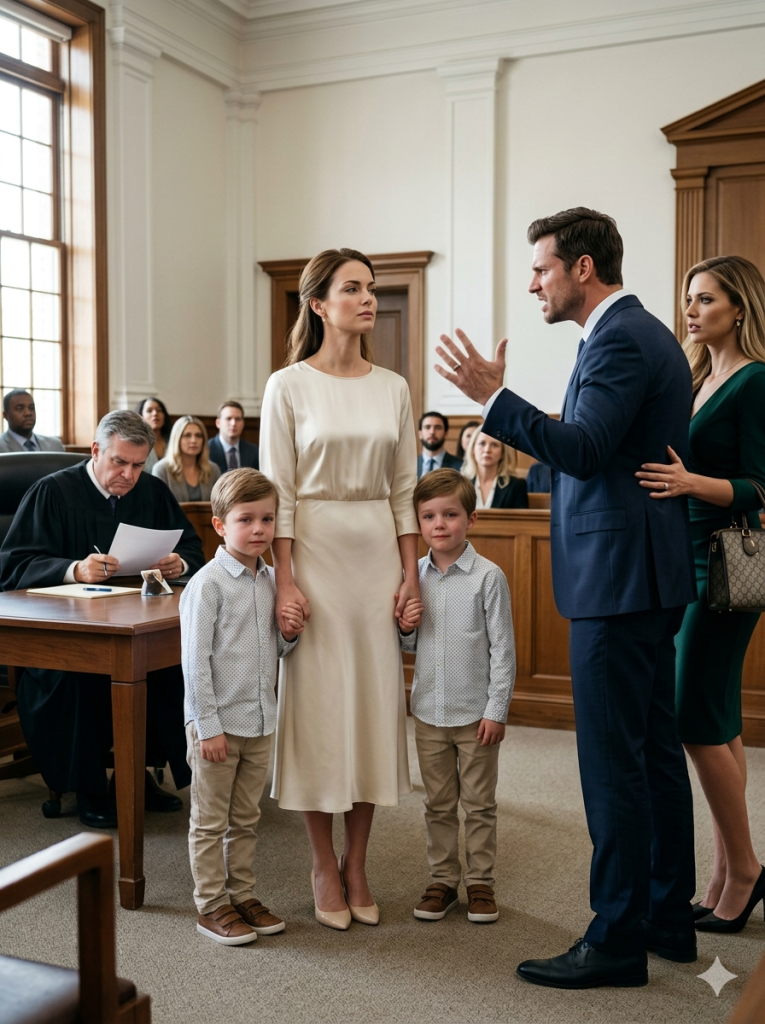
My dad smashed my jaw for talking back. Mom laughed, “That’s what you get for being useless.” Dad said, “Maybe now you’ll learn to keep that gutter mouth shut.”I smiled. They had no idea what was coming.
The sound of bone meeting bone is not a clean snap; it is a wet, heavy percussion that vibrates through the skull like a funeral bell. When my father’s fist—a gnarled, heavy thing forged by years of self-righteousness—connected with my jaw, the world didn’t just spin. It tilted on its axis, spilling me toward the cold, unforgiving porcelain of the Blackwood Manor kitchen floor.
The iron tang of blood bloomed across my tongue instantly. It was hot and salty, a visceral reminder of my own mortality. I landed hard, my palms sliding through a thin, crimson smear that was, only moments ago, inside of me. My ears rang with a high-pitched whine that drowned out the hum of the refrigerator, but it wasn’t loud enough to mask the sound that followed.
It wasn’t a gasp of horror. It wasn’t the frantic scuff of a mother’s shoes rushing to check her daughter’s pulse.
It was a laugh.
A sharp, brittle sound, like ice cracking under a winter boot. My mother, Lydia Thorne, stood by the marble island, her silk robe fluttering as she chuckled. She didn’t even look down at me as she stepped over my trembling form to reach for the kettle.
“That is precisely what you deserve for being utterly worthless, Elara,” she said, her voice devoid of heat, as if she were commenting on the weather. “Perhaps now you’ll finally learn your place in this house.”
All I had done—the grand “sin” that had earned me a dislocated jaw—was ask a question. I had looked out the window at the sprawling, overgrown backyard of our estate and then at my brother, Kyle, who was sprawled on the velvet sofa, his thumb rhythmically scrolling through a sea of mindless content.
“Why am I the only one cleaning the yard?” I had asked, my voice barely above a whisper. “Why can’t Kyle do anything?”
In the Thorne household, “why” was a declaration of war. My father, Arthur Thorne, a man who built his reputation on “traditional discipline” and “unyielding leadership,” had perceived my exhaustion as insurrection.
“Get up!” Arthur barked, his shadow looming over me like a thundercloud. “Or do you require a second lesson in humility?”
I tried to push myself up. My jaw throbbed with a rhythmic, pulsing agony that felt like a heartbeat in the wrong place. I couldn’t fully close my mouth; the alignment was gone.
“I’m… fine,” I managed to croak. Each syllable felt like a serrated blade scraping against my nerves.
“You’ll be fine when you learn to keep your mouth shut,” my father growled, adjusting his cufflinks. “Worthless people don’t get the luxury of a grievance. You are here to serve the bloodline that feeds you.”
Lydia poured her coffee, the steam rising in elegant curls. The smell of the dark roast mingled with the metallic scent of my blood. “Finish the yard before the sun hits its peak,” she commanded, her back still turned. “And for heaven’s sake, clean your face. I won’t have the neighbors thinking we live among savages.”
The irony was a bitter pill I couldn’t swallow. In this house, the savages wore silk and drank artisanal blends.
I dragged myself toward the back door, my legs feeling like lead. As I passed the living room, I saw Kyle. He was twenty-four, unemployed, and the “crown jewel” of the family. He looked up from his phone just long enough to offer a slow, jagged smirk. It was the look of a predator who knew he was protected by the alpha.
I stepped out into the humid morning air, the broom handle slick in my shaking hands. I looked at the reflection in the glass door—a twenty-six-year-old woman with a bruised face and hollow eyes. I was old enough to leave, but they had spent years ensuring I was too broken to fly. My savings had been drained to fund Kyle’s third “tech startup,” a venture that vanished into a cloud of expensive dinners and high-end watches. My car had “mysteriously” seized up the day of my last promotion interview.
They thought they had me caged. But as I swept the debris of their lives into neat little piles, a new sensation began to replace the pain. It was a cold, clinical clarity.
I wasn’t going to just leave. I was going to dismantle the cage while they were still inside it.
I looked at my father’s study window, and for the first time in my life, I wasn’t afraid. I was calculating.
By the following evening, the swelling in my face had turned a sickly shade of plum and mustard. I sat in the darkness of my room, pressing a frozen silver spoon against the hinge of my jaw. The house was quiet, save for the muffled sounds of a televised football game echoing from the den.
I reached deep into the back of my closet, pulling out a dusty, forgotten relic: an old cedar chest that had belonged to my grandmother. Inside, hidden beneath layers of moth-eaten blankets, sat my old high school laptop. It was slow, the screen flickered with a persistent green line, but it was my only tether to a world they didn’t control.
I opened a blank document. I didn’t write a diary. I didn’t write a suicide note. I wrote a ledger.
Phase One: Invisibility.
To catch a monster, you must first become the background noise of their lives. For the next three weeks, I became a ghost. I didn’t talk back. I didn’t ask questions. I didn’t even look them in the eye. I became the perfect, silent servant. I cooked Lydia’s poached eggs exactly to her liking; I polished Arthur’s shoes until they shone like mirrors; I even picked up Kyle’s discarded laundry without a single sigh of resentment.
They loved it. They took it as a sign that the “lesson” in the kitchen had finally broken my spirit.
“See?” Arthur remarked one evening over dinner, cutting into a rare steak. “A little firm guidance is all she needed. She’s finally contributing.”
“It’s about time,” Lydia added, sipping her Chardonnay. “She’s almost pleasant when she isn’t whining about her ‘potential.’”
I kept my head down, staring at my plate of plain rice. Let them believe it, I thought. Let them get comfortable in their cruelty.
But while my body was submissive, my mind was a sponge. I began to map the digital footprint of the Thorne family. I watched through the crack of the door as Arthur entered his passwords into his office computer—he was arrogant enough to use the same string of numbers for everything: Kyle’s birthday.
I waited for the moments of carelessness.
One afternoon, Lydia left her smartphone on the patio table to chase after a delivery driver. I didn’t hesitate. I had thirty seconds. I didn’t look at her photos or her social media. I went straight to her Notes app. There it was—a list of “Confidential Contacts” and login credentials for their shared investment accounts. I didn’t have time to copy them, so I used my old laptop’s camera to snap a grainy photo of the screen.
My heart hammered against my ribs like a trapped bird, but my hands remained steady.
As the days blurred into weeks, I discovered the true extent of the rot. Arthur wasn’t just a tough businessman; he was a scavenger. I found records of “consulting fees” that were nothing more than bribes. But the most damning discovery came from Kyle’s room.
I was “cleaning” his disaster of a bedroom when I found a discarded envelope from the St. Jude’s Children’s Foundation. It was a thank-you letter for a donation that had never arrived. Arthur had set up a charity gala in the name of a local child—a young boy named Leo who needed surgery to save his sight. The community had donated thousands.
According to the ledger I found hidden in Kyle’s nightstand, that money hadn’t gone to the hospital. It had gone into Kyle’s “Crypto-Venture” fund.
The cruelty of it made me feel physically ill. They were stealing the sight of a child to fund the delusions of a failure.
I closed the ledger and tucked it back into its hiding spot. The trap was set. Now, I just needed the stage.
The opportunity arrived in the form of an invitation embossed in gold. “The Thorne Legacy Launch.”
Kyle had convinced Arthur to host a massive event at the Grand Regency Ballroom to announce his new “Investment Firm.” It was a sham, of course. The firm was just a shell to launder more of the “charity” money they had siphoned. But to my parents, it was the social event of the decade. They had invited everyone—city council members, business rivals, the local press.
“You’ll be working the AV booth with the hired technicians,” Arthur told me two days before the event. “Since you’ve become so… efficient at following orders, I want someone I can trust to make sure the presentation goes off without a hitch. Don’t embarrass us.”
“I understand, Father,” I said, keeping my voice flat. “I’ll make sure it’s a night no one ever forgets.”
The night of the gala, Blackwood Manor was a hive of frantic activity. Lydia was draped in a gown that cost more than my college tuition. Arthur looked like a king in his tuxedo. And Kyle—Kyle was basking in the glow of a success he hadn’t earned, practicing his “visionary” speech in front of the mirror.
I dressed in a simple, high-necked black dress. I looked like a shadow. I looked like a ghost.
When we arrived at the Grand Regency, the air was thick with the scent of expensive perfume and even more expensive lies. I slipped away to the AV booth at the back of the darkened hall. The technicians were busy with the soundboard, leaving the main projector laptop unattended for several minutes.
It was all the time I needed.
I pulled a small, black USB drive from my clutch. On it was a file I had spent three weeks perfecting. It wasn’t just data; it was a narrative. It was the “Thorne Legacy,” stripped of its gold leaf and revealed for the rusted iron it truly was.
As the lights dimmed and the crowd fell silent, Arthur took the stage. He looked magnificent under the spotlights.
“Tonight,” he boomed, his voice echoing with practiced authority, “is not just about the launch of a company. It is about the continuation of a bloodline. It is about the values of hard work, integrity, and the strength to lead.”
Behind him, the massive screen flickered to life.
“My son, Kyle, represents the future,” Arthur continued. “A future built on a foundation of trust.”
I hit Enter.
The screen didn’t show the sleek, corporate logo Kyle had designed. Instead, a grainy, high-definition video filled the wall.
It was the kitchen. Three weeks ago.
The audio was crystal clear. The sound of the punch rang through the ballroom like a gunshot. The guests gasped in unison. On the screen, my father’s face was twisted in a snarl as he towered over my crumpled body.
“Worthless people don’t get the luxury of a grievance,” his recorded voice thundered through the professional sound system.
The crowd went deathly silent. I watched from the booth as Arthur froze, his hand still raised in a half-gesture of triumph. Lydia, sitting in the front row, went white as a sheet.
But I wasn’t finished.
The video faded, replaced by a series of documents. Bank statements highlighted in red. The St. Jude’s letter. A spreadsheet titled “Kyle’s Crypto – Charity Fund Diversion.”
A whisper began to ripple through the room—a low, angry tide of realization. One of the city’s largest donors to the charity, a woman known for her fierce protection of the community, stood up.
“Arthur?” she called out, her voice trembling with rage. “What is the meaning of this?”
Then came the final blow. I had recorded Kyle in his room, bragging on the phone to one of his friends. “The blind kid? Please. He won’t even know the money’s gone. Dad says the world belongs to those who take it. Besides, the kid’s already in the dark. What’s the difference?”
The sound of a hundred people exhaling in horror was the most beautiful music I had ever heard.
I stepped out of the booth and began walking toward the stage, the light catching the fading yellow bruise on my jaw.
The walk from the back of the ballroom to the stage felt like a mile, yet I moved with a lightness I hadn’t felt in a decade. Every head turned as I approached. The press, sensing a bloodbath, began snapping photos. The flashes were like strobe lights, illuminating the wreckage of the Thorne reputation.
I reached the stage and climbed the stairs. Arthur looked at me, his eyes wide with a mixture of shock and a primal, desperate fury. He took a step toward me, his hand beginning to rise—the same hand that had broken my jaw.
Click Here to continuous Read Full Ending Story👉 PART2: My dad smashed my jaw for talking back. Mom laughed, “That’s what you get for being useless.” Dad said, “Maybe now you’ll learn to keep that gutter mouth shut.”I smiled. They had no idea what was coming.
My dad smashed my jaw for talking back. Mom laughed, “That’s what you get for being useless.” Dad said, “Maybe now you’ll learn to keep that gutter mouth shut.”I smiled. They had no idea what was coming.
Part 1 of 2