Then Mark exhaled slowly, like he was letting out a breath he’d been holding for fifteen years with me.
“Oh, Emma,” he said. Not pitying. Not dramatic. Just… present. Like a hand on my shoulder.
“And she had twins,” I added, my anger flickering like a candle in a draft. “They want me at the hospital. I’m listed as her emergency contact, Mark. Me. After everything.”
“Okay,” Mark said simply. “Okay. Where are you?”
“At a listing,” I said, because my brain needed something practical to hold onto.
“I’m coming,” he said. “Stay put. I’m calling Elena.”
“No,” I blurted, too fast. I hated sounding needy. Neediness felt like childhood, like group-home hunger, like begging someone to remember you exist.
But Mark didn’t let me retreat.“Emma,” he said, calm but firm. “You don’t have to carry this alone.”
A minute later, my phone buzzed with Elena’s name on the screen. I answered before it could ring twice.
“Elena—”
“Oh, sweetheart,” she said, voice soft as a blanket but weighted like truth. “Mark told me. I’m so sorry.”
My eyes burned. I tried to swallow it down.
“I don’t know what to do,” I said. “I don’t even know what I feel. I’m angry. I’m… I don’t know.”
“You don’t have to know,” Elena said. “You just have to take the next step.”
“The next step is walking into a hospital and being handed the consequences of a woman who left me to rot,” I snapped.
Elena didn’t scold me. She didn’t tell me to calm down or be the bigger person. She understood anger the way good people do: as a cover that grief throws over you when it’s cold.
“I hear you,” she said. “And you’re allowed to feel every bit of that. But those babies didn’t do anything wrong. They didn’t abandon you. They didn’t choose her or her choices.”
I squeezed my eyes shut.
Elena continued, gently but without giving me any escape hatch.
“Go to the hospital. You don’t have to make decisions today. You don’t have to forgive anyone today. Just… go. Look at those boys. See what’s real.”
Mark’s voice returned, closer now, like he’d put the call on speaker while he grabbed his keys.
“You might find more than just answers,” he said quietly. “You might find… a chance to break something that’s been breaking in your family for a long time.”
Break the cycle.
My mother used to say that phrase in different words, without knowing it. Back when she still had enough breath to argue with life.
I sat on the staircase of the staged house, my back against the wall, my professional blazer suddenly too tight around my chest.
“Okay,” I said, because the only way through anything is forward, even if you’re dragging your heart behind you. “Okay. I’ll go.”
Fifteen Years Earlier
When people hear “my sister abandoned me,” they picture drama. A slammed door. A suitcase. A villain with perfect hair.
But abandonment, in my life, was mostly quieter than that. It was the slow realizing that someone had stopped reaching back for you. That the rope you were both holding had been let go on the other side, and you’d been falling ever since.
Rachel and I had never been easy sisters.
We were close in age, but not in temperament. Rachel was sharp, fast, and burning with a need to escape. I was stubborn in a quieter way, the kind of kid who dug in not because I loved the fight, but because I didn’t want to be moved.
We fought over everything.
Chores. Clothes. Who got the front seat of Mom’s dented sedan. Rachel had a talent for sarcasm that could slice through a room like a thrown knife, and I had a talent for refusing to bleed where she could see it.
Our mother, Julia, always tried to smooth the edges between us like they were just wrinkles that could be ironed out if she pressed hard enough.
“I don’t care how different you two are,” she’d say, usually through tired tears. “You’re sisters. You have to stick together. No matter what.”
She said it like it was a law of nature. Like sisterhood was gravity.
Then our dad left.
That’s the part people always ask about in a whisper, as if saying it too loudly will summon their own father’s shadow.
He didn’t die. He didn’t go to war. He didn’t even have the decency to make his departure dramatic.
He just… stopped coming home one night. His toothbrush disappeared. His side of the closet emptied. My mother’s face became something careful and haunted, like she was trying to live without breathing too hard.
Rachel took it personally, like Dad had left because she hadn’t been enough.
I took it personally, like Dad had left because I was too much.
Mom worked two jobs. The house became a place where exhaustion lived openly, sprawled across the furniture. Rachel counted the days until college like it was a prison sentence. I counted the days until Rachel would look at me without irritation like it was a prayer.
By the time Rachel left for college, I was still in high school. I remember watching her load her bags into a friend’s car, her eyes bright with that dangerous light of freedom.
I hated her for being able to leave.
And a part of me, shameful and small, felt relief.
The house was quiet without her, like the walls had stopped flinching.
I could breathe.
But the peace didn’t last. Because the universe has a cruel sense of timing.
Mom got sick.
Not the kind of sick you bounce back from. Not the kind where you keep a brave face and talk about “rest.”
The kind of sick that rearranges your life around hospital chairs and pill bottles.
There were tests. Scans. Words I didn’t understand at first. Then I understood them too well.
Rachel came home when Mom’s condition got worse, because Mom called her. Because Mom begged.
I remember one afternoon in the hospital, the light gray and thin, as if even the sun was afraid to get close. Mom lay in bed, pale, her hands like paper. Rachel stood beside her, arms crossed tight, her face held together by sheer will.
Mom reached out, fingers trembling, and grabbed Rachel’s wrist with surprising strength.
“If things don’t get better…” Mom whispered. “Please don’t leave Emma. She’ll end up in a group home. Promise me you’ll come back for her after you graduate.”
Rachel’s jaw tightened. Her eyes flicked toward me, standing awkwardly near the door, trying to take up as little space as possible.
Rachel didn’t answer out loud.
She didn’t promise.
But she didn’t pull her wrist away, either.
At the time, I clung to that like it meant something.
Mom died that winter.
We had a small funeral. The kind where people bring casseroles and say, “If you need anything…” and then disappear back into their own intact lives.
Rachel stayed long enough for the funeral. She stood rigid at the graveside, her hands clenched, staring at the dirt like it was insulting her.
Afterward, she hugged me for the first time in years.
It was brief. Awkward. Her arms felt like she didn’t quite remember how to use them.
Then she left.
“I’ll call,” she said, voice flat.
I watched her walk to the car, and my chest filled with a desperate hope so sharp it felt like glass.
She didn’t call.
Days turned to weeks. Weeks turned to months. The house wasn’t ours anymore. Bills went unpaid. There was no dad to return. There was no aunt to take me in. There was no grandmother with a spare room.
There was only paperwork and procedures and adults who looked at me like a sad file folder.
I ended up in a local shelter first, because it was “temporary.”
Temporary is what people say when they don’t want to admit they’re placing you somewhere you might never get out of.
I waited for Rachel.
I told myself she was grieving. That she needed time. That she’d come back when she finished school, like Mom asked.
On Rachel’s graduation day, I borrowed the shelter’s office phone and called the number I still had memorized.
She picked up.
There was a pause.
In that pause, I imagined everything: her crying, her apologizing, her saying she’d come get me.
Then she hung up.
No words. No explanation. Just the clean click of a line going dead.
That sound carved a canyon into my chest.
I never heard from her again.
People talk about abandonment like it’s being dropped.
For me, it was being erased.
The Group Home, and the Name That Changed
The group home wasn’t a Dickens novel. Nobody chained us to radiators. Nobody starved us on purpose.
It was worse in a quieter way.
It was fluorescent light and schedule charts and staff turnover. It was being told you were “resilient” as if resilience was a prize instead of a bruise. It was listening to other kids cry at night and learning not to cry with them because crying attracted attention, and attention always cost something.
My file still had my full name, and for reasons I never understood, one of the staff called me Linda. Maybe she read it wrong. Maybe she thought Linda sounded softer. Maybe she couldn’t pronounce Emma the way my mother did.
So there, in that place where I was trying to stay invisible, I became Linda.
And for a while, I let it happen, because fighting over a name felt like too much effort for a girl who already felt like she didn’t exist.
Linda learned the rules.
Don’t get attached to staff. They leave.
Don’t get attached to other kids. They get moved.
Don’t get your hopes up when someone says “maybe.”
Don’t ask “why” if you want to keep your heart intact.
But even invisible kids have breaking points.
Mine came the day a couple walked in with a social worker.
Mark was tall, quiet, with tired eyes that somehow still held humor. Elena was smaller, bright, the kind of woman who looked at you like you were the only person in the room.
They weren’t flashy. They didn’t bring balloons. They didn’t tell me they were there to “save” me.
They just sat down across from me at a worn table and asked, “Do you like art?” and “What’s your favorite food?” and “If you could have a dog, what would you name it?”
Normal questions. Human questions.
Elena told me later that when she first saw me, I was holding myself so carefully it looked like I was afraid my bones might rattle.
Mark didn’t try to crack me open with forced cheerfulness. He simply kept showing up.
Week after week.
He brought a small notebook and drew while we talked, quiet little sketches of whatever I mentioned. A shoe. A bird. A house.
Elena brought snacks and asked me about school and laughed at my jokes like they weren’t a surprise coming from a “group home kid.”
For the first time in a long time, I felt something dangerous: hope.
When the paperwork finally went through, and they told me I was going home with them, I didn’t cry.
I didn’t trust tears. Tears meant I cared, and caring had always been a trap.
But the moment Elena wrapped me in a hug, her cheek warm against my hair, I realized something.
I didn’t have to be Linda anymore.
“I’d like to be Emma,” I said quietly.
Elena smiled like it was the simplest thing in the world.
“Then you’re Emma,” she said. “Welcome home, sweetheart.”
Mark added, “We’re just a phone call away. Always.”
I didn’t believe them right away. I waited for the second shoe to drop, the way it always did.
But it didn’t.
They didn’t leave.
They were at my high school graduation, cheering louder than anyone. Mark clapped in that quiet way that still managed to feel like thunder. Elena cried openly and didn’t apologize for it.When I earned my real estate license later, Elena brought cupcakes to the office and made my coworkers take pictures with me like I was a celebrity.
“No matter what happens,” she’d say, “you’re part of our family now.”
And slowly, quietly, I built a life I was proud of.
I stayed in my hometown. I worked hard. I helped families find homes that fit their futures.
I built stability like a brick wall, one showing, one closing, one mortgage approval at a time.
And the whole time, Rachel stayed a ghost.
Back to the Hospital
Mark drove me to St. Mary’s because Elena insisted I shouldn’t be alone.
On the way, the sky looked bruised, winter light dim and heavy. The roads were wet from earlier rain. Everything outside the car felt muted, like the world had turned down its volume out of respect for what we were walking into.
I didn’t talk much. I kept seeing Rachel’s face as a teenager, sneering at me over the breakfast table, then I’d see her at Mom’s funeral, her eyes like locked doors.
“How could she list me?” I asked finally, voice raw. “Why now?”
Mark kept his eyes on the road.
“Sometimes people know exactly who they hurt,” he said. “And sometimes, when they’re scared, they reach for the person they should’ve been good to.”
“That doesn’t make it okay,” I snapped.
“No,” Mark agreed. “It doesn’t.”
Elena met us at the hospital entrance. She hugged me hard, like she could hold my pieces together through sheer will.
Inside, the hospital smelled like antiseptic and something faintly sweet, like baby powder trying to fight for space.
A nurse with kind eyes approached.
“Emma Sullivan?” she asked.
I nodded, my throat too tight to speak.
“I’m Nora,” she said. “I’m so sorry for your loss.”
Loss. Another polite word.
She led us down a hallway that seemed too bright, too normal. People passed carrying coffee, laughing softly. A janitor pushed a mop bucket. Life kept happening, indifferent.
Nora stopped outside a small room.
“They’re here,” she said gently. “You can take a moment before you go in.”
My feet wouldn’t move.
Elena touched my back.
“Just look,” she whispered. “Just see what’s real.”
I stepped inside.
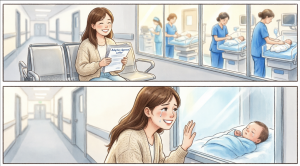
Two bassinets sat side by side. Two tiny bundles swaddled in pale blankets. Two faces so small they looked unfinished, like the world had barely had time to paint them.
They were sleeping.
Their mouths opened and closed in slow reflex. Their fists curled and uncurling like little sea creatures.
I stood frozen, my anger suddenly confused. Babies don’t look like revenge. They don’t look like consequence. They look like newness.
Nora’s voice floated from behind me.
“They’re healthy,” she said. “Strong little boys. We’re monitoring them, but they’re doing very well.”
I stared down at them, my chest aching in a way I couldn’t name.
One of them yawned, his face scrunching up in a tiny frown. The other made a small sound, like a kitten trying to meow.
My heart did something traitorous.
It softened.
Then Nora cleared her throat.
“There’s something else,” she said. “Your sister left a letter. She wrote it the day before she delivered. She asked that it be given to you.”
She handed me an envelope.
My name was written on the front in familiar handwriting.
Rachel’s handwriting.
The sight of it made my stomach drop. It was like seeing her reach out across fifteen years of silence.
My hands trembled as I opened it.
Mark and Elena stepped back, giving me space, but I could feel them near, like guardrails.
I unfolded the paper.
And I read.
Rachel’s Letter
“Emma,
I know it’s probably too late. Maybe you won’t even read this. But if you do, I need you to know… I’m sorry.
I’ve made more mistakes than I can count. And the biggest one was turning my back on you when you needed me most. I thought I was doing what was best for me, but now that I’m about to become a mother, I finally understand what Mom felt when she begged me not to leave you.
I feel it now. That fear, that guilt, that fierce need to protect.
I don’t expect forgiveness. But I’m asking you, begging you, to take care of my sons. Don’t let them be alone in the world. Please, Emma.
Love,
Rachel”
The words blurred.
My eyes filled so fast it felt like I’d been punched.
I sank into a chair in the hallway outside the nursery room, pressing the letter to my chest as if it could stop the tremor running through my body.
A strange sound came out of me, half laugh, half sob.
Rachel was sorry.
Rachel knew.
For fifteen years, I’d told myself she didn’t care. That she forgot me. That she erased me because I wasn’t worth the trouble.
But the letter proved something far worse and far more human.
She remembered.
She just chose herself anyway.
My world didn’t collapse because she apologized.
It collapsed because her apology meant she understood exactly what she’d done.
And still did it.
Mark crouched in front of me.
“Emma,” he said softly. “Breathe.”
I tried. It felt like inhaling broken glass.
Elena sat beside me, rubbing slow circles on my back the way she used to when I had nightmares as a teenager.
Nora returned after a few minutes, her expression careful.
“I can bring you your sister’s belongings,” she said. “Her bag and phone. If you want them.”
I hesitated, then nodded.
Part of me wanted answers like a starving person wants food.
When Nora returned with a small hospital bag and a phone in a clear plastic sleeve, I took them with hands that didn’t feel like mine.
I didn’t look at the bag first.
I looked at the phone.
Because phones tell the truth in a way people don’t. They keep the evidence of who we called and who didn’t call back.
I opened the call history.
And there it was.
Derek.
Over and over.
Missed calls. Unanswered texts.
The messages changed tone as the weeks progressed.
At first: Hey, I’ve been busy. We’ll talk later.
Then: Rachel, stop calling me like this.
Then: I can’t do this. I’m not ready.
Then: Don’t contact me again.
The last few were from Rachel, sent late at night.
Please. I’m scared.
I’m doing this alone.
You promised you wouldn’t leave.
Please, Derek. Please.
My stomach twisted.
Rachel had been abandoned.
Just like our mother had been.
Just like I had been.
The anger in me shifted, not disappearing, but changing shape. It became sharper, sadder, more complicated.
I looked back through the nursery window at the two tiny boys.
The cycle had found them already, trying to wrap itself around their ankles before they could even walk.
I sat with them for hours.
Not holding them at first. Just watching.
Listening to the small, rhythmic sounds of their breathing. Watching their chests rise and fall like quiet waves.
Finally, one began to fuss, his face wrinkling in newborn outrage.
Nora came in.
“Would you like to hold him?” she asked.
My arms felt suddenly inadequate. Like they weren’t built for something this delicate.
“I don’t know how,” I whispered.
Nora smiled gently. “Most people don’t at first.”
She placed the baby in my arms with practiced ease. His weight was so light, it barely registered, but the responsibility of him landed like a stone.
He quieted almost immediately, his tiny hand curling around my finger with surprising strength.
Something in my chest cracked.
I stared at his face, at the soft curve of his cheek, the faint crease above his brow.
Rachel’s baby.
My nephew.Family, whether I wanted it or not.
The other baby fussed too, and Nora placed him in Elena’s arms. Elena’s face transformed. She looked like she’d been waiting her whole life to hold a grief-born miracle and tell it, wordlessly, that it was safe.
Mark stood beside us, quiet. His eyes were shiny.
I swallowed hard.
“I can’t let them end up in a group home,” I whispered, not to anyone in particular, but to the part of me that still remembered being Linda.
Mark’s voice was steady. “Then don’t.”
I called Elena later that evening from the hospital cafeteria, even though she was sitting five feet away, because sometimes your heart needs to say something into a phone to believe it’s true.
“I don’t know what to do,” I admitted, voice breaking. “But when I look at them, I remember how it felt. Being left behind. Being alone.”
Elena’s eyes softened.
“Sounds to me like you already know what to do,” she said.
I stared at the babies through the nursery glass again, and the decision formed in me like sunrise: not sudden, but inevitable.
Before I left that night, I sent one message to Derek.
I didn’t know if he’d read it.
I didn’t care.
“You may never understand the damage you’ve done. But I hope someday you look for your sons and see what you gave up. I hope you ask for forgiveness before it’s too late.”
I hit send, hands shaking.
Then I went home to an apartment that suddenly felt too small, too quiet, too unprepared for two new lives.
And I stared at my living room like it was a problem to solve.
Because that’s what I did now.
I built homes.
Even when my own had been taken away.
Paperwork and Panic
The next morning, I returned to the hospital.
The social worker assigned to the case was named Denise. She was professional, polite, and very clearly exhausted in the way people get when they’ve seen too many children fall through too many cracks.
“I’m glad you came in,” she said, guiding me into a small office. “We need to talk about next steps.”
Next steps.
Those words again.
Denise explained the guardianship process like she’d done it a thousand times, which she probably had. Temporary custody, emergency placement, home evaluation, court date.
I nodded, absorbing it like it was a contract.
And then she looked at me over her glasses.
“Ms. Sullivan,” she said carefully. “Are you sure you want to do this? It’s a big commitment. They’re newborns. There are resources for placing them with a foster family immediately.”
The thought of two strangers carrying my nephews out of the hospital made bile rise in my throat.
A foster family might be kind. Might be safe.
Or it might not.
And even in the best scenario, those babies would still have to wonder why nobody from their own blood wanted them enough to stay.
I remembered the group home’s fluorescent lights.
I remembered being called Linda.
I remembered learning not to cry because nobody came when you did.
I lifted my chin.
“Yes,” I said. “I’m sure.”….
Click Here to continuous Read Full Ending Story : PART2: “Sister Estranged 15 Years. She Passed. I’m Only Family.”
“Sister Estranged 15 Years. She Passed. I’m Only Family.”
Part 1 of 2