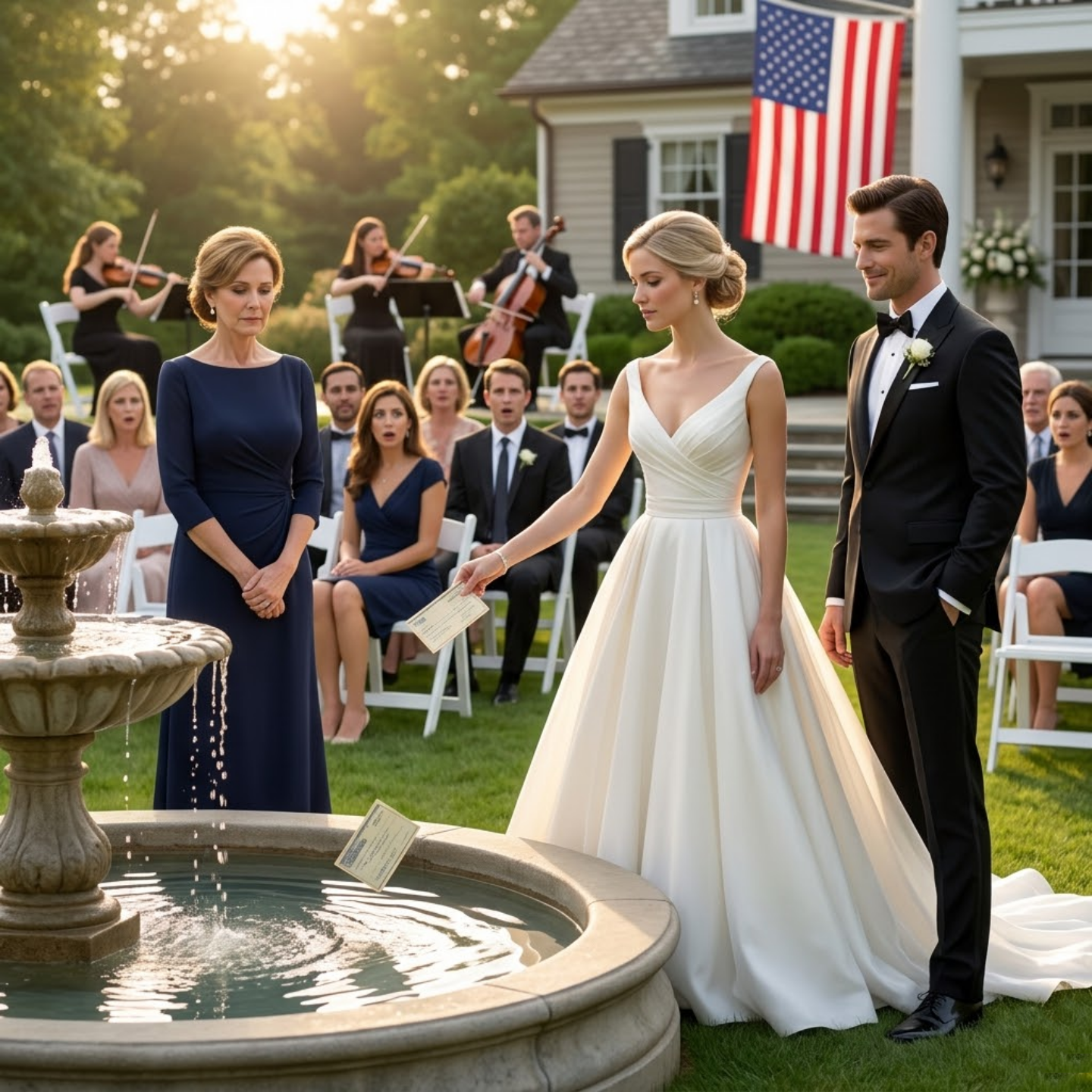
The fountain at the Sterling estate held the late-afternoon light the way only old money can, as if the sun itself had been invited in, seated, and instructed to flatter every surface it touched. Water lifted in clean silver arcs and fell back into a shallow basin of imported stone while waiters in white jackets drifted between tables with trays of champagne. Beyond the fountain, the lawn rolled away in a careful green sheet toward a line of old oaks, and under those trees two hundred guests moved in slow, polished currents, laughing, clinking glasses, leaning toward one another with the easy confidence of people who had never had to count the price of anything before saying yes to it.
My daughter looked beautiful that day. Lauren was my only child, and when she turned in her silk dress the fabric caught the breeze and shivered like water. She had her father’s eyes, though she never liked hearing that, and the kind of posture women learn after years of entering rooms that quietly rank everyone in them. Beside her stood Trevor Kingsley, her new husband, one hand resting at the small of her back, tie already loosened, grin easy, shoulders relaxed. He was speaking to a circle of men from his firm, finance men with sharp watches and louder laughter than the moment called for, carrying himself with the smug ease of a man who believed he had won something permanent.
I watched from the edge of the reception with my smile fixed in place, the way you learn to fix it after years of being the person nobody notices until something spills.
All afternoon I had been carrying a small package in my purse. Inside was an old savings book, the passbook I had fed for decades, one deposit at a time, one sacrifice at a time, one quiet decision after another. The leather was dark with age and softened at the edges by my own fingers. I had wrapped it in cream paper that morning and tied it with a ribbon the color of Lauren’s flowers. It looked plain compared with the crystal, the silk, the polished silver, but plain things have never frightened me. Plain things are often where life is really kept.
I waited until Lauren stood near the fountain without Trevor beside her. Then I crossed the lawn, careful in my good shoes, and held the package out with both hands.
“Lauren, honey,” I said. “I wanted to give you this.”
She turned, and before she smiled I saw it, that quick, involuntary flicker across her face. Not joy. Not surprise. Embarrassment. Her eyes moved past me at once, checking who might be looking.
“Mom. Hi.” She took the package, but delicately, almost defensively. “You didn’t have to.”
“I wanted to,” I said. “It’s something I’ve been saving for you.”
For one second I thought that might soften her. For one second I thought perhaps the old tenderness was still there somewhere under the polish and the careful distance and the years she had spent pretending my life was an inconvenient draft slipping under the door of hers. But before she could answer, another voice slid into the space between us.
“Oh, how lovely,” said Lillian Kingsley.
Trevor’s mother appeared the way perfume enters a room before the person wearing it. Pearls at her ears. A cream dress with a cut too clean to be accidental. A smile that had probably passed for grace in most rooms she entered, though up close it had edges. “What do we have here?”
Lauren hesitated. I saw her fingers tighten around the ribbon. She opened the package because she had to, because Lillian was watching, because weddings are performances long before they become marriages. The paper fell away. The old leather book lay in her hand.
Lillian gave one musical little laugh.
“A passbook,” she said. “How wonderfully vintage. I didn’t realize banks still issued these.”
Heat rose along Lauren’s cheekbones. Not for me. For herself. For being seen with me, with this, with anything that did not fit the glossy frame she had chosen for the day.
“Mom,” she said under her breath, urgent now. “Please. Not here.”
Before I could answer, Trevor crossed the lawn in three brisk strides, already smiling, already curious in the way people are when they smell material for a joke. He plucked the passbook from Lauren’s hand and flipped it open.
“What’s this, babe?” He glanced at the entries, then at me. “Mrs. Collins, this is sweet. Really. But we’re pretty digital these days.”
He held the book between two fingers as if it had come out of an attic trunk.
Then, with that slick half-smile men like him think passes for charm, he looked at Lauren and said, “Just spare change, right?”
There are moments in a life when time does not slow so much as spread itself thin. I remember the water in the fountain. I remember the smell of roses and cut grass and expensive wine. I remember hearing a burst of laughter from somewhere behind me, from people who had no idea they were standing near the edge of another person’s grief.
I also remember that I almost spoke. I almost told him what he was holding. I almost said those little stamped entries were not quaint relics, but thirty years of overtime, split shifts, cleaned toilets, skipped dinners, patched hems, turned-down invitations, and every other quiet refusal that lets a woman build something nobody bothers to imagine she is building. I almost said the old savings book had not been fed with spare change, but with the hours of a life.
But my daughter spoke first.
“Just spare change, Mom,” Lauren said, and her voice carried farther than she meant it to. “You really shouldn’t have.”
She held the passbook over the water.
For an instant, one thin and foolish instant, I thought she was handing it back.
Instead, she opened her fingers.
The book hit the surface with a splash too loud for a wedding full of string music and soft conversation. It bobbed once, pages already darkening, paper beginning to swell.
There was a hush, then the muffled release that follows a public cruelty people are trying to disguise as discomfort. A few nearby guests laughed. A few glanced away and then back again. Someone muttered something I did not catch, and more laughter rose in answer.
Trevor smirked. Not broadly. He did not need to. Lillian’s mouth curved in that polite, private way women like her weaponize contempt. Lauren had already turned half away, as if the worst thing happening in that moment was not what she had done, but the possibility that someone might remember she had done it.
I looked down at the fountain. Thirty years of my hands floated in champagne-tinted water.
Then I bent, slipped off my shoes, stepped into the June-cold basin, and reached in with my bare hand.
The water bit all the way up my legs. My dress clung at once. I felt the passbook under my fingers, heavy now, slick, alive with the damage that only paper can show so quickly. When I lifted it out, water streamed from the leather and dripped onto the pale stone around the fountain, a trail of dark marks on imported marble chosen, no doubt, because it photographed beautifully.
I climbed back out without hurrying. My shoes hung from one hand. The ruined book hung from the other.
No one stopped me. No one apologized. Most had already turned back to their glasses and their conversations about summer places on the Cape, private schools, market forecasts, and whether Vermont had become too crowded in the fall. A wedding is built to keep moving, no matter what human thing it has to glide over in order to do it.
I left a trail of water across the lawn and into the parking lot.
That night, in my studio apartment in Boston, I laid the passbook open on a dish towel by the sink and let the silence settle over the room. The radiator hissed once, then clicked. A siren moved somewhere far off and faded. Upstairs, my neighbors, travel nurses, both of them, came in after shift change, their footsteps crossing the floor above my ceiling with the tired rhythm of people who knew the cost of useful work.
I did not cry. I am not saying I did not want to. I am saying tears and I made our arrangements a long time ago. Working women do not always lose the habit of holding themselves together just because they finally get to sit down.
Instead, I went to the closet.
Behind old coats and a plastic tote of winter blankets, beneath a loose floorboard I had lifted so often over the years it rose almost willingly now, there was a small fireproof safe. I bought it in 1993 at a hardware store going out of business on Route 9. I still remember the handwritten sign in the window, EVERYTHING MUST GO, and how I stood there with two items in my hands, a broom set and the safe, and chose the safe because I already knew how to make a broom last.
I spun the dial. Lauren’s birthday. I had memorized that date the way some people memorize prayers.
The door opened.
Inside were the parts of my life my daughter had never asked to know.
Folders. Deeds. Stock certificates in old paper sleeves. Statements. Operating agreements. Insurance files. Tax records. Leases. Notes in my own hand clipped to corners and margins. I pulled out the real estate portfolio first. Forty-seven properties, alphabetical by street name, each one a line in a life built outside the field of vision of people who thought janitors went home at dawn and disappeared until they were needed again.
Current value, thirty-two million dollars.
People like to imagine wealth arrives with fanfare. In my experience, it arrives in overalls, with cracked knuckles and a notebook full of numbers.
It had started in 1994, when I was thirty-two, divorced, working nights downtown and raising Lauren on a janitor’s salary. I cleaned office buildings in the Financial District, and one winter I overheard two executives talking while I was waxing a hallway outside a conference room. They were discussing a foreclosed duplex in Dorchester. Forty-five thousand, one of them said. Total headache. The roof was bad, the second-floor pipes needed replacing, the tenants had left it rough. They laughed the way men laugh when they think ruin only belongs to other people.
I wrote the address on the back of a supply invoice.
Everyone told me not to buy it. Everyone said it was too risky for a woman in my position. I bought it anyway, using everything I had saved and every nerve I owned.
I fixed that duplex mostly by library books, neighbor advice, and trial so humiliating I still do not tell people some of it. I learned drywall with dust in my lungs and paint in my hair. I learned plumbing under a sink with a flashlight between my teeth. I learned electrical slowly, carefully, respectfully, because electricity punishes foolishness faster than life does. When the units were livable, I rented them to families like mine, single mothers, couples with two jobs and one plan, men who worked maintenance at hospitals, women who ran school cafeterias and held everything together anyway.
The rent paid the mortgage. Then it paid for the next property. Then the next one after that.
That is how empires are built when no one gives you permission to build them. Not with one miracle. With two hundred dollars here, four hundred there, a repaired roof, a filled vacancy, a tenant who stays three years instead of one, a furnace that survives another winter, and a woman who understands that patience is a financial instrument if you know how to use it.
I never told Lauren, not because I wanted to lie to her, but because I wanted to give her one clean chance to love me without the interference of money. I wanted her to understand that labor has dignity whether it is performed in heels or work shoes. I wanted her to learn that a woman who cleaned bathrooms could still be a woman worth honoring.
I thought if she did not know what I had, she would learn to see who I was.
That was my mistake.
I reached for another file.
Sterling Estate, acquired 2019 through PC Holdings LLC.
Purchase price, 4.2 million.
I set the deed flat on the table and looked at it for a long time.
The venue where my daughter had humiliated me in front of two hundred people belonged to me. Every imported tile, every clipped hedge, every polished ballroom floor, every branch of every oak casting afternoon shadows over those white-linen tables. The fountain where my passbook had landed belonged to me. The stone that chilled my feet belonged to me. The lawn under Trevor Kingsley’s expensive shoes belonged to me.
Lauren had chosen that estate because it had prestige. It had appeared in wedding magazines. It had the look of permanence and inherited importance. She had wanted those photos, that lawn, those columns, that fountain, because she thought they would say something about the life she was marrying into.
She had no idea her mother owned the ground beneath her.
The passbook sat near my elbow, still damp in places.
That account held 8.7 million dollars. Emergency money. Private money. Separate from the properties. Money I had meant to give her when she was ready.
“Just spare change, Mom.”
I did not sleep much that night.
By nine the next morning I was at First National Bank with the passbook sealed inside a clear plastic folder and the rest of my documents stacked in a leather case. The bank stood downtown in one of those old buildings whose marble lobbies were designed to make ordinary people lower their voices. Morning light poured through the high windows. Men in navy suits moved briskly between desks. A woman in running shoes and a camel coat stood by the ATM arguing under her breath with a password prompt. The coffee smell from the street drifted in every time the front doors opened.
I was dressed the way I dressed for work most days, khaki pants from Target, a blue cardigan I had owned so long the elbows were beginning to soften, sensible shoes. A woman in line behind me smelled faintly of expensive hand cream and impatience.
When it was my turn, the teller looked up with the practiced brightness of someone still new enough to believe people would be polite back. Her name tag said Megan.
“Good morning,” she said. “How can I help you?”
I slid the folder toward her. “I need to check the balance on this account.”
She took it, opened the plastic, and paused at the sight of the passbook as if I had handed her a telegram from another century.
“We don’t see many of these anymore,” she said with a small smile.
“No,” I said. “You don’t.”
She typed in the account number, clicked once, twice, then leaned closer to the screen. The smile left her face. Her fingers hovered over the keyboard.
“Ma’am,” she said quietly, “would you mind waiting just a moment? I need to get my manager.”
Within half a minute a man in a gray suit stepped out from behind a frosted glass door marked Private Banking. He wore reading glasses on a chain and moved with the quick composure of someone accustomed to problems he expected to solve.
“I’m Gerald Stratton,” he said. “Branch manager. There seems to be something unusual with your account.”
“No issue,” I said. “I’m checking the balance.”
He looked at the screen over Megan’s shoulder. I watched the expression shift across his face, that subtle but unmistakable rearranging that happens when a person moves you, in their mind, from one category into another.
“Mrs. Collins,” he said carefully, “would you step into our consultation room? Our regional director happens to be here today.”
A few minutes later I was seated in a leather chair in a room that smelled faintly of coffee, printer toner, and old money. Across from me sat Helen Dunford, regional director, a woman in a charcoal suit with pearl buttons and the calm gaze of someone who had spent twenty years watching people reveal themselves through what they asked banks to do.
She opened the passbook with both hands, gently this time.
“Mrs. Collins, this account was opened in 1988,” she said. “You’ve made regular deposits for decades and never once withdrawn from it.”
She looked up.
“The current balance, including accumulated interest and dividends, is eight million seven hundred thousand dollars.”
I already knew the number. Numbers and I have been close a long time. Still, hearing it spoken aloud in that room made it land with a different kind of force.
“That’s correct,” I said.
“What would you like to do today?”
“I’d like to withdraw everything,” I said. “Cashier’s checks. Made payable to myself.”
Gerald shifted at the door. “Mrs. Collins, that is highly unusual. Are you certain?”
“I’m certain,” I said. “And I would appreciate discretion.”
Helen Dunford closed the passbook and folded her hands over it. “Of course. We can have them ready within two hours.”
“Good.”
“Anything else?”
I looked at her, then at the folder on the table.
“Yes,” I said. “I need complete transaction records for the past three years. Every statement, every deposit.”
“Certainly.”
I paused.
“And I need the name of a discreet private investigator.”
Neither she nor Gerald so much as blinked. Wealth teaches institutions not to be surprised by the private decisions of the people who have it.
“I know someone,” Helen said at last. She took out a business card, wrote a number on the back, and slid it across the table. “Vincent Monroe. Former FBI. Reliable. Quiet.”
I took the card.
“Thank you.”
“You may return at noon,” she said. “Your checks will be ready.”
When I came back, she met me personally. The checks were inside a leather portfolio, eight neat papers that together weighed less than the years required to make them possible. Alongside them sat a sealed envelope containing the records I had requested.
“If you need anything further,” she said, “call me directly.”
“I appreciate your discretion.”
“Always,” she replied.
I stepped back out into the Boston afternoon with 8.7 million dollars in my handbag and Vincent Monroe’s card in my wallet. On Tremont Street a bus sighed at the curb. Someone was eating a hot dog too early for lunch. The whole city carried on as if nothing at all had shifted, which is one of the crueler truths of adult life. The world does not visibly acknowledge your turning points.
Vincent Monroe and I met five days later at Mitchell’s Coffee House, the kind of place half the city treated as neutral ground because nobody important was willing to admit how often they went there. Burnt espresso in the air. Mismatched chairs. College kids at the back pretending to write papers while scrolling their phones. The windows rattled each time the Green Line rolled close enough to be felt rather than seen.
Vincent looked nothing like the private investigators television had taught people to expect. He looked like a retired history teacher from Worcester. Silver hair. Cardigan. Sensible glasses. Black coffee gone cold in front of him. The first useful thing I ever learned about men who are genuinely dangerous is that they rarely perform it.
“Mrs. Collins,” he said, shaking my hand. “Helen speaks highly of you.”
“That makes one of us,” I said.
The ghost of a smile passed over his face. Then he set a manila folder on the table.
“I’ve been following Trevor Kingsley for four days,” he said. “You’re not going to like what I found.”
Inside the folder were photographs of Trevor leaving his office, parking receipts, restaurant bills, watch purchases, a lease on a luxury car, country club fees, dinners with wine that cost more than my monthly grocery bill used to when Lauren was little. Trevor officially earned seventy-eight thousand dollars a year as a portfolio manager at Harris Investment Management. Unofficially, he was spending like a man with private equity in his bloodstream.
“Where’s the money coming from?” I asked.
Vincent slid over another page.
“Cayman Islands account,” he said. “Eighteen months of wire transfers. Total so far, approximately three hundred forty thousand.”
I stared at the figure.
“Transferred from?”
“Client accounts,” he said. “He falsifies performance reports, delays reconciliations, moves money in increments small enough to avoid immediate alarm. Classic embezzlement pattern. Sloppy in places, confident in others. The kind of scheme men run when they mistake luck for intelligence.”
I felt something cold settle in my chest, not surprise, exactly. Trevor had always given off the wrong kind of confidence. He had the easy laugh of a man accustomed to speaking first and thinking later, but beneath it there was strain, a hunger that had nothing to do with ambition and everything to do with appetite. Still, suspicion and proof are not the same thing.
“My daughter,” I said.
Vincent nodded as if he had expected the question before I finished asking it. “Her name doesn’t appear on the offshore account. Her cards are separate. As far as I can tell, she doesn’t know.”
That should have brought relief. Instead it brought an uglier grief.
Lauren had married a man whose life was already cracking beneath the paint, and she did not know she was standing on top of the break.
“What do you want to do?” Vincent asked.
I looked around the coffee shop. At a mother coaxing a toddler to eat half a blueberry muffin. At a student asleep over a laptop. At two old men by the window arguing softly about the Red Sox bullpen as if civilization depended on it. Ordinary lives. Ordinary money. Savings, retirement accounts, college funds. Three hundred forty thousand dollars does not vanish from the wealthy alone. It vanishes from schoolteachers, from widowers, from people who trusted a man in a pressed shirt because he sounded certain.
“I need to think,” I said.
“Don’t take too long,” Vincent said. “These things have a way of collapsing all at once.”
He was right. I knew that as surely as I knew my own handwriting.
That afternoon I went to the public library on Boylston, because no honest person underestimating me had ever learned how much I understood about privacy. I used a public computer. No home Wi-Fi. No trail leading neatly back to my apartment. The library hummed around me, scanner beeps at the front desk, the soft cough of a printer, teenagers pretending not to whisper over homework.
The FBI tip portal was simpler than I expected. Subject of tip. Nature of suspected crime. Details and evidence.
I attached the photographs Vincent had given me, along with scans of the documents. Then I sat with my fingers above the keyboard and asked myself the only question that mattered.
Was this revenge?
No.
If Trevor had only mocked me, if this had only been about the fountain, the laughter, the word janitor spoken like it was rot, then maybe silence would have been the cleaner path. But this was not about my humiliation. This was about money stolen from people who could not afford to be stolen from. It was about a man willing to use trust as a tool and theft as a bridge.
I began to type.
I wrote that I had credible information regarding securities fraud at Harris Investment Management. I wrote Trevor’s name. I wrote the amount moved offshore. I wrote what I could support and did not embellish what I could not. I attached falsified reports, transfer records, screenshots, dates.
Then I hit submit.
A confirmation appeared on the screen.
Your tip has been received.
Reference number, FC-2024-8847.
I wrote the number on a scrap of paper and folded it into my wallet. Then I cleared the browser history, logged out, and sat for another minute staring at the blank library homepage as if it might tell me what came next.
My phone buzzed in my purse.
Lauren.
“Mom, can we talk? Trevor and I need to discuss something with you.”
I looked at the screen until it went dark. Then I turned the phone off and slipped it back into my bag.
Not yet.
That evening I opened the spreadsheet I kept on my properties and scrolled to the S section.
Sterling Estate LLC. Acquired March 2019. Purchase price, 4.2 million. Current estimated value, 6.8 million.
I remembered the first time I toured it. Early spring. The kind of Massachusetts cold that slides through a jacket and settles in your bones. The previous owners had spent themselves foolish trying to turn the place into a luxury venue, then blamed the market when the numbers did what numbers always do in the face of fantasy. Everybody said it was a bad buy. The county planners said weddings were too seasonal. The lenders said the renovation costs had made the property too unstable. One broker, a man with cufflinks the size of dimes, actually smiled at me in that sad little way men smile when they think they are being kind to someone too unsophisticated to understand the scale of her mistake.
I bought it through PC Holdings LLC, my initials, my rules, nobody’s business, and hired Philip Donovan to manage it. Philip had been running event venues since before Pinterest convinced half the country they had design instincts. He knew what families wanted, what they could actually afford, and how to keep a place booked without bleeding it dry. Within two seasons, Sterling was full from May through October.
Lauren chose it because it looked like a magazine. Trevor loved it because it looked expensive.
I picked up the phone and called Philip.
“Penelope,” he said. “Everything all right?”
“Depends on your definition.”
That made him laugh once, then stop. “What do you need?”
“Pull all future bookings under the Collins-Kingsley name.”
A pause. “Understood.”
“There’s more. I want preliminary plans to convert the estate.”
“To what?”
“Affordable housing,” I said. “Sixty units. Mixed-income. Teachers, nurses, service workers.”
This pause was longer.
“Penelope, that’s a major project. The venue is profitable.”
“I know.”
“Are you sure?”