
There are sentences that tell you everything if you listen carefully. Not this is wrong. Not we need to stop. Not I had no idea it had gotten this far. Just: it looks bad. As if the problem was not the behavior, but the visibility.
We talked that night until nearly two in the morning. He agreed boundaries were needed. He agreed things had gotten out of hand. He agreed his family relied on us too much and repaid too little. For two weeks he was firm. Then Carol called crying because Melissa was behind on rent after missing shifts when her son got strep, and we were back in the current before I fully understood I had stepped into it again.
The truth is, I did not mind helping people I loved. I still do not. What hollowed me out was the one-way nature of it. Support moved in a single direction. Need always traveled toward me. When I had my gallbladder removed and could barely stand upright, Carol brought over a casserole once, then spent forty minutes telling me about her own surgery from 1998 and how much harder recovery had been for her because “they don’t make women tough anymore.” When Lily had pneumonia and I asked Melissa if she could pick up Noah from school because Daniel was out of town and I was stuck at urgent care, she texted back two hours later to say she had just seen the message.
No one refused loudly. That would have at least been honest. They delayed. Deflected. Minimized. They offered sympathy shaped like distance.
I kept telling myself families are uneven. I kept telling myself that people raised in scarcity sometimes get strange around money and obligation and gratitude, and who was I to judge when I had known scarcity too? I kept telling myself the children were loved, even if care arrived clumsily. I kept telling myself all marriages involve one family system colliding with another and that maturity means absorbing a certain amount of discomfort without turning every disappointment into a referendum on character.
Then I would see Carol post photos online of a birthday dinner we had not been told about until after it happened, every grandchild around the table except mine, and I would feel something cold move beneath all those explanations.
It never erupted then. That is what I want people to understand. Big endings are almost always built from small tolerated things.
By the time we had been married ten years, I had become, without exactly meaning to, the person who made that side of the family function more smoothly than it otherwise would have. I remembered birthdays. I sent graduation gifts. I bought extra school supplies in August because Melissa was always short by then. I hosted Thanksgiving twice when Carol’s arthritis was acting up and cooked enough sweet potato casserole and green beans and yeast rolls to feed seventeen people because I could not bear the thought of the day collapsing. I did those things partly because I was competent, partly because I was kind, and partly because somewhere along the way I had confused being necessary with being loved.
That is not the same thing.
Necessary people are valued right up until they stop giving.
There were moments when I came close to seeing the truth cleanly. Once, at Christmas, I stayed up until one in the morning assembling a dollhouse for Melissa’s daughter because she said she could not make sense of the instructions and her hands were tired. The next day Carol raved to everyone about how “crafty” Melissa was for getting it done before breakfast. I stood there holding a roll of wrapping paper, listening to praise travel cleanly toward someone else, and understood with startling sharpness that my labor in that family was best received when it remained invisible.
Another time, after Daniel got a bonus at work, Carol suggested over Sunday lunch that we finally take the kids to Disney “before they’re too old to enjoy it.” I had barely started thinking through hotel prices when she followed it by wondering if, instead, we might help Melissa catch up her mortgage first because “vacations come and go, but a home is forever.” She said it with such moral certainty you would have thought wanting to take my children somewhere joyful was evidence of selfishness.
I wish I could say I pushed back hard then. I wish I could say I saw the pattern years earlier and refused to keep feeding it. But insight is not always enough when your whole identity has been built around being the one who handles things. There is a pride in over-functioning that looks noble from the outside and rots your life from the inside. People praise you for your calm. They admire how dependable you are. They call you strong when what they mean is convenient.
And the children watch all of it.
That was the part I had not let myself fully face until the car pulled onto that gravel shoulder and my son, in the flat voice of a child reporting the weather, said they were used to sitting away from everyone.
Used to it.
There are phrases that rearrange memory. Suddenly all the moments I had filed under awkwardness, hosting stress, family chaos, looked different. The cousins seated together on the couch while my children were redirected to the rug. The extra movie ticket that somehow did not include Lily. The church potluck where Noah was handed a plate last after everyone else had eaten. The family photo on Carol’s mantel from last spring with my children tucked at the far edge, half-obscured by an aunt’s shoulder, because Melissa had taken over the arrangement and placed “the little ones” where there was space.
It was all there. I just had not wanted to say what it was.
Because saying what it was would lead to the next question.
And what are you going to do about it?
I drove the children to a McDonald’s off the bypass because I needed somewhere with air conditioning and french fries and a bathroom and fluorescent normalcy, somewhere the world still obeyed simple rules. You wait in line. You order food. Children get seats. Nobody pretends not to notice where they have placed them. Noah asked if he could get a Sprite. Lily wanted nuggets. I bought them both sundaes they barely touched. We sat in a booth by the window while families came and went around us, and I watched my children relax by degrees into the ordinary mercy of being served without having to earn their place first.
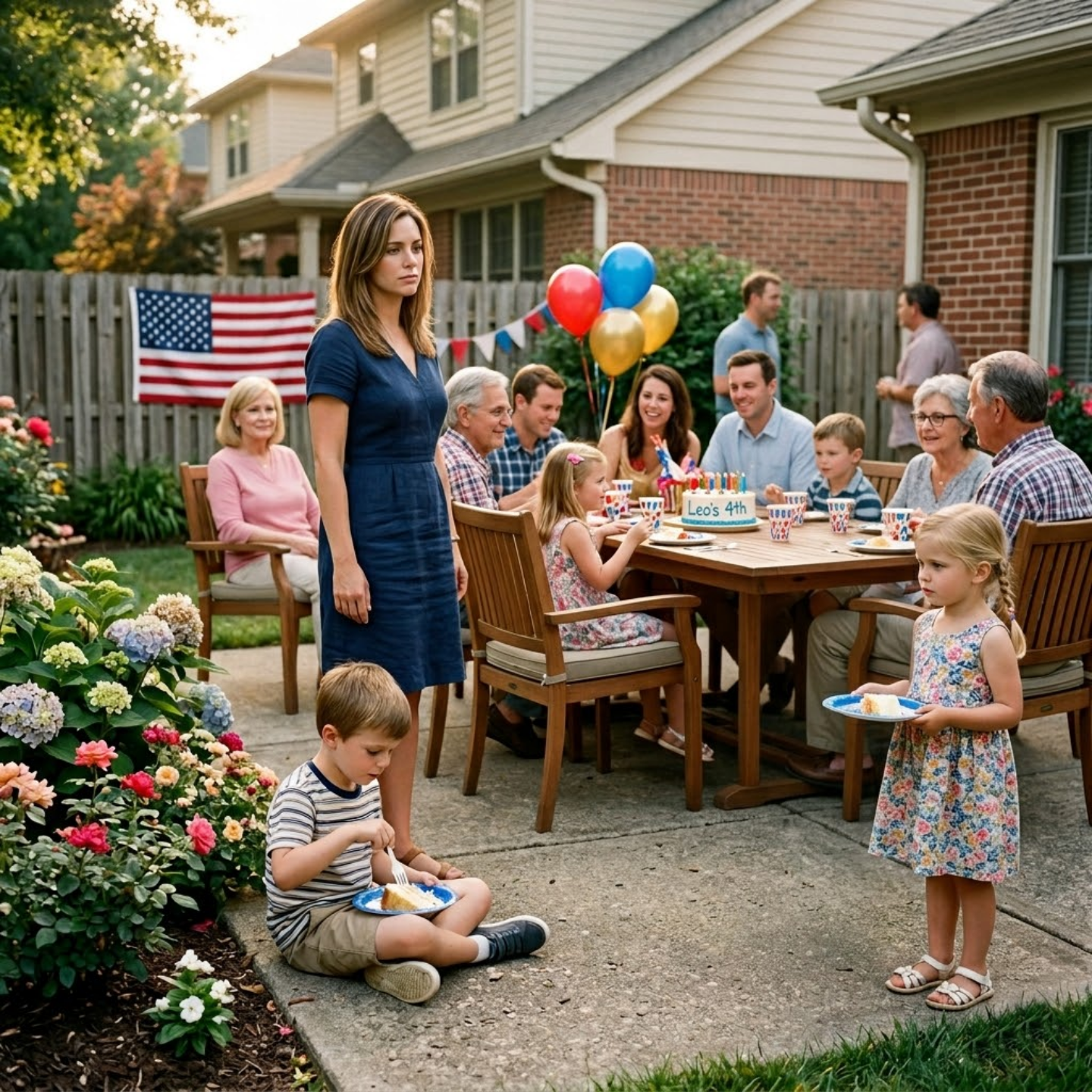
Noah licked melted vanilla from the side of his spoon and told me, after much gentle asking, that sometimes Grandma Carol would tell the cousins to sit at the big table and say the younger kids could eat “wherever.” Sometimes that meant the den. Sometimes the patio. Once, at Easter, it had meant the back steps. Lily said it did not happen every single visit, which was exactly the sort of detail that made the whole thing more insidious. Random enough to deny. Frequent enough to wound.
“Did you tell me before?” I asked, though even as I said it I knew children often tell us the truth in ways adults are too busy to hear.
Lily shrugged. “I thought maybe it was just because there wasn’t room.”
“And I don’t like making stuff worse,” she added after a second, so quietly I almost missed it.
That sentence belonged to me. Not in content. In shape. In burden. In the old, familiar instinct to manage other people’s discomfort before your own. Hearing it in my daughter’s voice felt like looking at a bruise I had somehow passed down.
By the time we got home, the sky had gone the soft gold it gets in Kentucky evenings before the heat fully breaks. Daniel’s truck was not in the driveway yet. He had gone earlier that morning to help a coworker move a washer and had said he would meet us at Carol’s place later for cake. I parked in the garage and sat there for a moment after turning off the engine, listening to the metal ping of the car cooling. The house beyond the mudroom door was quiet. Our ordinary life waited on the other side of it the basket of unmatched socks on the laundry room counter, the permission slip I had forgotten to sign, the blueberries in the fridge that needed using.
Inside me, something else had begun.
They did not know it yet, but in exactly three hours, everything would start to come apart. Not loudly. Not with broken dishes or screaming phone calls or some dramatic scene fit for television. It would begin the way so many real endings do: with stillness, with records, with memory finally allowed to line itself up in order.
To understand why those three hours mattered, you have to understand how I got to a point where being treated like this was something people around me felt comfortable doing without consequence. It did not start with a birthday party. It did not start with folding chairs. It started years earlier, with each small compromise laid on top of the last until I could not see the shape of the pile anymore.
I had spent so long being grateful not to be where I came from that I did not notice how often gratitude can become a muzzle.
When you have survived instability, it is very easy to tolerate disrespect from anyone who offers you the appearance of belonging. You tell yourself not to be too demanding. You tell yourself no family is perfect. You tell yourself there are worse things than a difficult mother-in-law, a needy sister-in-law, a husband who goes weak around guilt. And all of that may even be true. The problem is that truth, misused, becomes another excuse to stay in rooms where you are slowly disappearing.
I did not see myself that way then. I saw myself as capable. As practical. As generous. As the one who could absorb more because I had absorbed more before. There is a peculiar vanity in being the competent person in a broken system. You begin to believe the system would collapse without you, and on some level you like that. It gives your suffering purpose. It lets you imagine that the drain on your spirit is evidence of your strength rather than your lack of limits.
Daniel benefited from that more than anyone, though I do not think he would have put it in those terms. He loved me, I believe that. He still did things every day that looked like love. But love without courage is a frail shelter. Love that keeps asking one person to endure what the other refuses to confront becomes something smaller than its own name.
I knew he would come home that evening assuming the party had been awkward and that I was upset. I knew he would walk in prepared to soothe, not to reckon. He would probably start by saying, “Tell me what happened,” in that careful voice people use when they suspect the truth may require them to choose a side. And I knew, with a certainty that felt almost holy, that I was done helping him stay neutral in situations where neutrality had become betrayal.
Upstairs, I could hear Lily running bathwater. Noah was in his room with the door half-open, humming absently as he lined up toy cars along the windowsill. Their resilience should have comforted me. Instead it made me furious in a new way, because children are resilient far too often in circumstances where they should simply be protected.
I moved through the house on muscle memory. Baths. Pajamas. Leftover mac and cheese heated on the stove because neither child had eaten much. A cartoon playing low in the living room while I folded a load of towels just to keep my hands busy. I answered Lily’s question about whether we were still going to church in the morning with a yes I was not yet sure I meant. All the while, something deep in me was gathering.
When I tucked them in, Lily held onto my wrist for a second longer than usual.
“Are you mad at them?” she asked.
I sat on the edge of her bed in the dim glow of the night-light shaped like a crescent moon. Her room smelled faintly of shampoo and the strawberry lotion she liked. On the wall above her desk hung a watercolor she had made at school, all blues and greens bleeding into one another. She looked so open then, so carefully brave, and I felt the weight of every answer I had ever softened for the sake of someone else’s comfort.
“Yes,” I said, because there are moments when honesty is cleaner than reassurance. “I am.”
She searched my face.
“Are you mad at me?”
“No.” The word came out before she had even finished. “Never for that. Not ever.”
She nodded, but her fingers were still tight around my wrist.
I brushed a strand of hair off her forehead and said the truest thing I knew. “Sometimes grown-ups let things go too long because they keep hoping people will do better on their own. That doesn’t mean you did anything wrong.”
I could tell she did not fully understand, and maybe that was for the best. Children do not need the whole architecture of adult failure explained to them all at once. They only need to know where safety is.
After both kids were asleep, I went downstairs and opened my laptop at the kitchen table.
The house was quiet in the way family houses only are after bedtime, full of small mechanical sounds suddenly audible again the refrigerator cycling, the dryer clicking to a stop, the faint buzz from the overhead light above the sink. Outside, our neighbor’s porch light flicked on. Somewhere down the street a dog barked twice and settled. I logged into our bank account with the same steady hands I had used to buckle Noah into his seat a few hours earlier.
Three hours.
That was how long it took for grief to harden into action.
I did not begin with emotion. I began with numbers.
People think breaking points are dramatic, that they arrive with shouting and slammed doors and the kind of scene others can point to later as the obvious beginning. But the truth is that many endings start in spreadsheets, bank statements, and quiet recollections no one else knows you are finally allowing yourself to put in order. The emotional explosion may happen somewhere beneath the surface, but the visible part can look almost boring. A woman at a kitchen table. A lamp on over one shoulder. A legal pad. A list.
I pulled up seven years of transactions first, then nine. I searched for Carol’s name, Melissa’s name, cash transfers, checks, online bill pay. I opened old email threads. I searched my texts for words like rent, electric, can you help, just this once, hate to ask, short this month, emergency. I found venmo notes with cartoon emojis attached to amounts that had once represented the difference between our children taking a vacation or not. I found grocery store receipts where I had covered three households’ worth of food the week before Thanksgiving because Carol said the card she intended to use had “suddenly declined.” I found the recurring insurance payment for Melissa’s car that I had set up six months earlier “temporarily” after her hours were cut and then, because life moved fast and my own capacity had become automatic, never canceled.
The legal pad filled quickly.
$620 for the water heater.
$1,100 for property taxes.
$487.36 for utilities.
$2,000 after Melissa’s divorce.
$350 for school clothes.
$148 for a prescription Carol’s insurance had not covered that month.
$900 toward a transmission.
$275 for groceries.
$400 for Christmas.
$1,300 for a funeral.
$96 every month for car insurance that had quietly become permanent.
The numbers stacked into years. The years stacked into a life.
At some point, I stopped needing the calculator because the exact total no longer mattered in the way I had once believed it did. Still, by the time I finished, I had it. Thirty-eight thousand four hundred and twelve dollars. That was the number I could document without digging through old paper files in the attic or counting the cash Daniel had taken from our emergency envelope because his mother “just needed a little to get through the weekend.”
Thirty-eight thousand four hundred and twelve dollars.
The number itself was terrible, but what undid me was not the amount. It was the map it created. There on the page was a record of what I had given, but also of what I had been to them: not daughter, not sister, not family in any mutual sense of the word, but resource. Buffer. Backup plan. The person who could be counted on to make sure consequences landed softly somewhere else.
And then my children had been placed on the ground to eat while empty chairs sat inside the house.
When the front door finally opened, I already knew I was done.
Daniel came in carrying the faint smell of sweat and cut grass and that outside heat men seem to bring home in summer, and I could tell from the second he saw my face that he understood the evening would not go the way he had hoped. He set his keys in the bowl by the entryway and looked toward the stairs.
“Are the kids asleep?”
“Yes.”
He waited a beat. “Melissa texted. She said you left upset.”

One Comment on “Part4: My son had to sit on the floor to eat at a family party while everyone around him had a seat, and my mother-in-law smiled as if it were completely normal. I didn’t argue, raise my voice, or give them the scene they were waiting for. I just took my children and left, because for the first time, I was ready to let them see for themselves what family life would look like without me working so hard to keep everything peaceful.”