At 11:17 p.m., my phone rang for the third time from an unknown number. I finally answered.
“Ms. Claire Bennett?” a woman asked.
“Yes.”
“This is Natalie from Fifth River Bank’s fraud prevention department. We detected unusual withdrawals and attempted to reach you several times. Did you authorize cash withdrawals totaling twenty-nine thousand dollars and a wire transfer of eight thousand four hundred dollars today?”
“No,” I said immediately. “My brother stole my ATM card.”
Her voice sharpened. “Do you have possession of the card now?”
“Yes.”
“Good. We’re freezing the account. Because of the volume and pattern of withdrawals, this has been flagged for internal review. I also need to ask—do you know the source of the funds in the savings account?”
I closed my eyes.
“Yes,” I said. “It’s part of a restricted disbursement connected to my aunt’s wrongful death settlement.”
There was a pause.
“I see,” Natalie said carefully. “Then you need to come into the branch first thing in the morning. Bring identification and any related documentation you have. If these funds were withdrawn by an unauthorized person, this may involve both law enforcement and probate compliance.”
I thanked her, hung up, and sat frozen in the driver’s seat.
Three years earlier, my aunt Rebecca had died in a trucking accident outside Dayton. She had no children, no spouse, and for reasons that shocked everyone, she had named me in a small private trust created from part of the settlement. Not because I was her favorite, but because I was the one who had taken her to chemo, handled her paperwork, and stayed with her in the hospital when everyone else found excuses. The trust was not a fortune. After legal fees and taxes, it came to just under forty thousand dollars. But it was enough to fund graduate school if I used it carefully. The money had been placed in an account under my name with reporting conditions. I could spend it on tuition, housing, books, transportation, and documented living costs. Large irregular withdrawals triggered review.
Jason and my parents knew Aunt Rebecca had left me “something.” They did not know how the account was structured. They had simply assumed money in my name was money they could bully out of me.
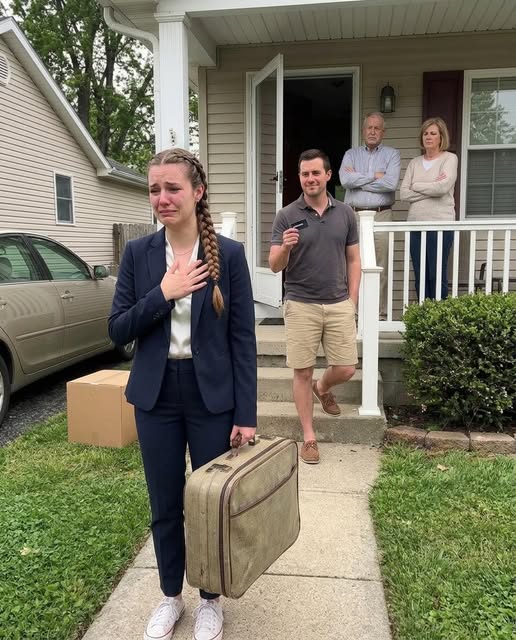
At eight the next morning, I went to the bank branch downtown still wearing yesterday’s clothes. The branch manager, a gray-haired woman named Denise Harper, took me into a private office. She reviewed the transactions, then asked for every detail. I told her about the stolen card, the confrontation, the expulsion from the house. Her expression turned grim when I mentioned the trust arrangement.
“This is bigger than family theft,” she said. “If those funds are restricted and someone knowingly withdrew them without authorization, there can be civil and criminal consequences.”
“Can I get the money back?”
“Possibly. We can reverse the wire if it hasn’t cleared. The cash withdrawals are harder, but we already have ATM footage requests pending.”
I almost cried right there.
By noon, I had filed a police report. By two, I had contacted the attorney who had handled Aunt Rebecca’s estate, Martin Kessler. He remembered me immediately. Once I explained what happened, his tone changed from polite to razor-sharp.
“Do not speak to your family without counsel present,” he said. “If the account was tied to court-monitored disbursement conditions, they may have exposed themselves to more liability than they realize.”
That evening Jason finally called.
“You called the bank?” he demanded.
“You stole from me.”
“It was family money!”
“No,” I said. “It was protected money.”
He went silent.
Then he laughed, but it sounded forced now. “You’re bluffing.”
“Am I?”
He hung up.
Two days later, officers went to my parents’ house. And that was when my family learned the account they emptied was actually part of a legally restricted settlement fund that had been left specifically to me—and that taking it was not just cruel. It was prosecutable.
