I called my family to say I had breast cancer. Mom said, “We’re in the middle of your cousin’s bridal shower.” I went through chemo alone. Days later, they came asking if I could still co-sign my sister’s car loan. My 6-year-old son came ou
When I called my mother to tell her I had breast cancer, she picked up on the third ring and lowered her voice as if I were interrupting something important.
“Claire, we’re in the middle of your cousin Jenna’s bridal shower,” she said. I could hear laughter behind her, glasses clinking, someone calling for ribbon scissors. “Can this wait?”
I was standing in the hospital parking lot, a folder clutched in my hand, a biopsy report that had just split my life into before and after. My knees were shaking so badly I had to brace myself against my car.
“No,” I said. “It can’t wait. I have cancer.”
There was a pause—but not the kind I had imagined. Not shock. Not grief. Just annoyance, like I’d brought up a plumbing issue in the middle of dessert.
“Oh my God,” she muttered. “Are you serious?”
“Yes.”
Another burst of muffled laughter drifted through the phone. Then she sighed. “Well, what do you want me to do right now? We have people here.”
I remember staring at the pavement beneath my feet and feeling something inside me go cold. “I thought maybe you’d say you were coming.”
“Tonight isn’t possible,” she said quickly. “Call your sister if you need company.”
My sister, Megan, didn’t answer. She texted twenty minutes later: Mom said you’re upset. I’m at the shower. We’ll talk tomorrow.
Tomorrow turned into next week. Next week turned into the start of chemotherapy.
I drove myself to every appointment except one—when my neighbor, Denise, took time off work because she said no one should go through their first infusion alone. She held my coat while I threw up into a paper bag in the parking garage. She shaved my head in her kitchen when my hair began falling out in thick, humiliating clumps. My mother sent flowers once, but the card read, Stay strong! Sorry we missed your call. Love, the family. The family—like they were a committee.
Then, four days after my second chemo session, they showed up.
Mom, Megan, and my stepfather, Ron. Smiling. Holding a grocery-store fruit tray like they were auditioning for kindness.
I was on the couch under a blanket, pale and aching, when Megan perched on the armrest and said, “You look better than I expected.”
I almost laughed.
Mom folded her hands and gave me that careful expression people use before asking for something they know they shouldn’t.
“So,” she began, “we need a little favor.”
Ron explained that Megan had found a car she loved, but the bank wanted a stronger co-signer. Megan’s credit was shaky after missed payments. Ron had recently refinanced his business loan. Mom said my credit had always been “the good one.”
I looked at all three of them and genuinely wondered if the nausea medication was making me hallucinate.
“You came here,” I said slowly, “while I’m in chemo… to ask me to co-sign a car loan?”
Megan shrugged helplessly. “It’s not like we’re asking for cash.”
Before I could respond, small footsteps came down the hallway.
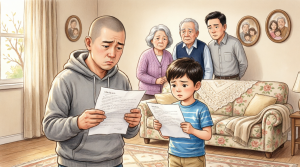
My six-year-old son, Ethan, walked into the living room holding a folded paper with both hands. He looked at me, then at them, and said in his quiet, careful voice:
“Mommy said to show you this if you ever ask for money.”
Their smiles froze before he even handed it over.
And when my mother opened the note and started reading, the color drained from her face.
For a moment, no one moved.
Ethan stood there in dinosaur pajamas, one sock half off his heel, waiting like he knew this mattered. Megan reached for the paper, but Mom pulled it back and read it under her breath.
It wasn’t a typical doctor’s note. It was printed on oncology letterhead, signed by my physician assistant, confirming that I was actively undergoing chemotherapy, unable to take on additional financial stress, and advised by my care team to avoid any new legal or financial obligations during treatment. At the bottom, in my own handwriting, I had added one final sentence:
If you are reading this, it means I was too sick or too tired to argue. The answer is no.
Megan’s expression hardened instantly. “Wow.”
“Wow?” I echoed.
She stood up. “You made your kid do this? That is unbelievably manipulative.”
I pushed the blanket off my lap, even though the room tilted when I moved too fast. “You walked into my house and asked a woman in chemo to risk her credit for a car you don’t need.”
“I do need a car.”
“You need this car,” I shot back. “A brand-new SUV with heated seats.”
Mom folded the paper so sharply I thought it might tear. “Claire, no one is trying to hurt you. Families help each other.”
The words hit so hard I actually laughed—bitter, cracked, ugly laughter.
“Families?” I said. “Which part felt like family? When I called from the hospital parking lot and you told me you were busy playing ribbon games? Or when Megan texted me instead of showing up? Or maybe family was the silence during my first chemo, second chemo, the surgery consult, the biopsy follow-up—”
“Oh please,” Megan cut in. “We sent flowers.”
Denise, who had just let herself in through the side door with a casserole dish balanced in one hand, stopped in the entryway. She took in the scene in one glance—the fruit tray, my son, my mother’s face—and slowly set the dish down on the counter.
“Should I come back?” she asked.
“No,” I said.
My mother turned, forcing a smile. “And you are?”
“Someone who showed up,” Denise replied.
The silence that followed shattered the room.
Ron cleared his throat. “Maybe this was bad timing.”
“That’s one way to put it,” Denise said.
Mom ignored her and turned back to me, shifting into wounded martyr mode. “I can’t believe you’d humiliate us in front of a stranger.”
I stared at her. “You humiliated yourselves.”
Ethan moved closer to me, pressing against my leg. I rested a hand on his shoulder, and in that moment, something inside me settled. It wasn’t anger anymore. Anger still hoped to be understood. This was clarity.
“Megan,” I said quietly, “you are not getting my signature.”
She crossed her arms. “Fine. Forget the loan.”
“Oh, I will. And while we’re being honest, I’m done being the emergency contact, the backup wallet, the responsible daughter you ignore until your plans fall apart.”