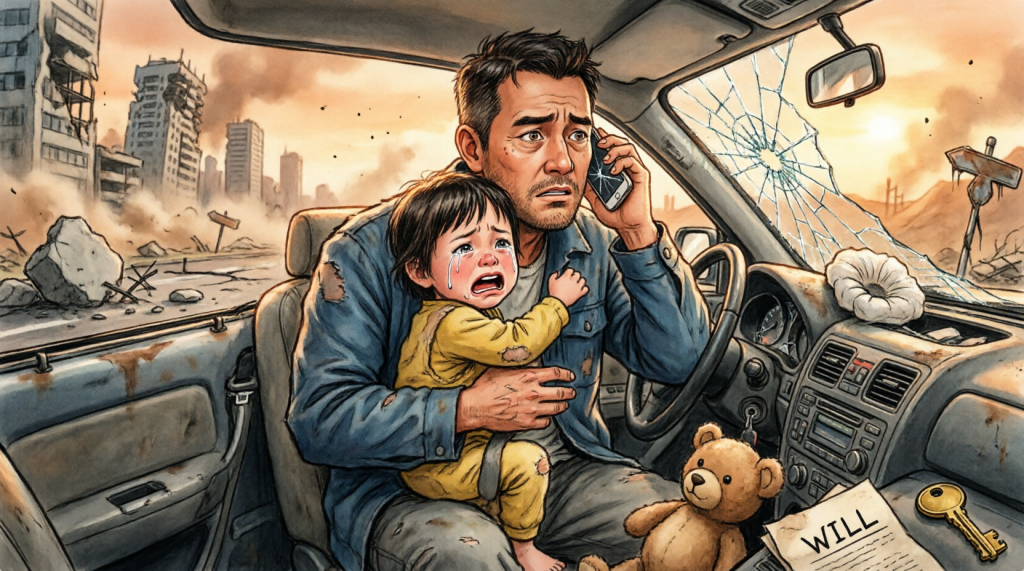
“Living in a Truck With My Daughter — Until I Got a Call That Turned My Life Around”
By the time the bell rang, Lily had vanished into the crowd of backpacks and lunchboxes, and I stood in the parking lot, staring at the truck like it was both a prison and a lifeboat.
The frost had melted into a thin sheen of ice, glinting gold in the late morning sun. I could feel my own heartbeat in my throat—long months of barely controlled panic made even ordinary moments feel sharp.
I climbed in, leaving the heater on low, the engine idling to keep the cab above freezing. My hands shook as I held the steering wheel, trying to steady them. Eight months. Eight months of pretending to be invisible. Eight months of watching Lily’s small, curious face adapt to hardship I hadn’t been ready to endure. And yet, in that same stretch, I realized something: I wasn’t broken. Not entirely. Not yet.
The phone buzzed again. Jennifer.
“Marcus, you need to be careful,” she said. “The Chen family is more organized than you think. They’ve built layers—accounts, properties, shell companies. This isn’t just your ex. This is a network. I’ve traced the flow of money, and there are patterns. Some of them lead to other properties you didn’t know existed. Others… I can’t verify yet.”
I swallowed. The thought had been there, whispering faintly: someone else was watching. Someone else had been working in silence while we slept behind Tim Hortons, surviving on day-old muffins and hope. Now it wasn’t a whisper. It was a roar in my chest.
“What do I do?” I asked.
“First,” she said, “we secure what you already legally own. Freeze the accounts, do a full audit. Then… we dig. Carefully. Every document, every email, every transaction. Whoever thought they could bury this quietly—they underestimated you. You’re not invisible anymore.”
I looked at Lily’s lunchbox in the backseat. Cartoon bears, slightly faded. She had packed it herself that morning, humming a song she made up about “home someday.” Her resilience was a quiet kind of weapon, sharper than any lawyer’s filing.
“I understand,” I said. “We’ll start immediately.”
Walking back to the library to access the public Wi-Fi and send encrypted messages to Jennifer, I felt a strange sort of clarity. For eight months, life had been a constant scrape—every coin counted, every day planned, every glance over my shoulder. Now the scrape was still there, but it had shape. Purpose. I wasn’t just reacting anymore. I was building. Strategizing. Reclaiming.
At night, when Lily slept curled under the cartoon bear sleeping bag, I reviewed blueprints of the twelve-unit building in my head. I remembered the nails, the floors, the railings, the angles of the staircases I had poured sweat into years ago. My hands had been instruments of creation, even when life tried to strip me bare. They still were.
The first audit revealed months of unexplained withdrawals. Fees “authorized” by Amanda’s parents. Tenants paying rent into accounts I had no access to. Accounts drained, money shifted. And yet, every line was traceable, every transaction recorded. Jennifer smiled faintly.
“This isn’t just theft,” she said. “It’s exploitation. But it’s also proof. Every line proves intent, and we have a trail now.”
That night, I slept in the truck with a plan. For the first time in months, the future wasn’t just survival—it was strategy. I imagined owning the building outright, Lily in a real home, and finally looking at myself in a mirror without flinching.
But beneath it all, the shadow remained. Someone had orchestrated this meticulously, had anticipated every move, had assumed I would never discover the layers they’d hidden.
I was no longer invisible, and that made me dangerous to them.
I could hear it in the quiet—the hum of the truck’s heater, the occasional car passing, the faint wind against the windows. Life had returned its shape, but vigilance had become a new muscle. Every creak, every whisper of movement, every email alert carried weight.
And yet, for the first time in nearly a year, I felt something I hadn’t felt since the divorce: possibility.
Possibility meant not just surviving.
Possibility meant reclaiming what was mine.
Possibility meant teaching Lily that life could be chaotic and cruel—but also that it could be carved back into safety and dignity, one deliberate step at a time.
By dawn, I had drafted the first of many letters to the bank, instructing them to freeze all accounts in my name, to require dual authorization for any withdrawals, to begin tracing transfers. Jennifer would handle the rest. My part was presence, vigilance, strategy.
And for the first time, I believed in the power of presence.
Presence in the truck, presence in Lily’s classroom, presence in the world that had tried to erase me.
Presence that would reclaim what they had stolen.
Presence that would see them revealed, layer by layer.
The road ahead was long. Dangerous. Exhausting. But for the first time, I wasn’t running from the shadows. I was moving toward them.
And I knew, without a doubt, that I was ready.
By the time I climbed back into the truck that night, the world felt unsteady in a way that wasn’t entirely unpleasant. For eight months, the ground had shifted beneath me in ways I could never control. Today, for the first time, it felt like someone else was holding the rope while I climbed. Jennifer. Not my ex, not the Chens, not the judgmental eyes of strangers who had already decided my worth. Someone in my corner.
Lily slept sprawled across the passenger seat, her small face serene beneath the dim glow of the streetlight. I studied her for a long moment, remembering every morning I’d rubbed the sleep from her eyes, handed her a muffin from the food bank, and told her “we’ll be home soon.” I hadn’t known it then, but “home” had nothing to do with a building, and everything to do with the people who refused to give up on you.
Jennifer had been clear: we had leverage now, and time was of the essence. Each day the Chens had access to the building was another month of rent they could pocket. They had assumed I would never discover the inheritance, that I would sink quietly into obscurity. That assumption was about to be demolished.
The next morning, I woke before dawn. The frost had glazed the truck’s windshield with another layer of delicate ice, and I scraped it away slowly, deliberately, savoring the quiet. In the library, Jennifer called with updates: forensic accounting had traced each rent check, every maintenance fee, every transfer to shell accounts. The pattern was meticulous, deliberate. They had engineered months of invisibility.
“They thought they could make you disappear, Marcus,” Jennifer said, voice low over the speakerphone. “They underestimated how far you’d go to protect yourself and Lily. Once the court sees this, they’re going to be scrambling.”
I tried to picture them in that courtroom: Douglas with his polished calm, Amanda with her practiced indifference, Patricia Chen adjusting her pearl necklace. None of it mattered. The facts were cold and precise, and I had them all.
By midweek, the court order came down: the accounts frozen, all rental income redirected into a trust under my name, pending final adjudication. I drove to the bank first thing, handing the paperwork over to the manager, who looked at me as though he’d expected someone else. But this time, I was the someone else—the one they hadn’t factored into the equation.
“Do you understand the scope of this?” he asked.
“I do,” I said. “And I’ll hold it until the court confirms the transfer is finalized.”