I went in for a furnace filter and watched a young mother get humiliated over baby formula—until one old steelworker said the one thing nobody else would.
“Run it again,” the girl whispered.
Her voice was so thin I almost missed it over the beeping scanners and shopping carts.
The cashier tried.
Declined.
He tried again.
Declined.
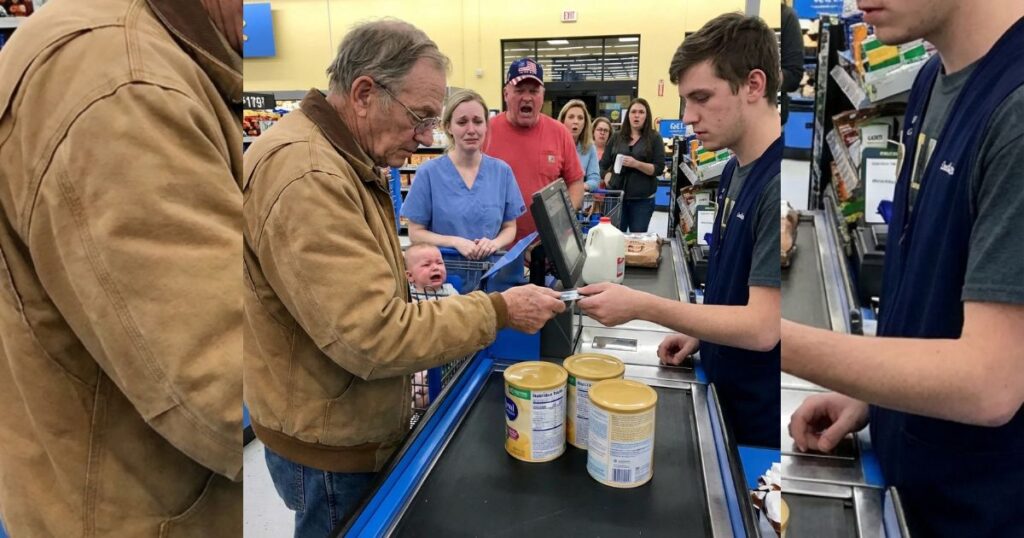
She stood there in faded scrubs with a baby strapped into the cart seat, bouncing one shaking hand on the handle like she could keep herself from falling apart if she just kept moving.
On the belt were three cans of formula, a gallon of milk, and a cheap box of cereal.
That was it.
No junk food. No makeup. No extras.
Just the kind of groceries that tell you somebody’s already cut everything they can cut.
I’m Arthur Donovan. Seventy-four years old. Army veteran. Retired steelworker.
I live in western Pennsylvania in a town where the mills used to light up the whole night sky. Now the buildings are empty, the jobs are gone, and half the people I know count pills and dollars at the kitchen table before they decide which one matters more that week.
I was only there for a furnace filter.
My place gets cold fast, and at my age cold settles into your bones like it owns the deed.
The baby started crying then.
Not loud at first.
Just tired.
Hungry.
The kind of cry that makes decent people look up.
The girl swiped her card one more time.
Declined again.
She stared at the screen like if she looked hard enough it might change its mind.
Behind me, somebody sighed hard.
Then a man farther back in line said it.
“If you can’t afford to feed a kid, maybe you shouldn’t have had one.”
Everything went still.
The girl froze.
She couldn’t have been older than twenty-two.
There were dark circles under her eyes. Her hair was twisted up in a messy knot. One sleeve of her scrub top had something dried on it that looked like formula or spit-up or maybe just the remains of a day too long for one human being.
She reached for the cans and started pulling them off the belt.
“I’ll just take the milk,” she said, and I swear she was trying not to cry in front of strangers.
The man kept going.
People like him always do.
“Whole line’s gotta wait because nobody plans anymore,” he said. “Then the rest of us are supposed to feel sorry.”
A woman near the candy rack snapped, “Oh, for heaven’s sake, leave her alone.”
Another person muttered, “Nobody helps working people either.”
And just like that, the whole line split open.
Not over formula.
Not over a baby.
Over anger.
The kind people carry around now like it’s part of their clothing.
Anger over money.
Over rent.
Over doctor bills.
Over jobs that disappeared and never came back.
Over feeling invisible.
I know that anger.
I carried it home from war.
I carried it through layoffs, funerals, union meetings, and long winters after my wife died.
My wife, Ellen, used to say the country gets meanest when people are scared.
Standing there, I thought of her.
I thought of the year our youngest got pneumonia and we sat up half the night deciding which bill could wait.
I thought of how ashamed Ellen looked when a pharmacy clerk once told her our card didn’t go through.
I still remember that look.
It wasn’t poverty.
It was humiliation.
That girl in front of me had the same look.
So I took out my wallet.
My pension isn’t much. My savings are smaller than they should be. I count every refill and every grocery trip like most old men I know.
But I also know what a hungry baby sounds like.
I held out my card.
“Ring it up,” I said.
The girl turned so fast she almost knocked the cart.
“Sir, no,” she said. “I can’t let you do that.”
“Yes, you can.”
The cashier looked at me like he wanted to make sure I meant it.
“I said ring it up,” I told him. “All of it.”
The man in back barked a laugh.
“You’re part of the problem.”
I turned and looked right at him.
Maybe it was the Army still in me. Maybe it was the old union man. Maybe it was just grief with nowhere left to go.
“No,” I said. “The problem is grown men picking on exhausted women with hungry babies.”
He puffed up.
I stepped closer.
I’m old, but I’m still tall, and some things about a man don’t leave when the hair goes gray.
“You don’t know one thing about her,” I said. “Not one. You don’t know if she just got off a double shift. You don’t know if the baby’s sick. You don’t know if she slept at all last night. All you know is you saw somebody weaker than you and decided to make yourself feel bigger.”
Nobody said a word.
Even the baby had gone quiet.
The man looked around for backup and found none.
He muttered something ugly under his breath, abandoned his cart, and walked out.
The girl started crying then for real.
Not loud.
Just the kind of crying that comes when you’ve been holding too much for too long.
“Thank you,” she said. “I was sure the deposit would hit. My son can’t keep regular formula down. I worked an overnight shift and—”
“You don’t owe me your story,” I told her.
She covered her mouth and nodded.
“Just feed your little boy.”
She left with the bag clutched to her chest like it held oxygen.
I paid for my filter and went home thinking that was the end of it.
It wasn’t.
Somebody had filmed the whole thing.
By evening my daughter called and said, “Dad, your face is everywhere.”
By morning strangers were arguing about me like I was public property.
Some called me a hero.
Some called me a fool.
Some used that girl and that baby to make whatever point they were already hungry to make.
I shut the phone off.
I didn’t want praise.
I sure didn’t want noise.
A week later I went back for my blood pressure pills.
Near the front doors, where they usually stacked patio chairs and bags of mulch, there were two plastic shelves and a hand-painted sign.
NEIGHBOR’S SHELF
Take what you need. Leave what you can.
Diapers.
Formula.
Soup.
Cereal.
Toothpaste.
Baby food.
Pasta.
More than I could count.
The young cashier was stocking cans.
“What is all this?” I asked.
He smiled.
“Started the day after you were here,” he said. “One woman left two cans of formula at my register and said, ‘For the next mom.’ Then somebody brought diapers. Then soup. Then more. It hasn’t been empty since.”
I stood there longer than I meant to.
People in that store walked up quietly, dropped things in the bins, and kept going.
No speeches.
No lectures.
No cameras.
Just neighbors making sure another neighbor’s baby ate.
My wife was right.
People get scared. Then they get mean.
But sometimes, if somebody is brave enough to stop the meanness for one minute, other people remember who they were before fear got hold of them.
That’s what I saw in that store.
Not charity.
Not weakness.
Not pity.
Just people refusing to let one another go hungry.
And these days, that feels like the most American thing I know.
PART 2
Three days after that shelf appeared, somebody chained it shut.
I saw it the second I stepped through the automatic doors.
The hand-painted sign was still there.
NEIGHBOR’S SHELF.
Take what you need. Leave what you can.
But the plastic shelves behind it had a silver chain looped around them, with a printed notice taped crooked across the front.
TEMPORARILY PAUSED PENDING REVIEW.
That word hit me harder than it should have.
Paused.
As if hunger was a summer concert.
As if babies could wait politely while grown people reviewed things.
Tyler, the young cashier from the other day, was standing nearby with a cardboard box full of diapers in his arms and the kind of face a person gets when they’ve been yelled at by people above them and in front of them in the same week.
“What happened?” I asked.
He let out a breath through his nose.
“Complaints,” he said.
“About what?”
He gave a tired little laugh.
I have learned there are laughs that mean something is funny, and laughs that mean a person is too worn out to swear.
“About everything,” he said. “People said the shelf was a blessing. People said it was encouraging dependence. People said it looked messy. People said people were taking too much. Somebody said it was a liability. Somebody said it made customers uncomfortable.”
“Hungry babies make customers uncomfortable?”
He shifted the box against his hip.
“No,” he said quietly. “Poor people do.”
That landed in my chest and stayed there.
A woman came in behind me carrying two bags of pasta and a jar of peanut butter.
She stopped short when she saw the chain.
“Oh, come on,” she said.
She looked at Tyler like he personally had done it.
“I brought this before work.”
“I know,” he said. “I’m sorry. We can hold donations in the back for now.”
“For now,” she repeated.
She set the bags down harder than she meant to and walked off muttering to herself.
An older man by the carts said, “Good. It was getting out of hand.”
A younger woman in a denim jacket snapped, “Out of hand for who?”
He shrugged.
“For people paying full price while half the town shops for free.”
Nobody raised their voice.
That almost made it worse.
The meanness had gotten neat.
Organized.
The store manager came out from the office then.
Her name was Joanie Barrett.
Mid-fifties, practical shoes, reading glasses on a cord, the kind of woman who looked like she had spent twenty years solving everybody else’s emergencies while eating crackers for lunch.
She saw me and rubbed her forehead.
“Arthur.”
“That shelf fed people.”
“I know it did.”
“Then why’s it chained up?”
She looked around before answering, which told me the answer had more weight than she wanted it to.
“Regional office called,” she said.
There it was.
Not a real person.
An office.
A floating cloud of people who never stood in front of a crying baby and still felt entitled to decide what looked acceptable near the front entrance.
“They said we need a plan,” she went on. “Inventory, oversight, basic rules. There’s concern about fairness. And safety. And whether people are taking specialty items that some families can’t replace.”
I stared at the chain.
There had been maybe forty dollars’ worth of plastic and canned food on those shelves when I last saw them.
Now it looked like a bank vault.
“Fairness,” I said.
Joanie didn’t flinch.
“That’s what they’re calling it.”
“And what are you calling it?”
She took a second before answering.
“I’m calling it a town full of scared people trying to control the wrong thing.”
That surprised me.
So did the way she said it.
Like she had been holding it in.
I glanced back at the notice.
“There more to it than complaints?”
She nodded.
“Someone posted photos of the shelf half empty and wrote that people were ‘cleaning it out.’ Then somebody else said a family couldn’t find the formula they needed because donations were getting taken too fast. Then three more people piled on. By yesterday afternoon, everybody had an opinion.”
“Everybody always does once there’s a camera involved.”
She gave me a look.
“Your video’s still making the rounds.”
I felt my shoulders tighten.
I hated hearing it put that way.
My video.
As if the internet had not simply taken a hungry young mother and a loudmouthed fool and turned both into chewing gum.
“I didn’t ask for any of that,” I said.
“I know.”
“But they’re using it.”
“I know that too.”
Tyler set the box down by the office door.
“A lady called this morning and said if we reopen it, there should be ID checks,” he said. “Income verification. Limit one item per household per week. She said otherwise it’s not a shelf, it’s theft with a sign.”
I looked at him.
He looked right back.
He was maybe twenty-three.
Too young to already sound that tired.
“And what’d you say?” I asked.
He pushed his name tag with one finger.
“I said I’m an hourly cashier, ma’am.”
That got the smallest smile out of me.
Then it disappeared.
Because right then a woman pushing a stroller walked over to the chained shelf and just stood there.
She didn’t say anything.
She just looked.
At the diapers.
At the baby food.
At the locked plastic tubs.
Then she turned around and left the store without buying a thing.
I watched the doors close behind her.
There are moments when you can feel a whole country in one set of automatic doors.
That was one of them.
Joanie folded her arms.
“We’re having a community meeting Thursday evening in the old library room,” she said. “Store staff, customers, anyone who wants a say. Regional office says if we keep it, we need guidelines. Some people want sign-in sheets. Some want cameras. Some want it moved to a formal partner site. Some want it gone completely.”
“Formal partner site,” I repeated.
She nodded.
“It means somewhere nobody has to look at need while buying paper towels.”
That time she did smile.
Only it wasn’t because anything was funny.
“Arthur,” she said, softer now. “They’re going to ask you to come.”
“Why?”
“You know why.”
I did.
Because once your face gets attached to a thing, people start acting like you belong to the thing.
I wanted no part of it.
I wanted my pills.
My furnace filter from last week.
My quiet house.
My coffee in the same mug Ellen bought at a church sale in 1998.
I wanted to age privately.
Instead, I stood in a grocery store under bad fluorescent lights, staring at a chained donation shelf, while a baby somewhere in town probably needed what was now sitting behind plastic ties and printed policy language.
“I’ll think about it,” I said.
Joanie looked like she knew that meant I was coming.
I got my blood pressure pills and headed home.
Halfway through the parking lot, my daughter called.
Maggie has a gift for sounding worried and annoyed at the same time.
She got it from her mother.
“Dad.”
“That’s usually my name.”
“Very funny. Were you at the store?”
“Yes.”
“Did you talk to anyone?”
“What is this, an interrogation?”
“It’s called concern. You’ve been all over those local talk panels again.”
I kept walking.
The wind cut hard between the rows of cars.
“You still watching those things?” I asked.
“No. My friend Sandra keeps sending me screenshots because apparently western Pennsylvania has decided you’re the patron saint of baby formula.”
I groaned.
She kept going.
“One side says you proved neighbors still matter. The other side says public handouts encourage freeloading and punish people who work hard. Somebody even started an argument about whether kindness is helping or just covering for broken systems.”
“Of course they did.”
“Dad, I’m serious.”
“So am I.”
“You don’t have to get dragged into this.”
I stopped by my truck.
The metal was cold enough to sting my palm.
“Maggie,” I said, “I didn’t start anything. I bought groceries for a kid.”
“I know that.”
“Then what are we talking about?”
She was quiet a second.
Then she said, “We’re talking about the fact that people love building bonfires out of ordinary moments now. And I don’t want you standing in the middle of one.”
I leaned against the door.
Across the lot, a man loaded store bags into the back of a dented hatchback while a little girl in a knit hat spun in circles around the cart return.
Everything looked normal.
That was the trick of it.
Most of the ugliest things in this country happen in normal places, under normal weather, while people are still remembering to buy milk.
“I’m not looking for a bonfire,” I said.
“I know.”
“But if somebody’s cold already, walking away doesn’t feel much better just because the flames might spread.”
She sighed.
That was her mother too.
“Please tell me you’re not making speeches at some meeting.”
“I said I’d think about it.”
“That means yes.”
“It means I’m old and stubborn.”
“Same thing.”
When I got home, I found myself standing in the kitchen staring at the counter for a long time.
Ellen used to do that when something bothered her.
She’d come home from the pharmacy or the utility office or one of those places where poor people are expected to explain themselves, and she would set her purse down and just stand there.
Not because she was confused.
Because anger needed a minute to turn into words.
I understood that better after she was gone than I did while she was living.
That is the ugly part of marriage no one likes to admit.
Sometimes the wisdom arrives after the person.
I made coffee I didn’t need and sat by the window with the mug warming both hands.
Snow was piled gray at the curb.
The neighborhood looked tired.
A sagging porch here.
A tarp over a roof there.
A bike with one training wheel missing.
Somebody’s faded holiday wreath still hanging in late winter because taking it down meant you had enough left in you to care about appearance.
A little after noon, a beat-up sedan pulled into my driveway.
For one strange second I thought it might be Maggie, though she lived forty minutes away.
It wasn’t.
It was the young mother from the store.
She got out slow, like she was still deciding whether to stay.
No scrubs today.
Just a puffy coat, jeans, and that same look exhausted people have when sleep has become something other people do.
The baby was on her hip.
He had big solemn eyes and a knit cap with one floppy bear ear that bent sideways.
I opened the door before she reached the steps.
She looked startled.
Then embarrassed.
“Sorry,” she said. “I got your address from Tyler. I know that sounds strange. I told him not to if you’d mind.”
“I mind less when there’s a baby involved,” I said.
That got me the tiniest smile.
“Come in,” I told her. “It’s cold.”
She hesitated on the mat.
“I don’t want to impose.”
“You already drove here.”
That made the smile a little bigger.
She stepped inside.
The baby looked at me like he was deciding whether I was trustworthy.
Animals and babies usually know before adults do.
“This is Eli,” she said.
I nodded to him.
“Arthur.”
He blinked once.
Fair enough.
I hung up her coat while she bounced him on her shoulder.
“My name’s Marissa,” she said. “Marissa Cole.”
I remembered the way she had stood at the register.
Back curved in.
Shoulders braced for impact.
Today she looked steadier.
Not fine.
Nobody gets fine that fast.
But steadier.
“What brings you out here?” I asked.
She held up a reusable bag.
Inside were four cans of formula, a box of diapers, baby wipes, and two envelopes.
“I got paid,” she said.
I looked at the bag.
Then at her.
“You don’t owe me anything.”
“I know.”
She swallowed.
“That’s not why I brought it.”
I took the bag from her and set it on the table.
She kept talking before I could answer.
“I went back yesterday to leave some of this at the shelf, and it was locked.”
“I saw.”
Her face changed.
Not surprise.
Something heavier.
“I figured that happened because of me.”
“No,” I said. “It happened because too many people mistake discomfort for principle.”
She blew out a shaky breath.
“I hate that video.”
“So do I.”
She looked at me then.
Really looked.
Like maybe that was the first thing she’d heard all week that made her feel less alone.
“I’ve had strangers telling me what kind of mother I am,” she said. “Some say I’m brave. Some say I’m irresponsible. Some say if I can’t afford a child I shouldn’t have had one. Some say I should be grateful people care enough to talk. As if being discussed by strangers is a gift.”
I pulled out a chair for her.
“Sit down.”
She sat.
Eli grabbed one of her hoodie strings and tried to eat it.
She gently tugged it away.
“I wasn’t even going to buy the formula that day,” she said. “Not all three cans. I was going to buy one. My deposit was late and I thought maybe if it hit while I was in line the card would clear. But then the milk and cereal were there too and I got stupid for a second and thought maybe we could make the whole week work.”
“That’s not stupidity.”
She gave a little shrug.
“It feels like it when a machine says no in front of twelve people.”
I sat across from her.
The kitchen ticked with the old wall clock Ellen used to wind.
I still wound it.
Mostly because the sound made the house feel less empty.
Marissa ran her thumb over Eli’s back.
“He’s on a sensitive formula,” she said. “He throws up most others. I work nights at a care home about twenty minutes over. Sometimes I pick up extra shifts cleaning rooms too. My mom watches him when she can, but she’s got rheumatoid arthritis so some mornings she can barely hold a coffee cup.”
She stopped and made a face.
“I’m doing the thing again.”
“What thing?”
“Trying to prove I deserve groceries.”
That one stayed between us a moment.
Then I said, “You don’t.”
She frowned.
I watched the thought hit her and settle.
“You don’t have to prove it,” I said. “That’s what I mean.”
Her eyes filled before she blinked it back.
“I didn’t come to cry in an old man’s kitchen.”
“Good. I’m low on tissues.”
That earned a real laugh.
A small one.
But real.
She reached into one of the envelopes and slid it toward me.
“Then take this,” she said. “For the formula.”
I didn’t touch it.
“No.”
“Please.”
“No.”
Her jaw tightened.
I had seen that expression before.
Pride is pride at twenty-two and seventy-four.
It only changes hairstyles.
“I’m not asking because I think you need it,” she said. “I’m asking because I do.”
That made me pause.
She went on.
“Everyone online made it sound like I stood there waiting for rescue. I didn’t. I was panicking. That’s different. What you did mattered. But if I can’t give back something, then I stay the girl at the register forever.”
That was one of the wisest things I had heard in a long time.
I pushed the envelope back toward her.
“Then don’t pay me,” I said. “Help the shelf.”
“It’s locked.”
“Then help whatever comes next.”
She sat with that.
Then nodded.
Eli made a soft snuffling noise and tucked his face against her coat.
I looked at the bag again.
“At least leave those,” I said. “I’ll take them to the meeting.”
“You’re going?”
“That appears to be the mistake I’m making.”
She almost smiled again.
Then she looked at me in a way that told me she had not driven all the way out just to return formula.
“Mr. Donovan?”
“Arthur.”
“Arthur.” She took a breath. “If they ask for IDs or pay stubs or some kind of proof… people like me won’t stop needing help.”
She glanced down at Eli.
“We’ll just stop asking in places where someone can see us.”
I nodded slowly.
“I know.”
“No,” she said. “I don’t think most people do.”
Her voice didn’t sharpen.
It got softer.
That was what gave it weight.
“They think shame is a small price. Something embarrassing, maybe, but manageable. Like waiting in a long line or filling out paperwork. But when you’re already one bad week from drowning, shame is heavy. It makes you tell yourself you’ll figure it out tomorrow. Then tomorrow comes and your baby still needs to eat and you still don’t have enough and now you’re also hiding from the one place that might have helped.”
I thought of Ellen at the pharmacy.
The way she held herself extra straight after the card failed.
As if posture could protect dignity.
“I know,” I said again, and this time I meant I knew exactly what she meant.
Marissa stood to leave a few minutes later.
At the door she turned back.
“I never said it right,” she said.
“You thanked me.”
“No. I said thank you because I was falling apart. That’s not the same as saying it right.”
She shifted Eli higher on her hip.
“What you did was more than pay for formula. You interrupted something ugly. Most people don’t. Even good people. They look away because they think not joining in is enough.”
I didn’t have an answer for that.
Maybe because I had done plenty of looking away in my life.
She gave me a tired, crooked smile.
“Anyway,” she said, “if they let the shelf come back, I want to help stock it. Quietly.”
“Quiet is good.”
“Quiet is holy,” she said.
After she left, I sat back down at the table and looked at the bag she had brought.
Four cans of formula.
A box of diapers.
Wipes.
The kind of donation that only comes from somebody who remembers exactly what it feels like not to have it.
I thought that meeting on Thursday might be about shelves and rules.
By Tuesday evening, I knew better.
It was about whether people still believed need had to perform in order to be seen.
That night, just before closing, I drove back to the store.
I told myself I was just dropping off Marissa’s bag so Tyler wouldn’t forget it at home in his car or some such nonsense.
The truth was I couldn’t leave the thing alone.
The sky had gone that dark iron color western Pennsylvania wears so well in winter.
The parking lot was half empty.
Inside, through the front glass, I could see Tyler mopping near the registers.
The shelf was still chained.
I had just opened my truck door when I saw somebody standing in the strip of shadow by the cart corral.
A man.
Heavy coat.
Ball cap pulled low.
Hands shoved deep in his pockets.
At first I thought he was smoking.
Then I realized he was just standing there staring at the locked shelf through the glass.
There was something familiar about the set of his shoulders.
The stiffness.
The angry way some men hold themselves when what they are really feeling is fear.
I started toward the doors.
So did he.
We reached them at almost the same time.
The light from inside fell across his face and I knew him.
He knew I knew him too.
He stopped like I had pointed a gun at him.
It was the man from the line.
The one who had said that thing about maybe not having a kid if you couldn’t afford to feed one.
Up close he looked worse than I remembered.
Not meaner.
Just worn down.
His cheeks were hollowing at the sides.
His eyes had that bloodshot gray look people get when sleep and appetite have both quit.
He glanced at the doors.
Then at me.
Then away again.
“Store’s about closed,” he muttered.
“So I noticed.”
We stood there in the cold.
He shifted once on his boots.
I waited.
Old steel taught me plenty.
One useful thing was this:
Silence makes some men lie.
It makes others tell the truth.
He finally spoke first.
“I’m not here for trouble.”
“That’d make two of us.”
His jaw moved.
Like he was chewing on something bitter.
“I saw the shelf online,” he said.
“I figured.”
He nodded toward the chain.
“Looks like people got what they wanted.”
I said nothing.
He drew a breath through his nose.
Then let it out slow.
“I was wrong,” he said.
The words sounded like they had edges.
Maybe because they had been cutting him all week before he brought them out.
I kept my face still.
A lot of men can say they were wrong.
Fewer can stand in it.
He looked at the pavement.
“My daughter moved back in with us a month ago,” he said. “Baby’s eight weeks old. Her boyfriend left. Took off with the truck too, which is funny because the truck was mostly mine.”
He gave a short, humorless laugh.
No part of me softened yet.
Maybe that makes me small.
Maybe it makes me human.
He kept going.
“Little girl can’t keep regular formula down. Doctor said try a gentler kind. Cost twice as much. Maybe more. Wife’s prescriptions went up in January. Furnace needed a repair. Daughter’s check got held up because of some paperwork mess. I came in here tonight hoping maybe…” He nodded again toward the shelf and swallowed. “Maybe there’d still be some.”
There it was.
No speech.
No excuse big enough to erase what he had said that day.
Just a man standing in the dark with his own shame hanging off him like wet denim.
“You remember me,” he said.
“Yes.”
“I figured.”
He rubbed one hand over his mouth.
“I recognized you that day too. Everybody did, after. Army veteran. Steelworker. The old guy who paid. Then the whole town decides you’re what decency looks like, and I’m the jackass in the background.”
He said the last word like he had earned it.
Maybe he had.
Still, I found myself asking, “Then why’d you say it?”
He took his time answering.
Because that was the real question.
Not whether he was sorry.
Why.
“I was mad before I walked in,” he said finally. “Mad at the heating bill. Mad at my daughter’s ex. Mad because my wife keeps cutting her pills in half and lying about it. Mad because I worked thirty-one years and still somehow ended up scared of every mailbox in America.”
He stared straight ahead through the glass.
“Then I saw her there. Young. Tired. Card declining. Baby crying. And I don’t know. Something in me went ugly. I looked at her and all I could think was that if I admitted she scared me, then I’d have to admit I was one bad month from standing in the same spot.”
That was honest enough to hurt.
He wasn’t done.
“So I did what cowards do. I called it character. I called it responsibility. I called it planning. Anything but what it was.”
The automatic doors gave a tired shudder and opened as Tyler came to lock one side.
He saw us.
Saw the man.
Something passed across his face.
Recognition too.
The whole town had seen the video.
“You okay out here?” Tyler asked me.
I nodded.
Then I looked at the man beside me.
“Depends,” I said.
Tyler waited.
The man stared at the chain inside.
His throat worked once.
Then he did something that surprised me.
He said, quietly, “Please.”
Just that.
Please.
I do not think the word has as much power in this country as it used to.
But standing there, coming out of the mouth of a man who had probably not asked anybody for anything without resenting it in thirty years, it had weight.
Tyler looked at me.
I looked at the shelf.
Then at the bag in my hand from Marissa.
Four cans.
Diapers.
Wipes.
Enough to matter.
Not enough for everybody.
That was always the problem.
It is easy to make speeches in a country of abundance.
Everything important happens when there isn’t enough.
I held the bag out.
The man looked at it, then at me.
“I can’t,” he said.
I thought of the line.
Of his voice.
Of Marissa’s face.
Of Eli’s hungry cry.
Of Ellen saying the country gets meanest when people are scared.
Then I said the only thing I could say and still live with myself.
“You can.”
He didn’t take it.
Not at first.
“After what I said?”
“Yes.”
“Why?”
“Because your granddaughter still has to eat.”
That broke something in his face.
Not dramatically.
Just enough.
He took the bag with both hands.
Like it was heavier than it looked.
“Thank you,” he said.
I almost told him he didn’t owe me his story.
But this time he already knew that.
Tyler unlocked the side door long enough to let us step into the entryway out of the wind.
The man stood there a second with the bag against his chest.
Then he said, “My name’s Randall Pike.”
“Arthur Donovan.”
“I know.”
“Figured.”
Tyler leaned the mop against the wall.
“What’re we doing about Thursday?” he asked.
Randall looked up sharply.
“Thursday?”
“Community meeting,” Tyler said. “About the shelf.”
Randall’s whole body changed.
Like a shutter came down inside him.
He shook his head hard.
“No.”
I watched him.
“Why not?”
“Because I don’t need a meeting.”
“That’s not what I asked.”
He tightened his grip on the bag.
“You tell those people anything you want,” he said to me. “Call me what I was. You wouldn’t be wrong. But don’t drag my daughter into some room full of opinions.”
There it was.
The next knot.
Not hunger.
Privacy.
Dignity.
I thought of what Joanie had said.
That they needed examples.
That people would want rules.
That somebody would say cameras were the price of fairness.
And right there stood the strongest argument I had yet seen against all of it.
The man who had humiliated someone else would rather starve quietly than become visible in public need.
“That your final word?” I asked.
He nodded.
Then stopped himself.
Then said, “Please.”
Again.
I held his gaze a second.
“Your family’s yours,” I said.
He closed his eyes briefly.