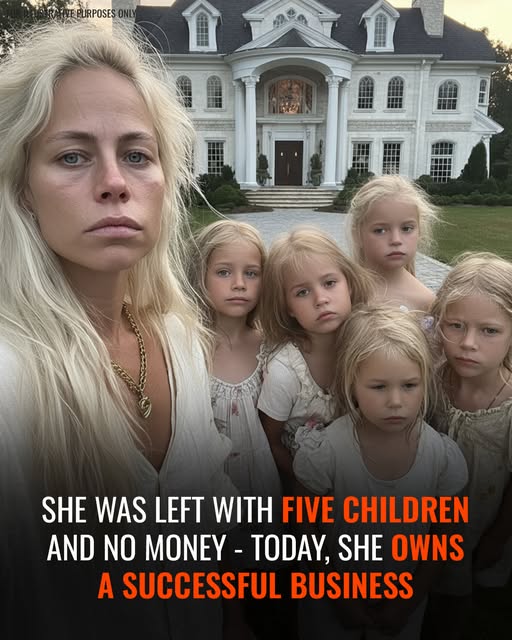
When Adrian walked out, he left Elara with five children, a crumbling mansion, and no income. What happened next was something no one — not even Elara — could have predicted. Could one knock on the door really change everything?
People always say they know their marriage is in trouble before it ends. They say there are signs like the coldness at dinner, the silences that grow too long, and the way your husband stops looking at you when you walk into a room.
But honestly, I never saw it coming.
For 20 years, I was Adrian’s wife. And for 20 years, I believed, with everything in me, that we were happy.
We lived in what I can only describe as a palace. It wasn’t just big — it was the kind of house that made visitors go quiet when they stepped through the front door. It had high ceilings, wide hallways, and a garden that stretched so far back you could lose a child in it. And we did lose children in it, actually. Many times. Five kids will do that to a garden.
I used to stand at the kitchen window in the mornings and listen to the noise of it all. I could hear someone arguing over the bathroom, someone else crying because they’d lost a shoe, and the twins chasing the dog through the hallway.
It was chaos, but it was warm, and I loved it.
Adrian was rarely home during those years. He was always building something, always closing a deal, always flying somewhere. Honestly, I didn’t mind because I had my children and the house. They made my life feel complete.
And then came a Tuesday morning in October that turned my world upside down.
I was standing at the kitchen counter making school lunches. I had the radio on low, half-listening to the weather forecast, when Adrian walked in still wearing his coat.
He looked at me and said, very calmly, like he was reading from a script, “I’m leaving you, Elara. I’ve been seeing someone. Her name is Cassandra. She’s 25.”
I put down the butter knife. I remember thinking that I hadn’t heard him right.
“What did you say?”
“I’m leaving,” he said again, and his voice didn’t waver. “I don’t love you anymore. I haven’t for a while. I think it’s better for everyone if I just go.”
I felt the room tilt. “Adrian, we have five children. We have a life. You can’t just — “
“I know,” he said, cutting me off. “And the house is yours. I’m not taking it. Consider it settled.”
“But how am I supposed to maintain it?” I asked.
“I don’t even have a job. I’m always taking care of the children.”
He shrugged. “I don’t know. I don’t need it anymore. Do whatever you want with it. Consider it my gift to you for the divorce.”
And then he picked up the bag he’d left by the door — the bag he had apparently already packed the night before while I slept — and he walked out.
I stood in that kitchen for a long time after that.
The lunches were still on the counter. The radio was still playing.
Outside, the kids were starting to stir, and I could hear footsteps on the stairs. I had to hold myself together long enough to get five children to school. So that’s what I did.
But once that front door closed behind the last of them, I sat down on the kitchen floor and cried until I had nothing left.
That was the beginning of the few months of my life.
Adrian had left the house to me, but that was all he’d left me. I had no income or savings that I could access. I had no plan.
The property taxes on a house that size were staggering, and I had no idea what they even were until the first bill arrived. Maintenance costs started piling up like a cruel joke. The heating alone was more than most people’s rent.
Bills arrived faster than I could open them. I started leaving envelopes on the kitchen table, telling myself I’d deal with them tomorrow.
With time, the pile got bigger, and my sleep became shorter.
I had never worked outside the home. I had a college degree I hadn’t used in two decades, and a skill set that read: school runs, meal planning, emotional labor, and managing a household that functioned like a small corporation. The bad news was that none of them paid a salary.
Eventually, I began to see only one way out: to sell the house, find a small apartment somewhere, and stretch whatever money the sale brought as far as it would go.
It wasn’t what I wanted, but I couldn’t see another option.
I had started making calls to real estate agents when, one afternoon in early December, someone knocked on the front door.
I wiped my face on a dish towel and went to answer it. And standing there on my front step, with three tired-looking kids pressed up against her legs and two overstuffed suitcases at her feet, was Mireya, my college roommate. She was someone I hadn’t seen in almost three years.
She looked like she hadn’t slept in days.
Her eyes were red, and one of her kids was asleep against her shoulder.
“Elara,” she said, and her voice broke on just that one word.
I didn’t even ask what had happened. I could see it on her face — the same look I’d been seeing in my own mirror for months.
“Come in,” I said. I stepped back and held the door open wide.
She exhaled like she’d been holding her breath for weeks.
I had no idea, standing there in that doorway, that the decision I’d just made in two seconds would end up saving my life.
Mireya’s divorce had been brutal, she told me later that night, after the kids were in bed. Her ex had emptied their joint account and left her with debt she hadn’t even known about.
She had nowhere to go and no money to get there with.
She’d thought of me — and the big, empty house she’d visited once years ago — and driven six hours on a hope and a prayer.
“I know this is a lot to ask,” she said, wrapping both hands around her mug of tea. “Just a few weeks. Until I can figure something out.”
“Stay as long as you need,” I told her. And I meant it, even though I was barely keeping my own head above water.
Within two days, five children became eight.
The house, which had started to feel like a tomb, suddenly felt like a fire station. It was loud and unpredictable.
Mireya’s youngest was four, the same age as my daughter Bea, and they were inseparable within an afternoon. Her older two folded into the rhythm of our school run as if they’d always been part of it.
But the logistics were, to put it plainly, a disaster.
“We need a system,” Mireya said one morning. “We can’t keep doing this. Someone’s going to lose their mind.”
“Someone already has,” I said, and we both laughed for the first time in weeks.
So we made a system.
Mireya picked up part-time grocery shifts while I handled the morning school run.
Corinne, my mother, called me that same week out of the blue and said she’d heard in my voice that something was wrong. Three days later, she showed up at the door with two suitcases, and that look on her face that meant there was no point arguing.
Click Here to continuous Read Full Ending Story👉 Part2: She Was Left with Five Children and No Money – Today, She Owns a Successful Business
She Was Left with Five Children and No Money – Today, She Owns a Successful Business
Part 1 of 2