Part 3 — The Clause That Changed Their Breathing
Marjorie snatched the paper like it could bite her. She read the first line, and her expression changed.
Not sadness.
Fear.
“Lifetime right of use and enjoyment in favor of the spouse…” she whispered, voice cracking.
Declan leaned in. Fiona made an offended sound.
I stayed leaning on the chair like I had all the time in the world.
“Bradley signed a document stating this home remains under my exclusive use for as long as I live,” I said. “Any attempt to evict me or take property without my consent is trespassing and coercion.”
I tapped a clause.
“And there’s an express waiver preventing family members from removing anything until a notarized inventory is completed.”
Marjorie’s eyes glistened with rage.
“That can’t be true. I’m his mother.”
“And I’m his wife,” I said. “Bradley was an adult with full legal capacity.”
Declan tried to pivot. “Fine, but the company… the accounts… the car—those belong to the family. Bradley inherited them.”
I nodded once.
“The company is covered, too.”
That sentence landed like a glass shattering quietly.
Because they weren’t here for memories.
They were here like hyenas—fast, hungry, organized.
“Bradley didn’t trust you,” I said. “And before he died, he left instructions. Not out of revenge. Out of prevention.”
Marjorie crushed the paper in her fist. “It’s fake!”
I opened my phone and pulled up Bradley’s email titled “Just in case.”
“I have the email chain. The notary has the original. You want to argue about it with a judge?”
Siobhan muttered, barely audible:
“Aunt Marj… we should leave.”
Marjorie snapped at her. “Shut up.”
And that’s when I saw it—what they’d do next.
If they couldn’t take the home, they’d take what they could carry.
“Nobody is taking anything,” I said, and dialed 911—my finger steady now. “From this moment on, anything leaving this apartment gets documented.”
Declan lifted his hands. “No need for police…”
“Yes,” I said. “There is. You already opened drawers. You already searched for the USB. You already crossed the line.”
Part 4 — The Moment “Family” Didn’t Work Anymore
The patrol car arrived in under fifteen minutes.
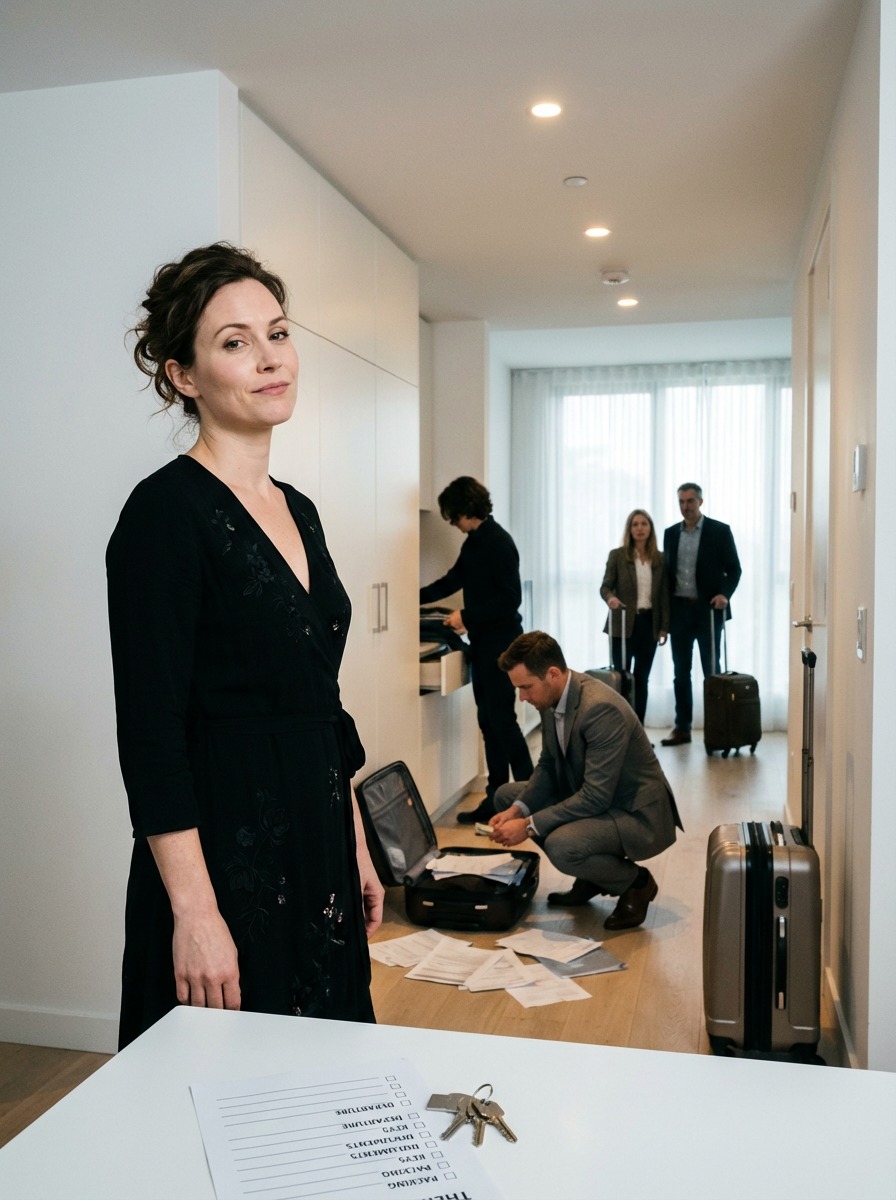
Two officers stepped in and immediately clocked the suitcases, the open drawers, the mess in the hallway. One—a woman in her forties—asked for my ID and listened without interrupting. The younger officer turned to Marjorie.
“Ma’am, why are you removing belongings from this property?”
Marjorie lifted her chin like the truth was optional.
“This is my son’s home. He passed. She is… a temporary occupant.”
The officer looked at me. I handed over the deed copy and the notary confirmation.
Her tone changed instantly.
“This document records an exclusive right of use for the surviving spouse. Without an authorized inventory, you cannot remove property.”
Declan jumped in. “We’re just helping her pack.”
“With eight suitcases?” the younger officer said flatly.
Silence.
Marjorie’s voice turned poisonous.
“Do you know what you are, Avery? A gold digger. You married for money.”
It hit the old wound—the one people love to press into young widows like a thumb on a bruise.
But Bradley left me something stronger than insult.
“No,” I said. “I married for love. And he signed this out of fear of you.”
Marjorie stepped forward.
The young officer moved between us.
“Ma’am. Keep your distance.”
Marjorie’s breathing went ragged. Then she hissed the sentence that explained everything:
“He was my son. He belonged to me.”
The officer’s voice went cold.
“Nobody belongs to anyone.”
I swallowed the lump in my throat.
This wasn’t the time to collapse.
It was the time to close doors.
I asked the officers to note the searched drawers and the missing USB. Siobhan went visibly tense at that.
“I… I don’t have it,” she muttered.
I didn’t look at her.
If it existed, it would surface.
The female officer addressed the family:
“You are vacating the premises now. Any dispute goes through civil court. If you refuse, it becomes trespassing and coercion.”
Suitcases started moving—fast, bitter, humiliating.
Marjorie held still until the very end, staring at me like I was the one who had died.
Before leaving, she leaned close enough for only me to hear.
“You don’t know who you messed with.”
I answered just as quietly.
“And you didn’t know who your son married.”
Part 5 — The Clean Silence After the War
When the door finally shut, the apartment felt different.
Not empty.
Clean.
I slid down to the floor beside the open closet and cried—hard, shaking. But it wasn’t defeat.
It was release.
The next morning, I went to the notary. I got the certified copy and, more importantly, the deposit record: Bradley had placed sensitive documents and company instructions in a protected channel.
Not a treasure.
A defense system.
Bradley knew they’d try to bulldoze me, so he built a maze with exits that only opened for me.
That afternoon, I changed the locks.
I filed the deed in a red folder.
And I hung a photo of Bradley on the wall—not the funeral one. The one where he was laughing on the beach like the world hadn’t touched him yet.
I stood there a long time, then whispered:
“Don’t worry. They can’t come in screaming anymore. Now they have to knock… and explain.”
And for the first time since he died, my grief didn’t feel like only loss.
It also felt like the beginning of a life where nobody—nobody—could push me out with noise.