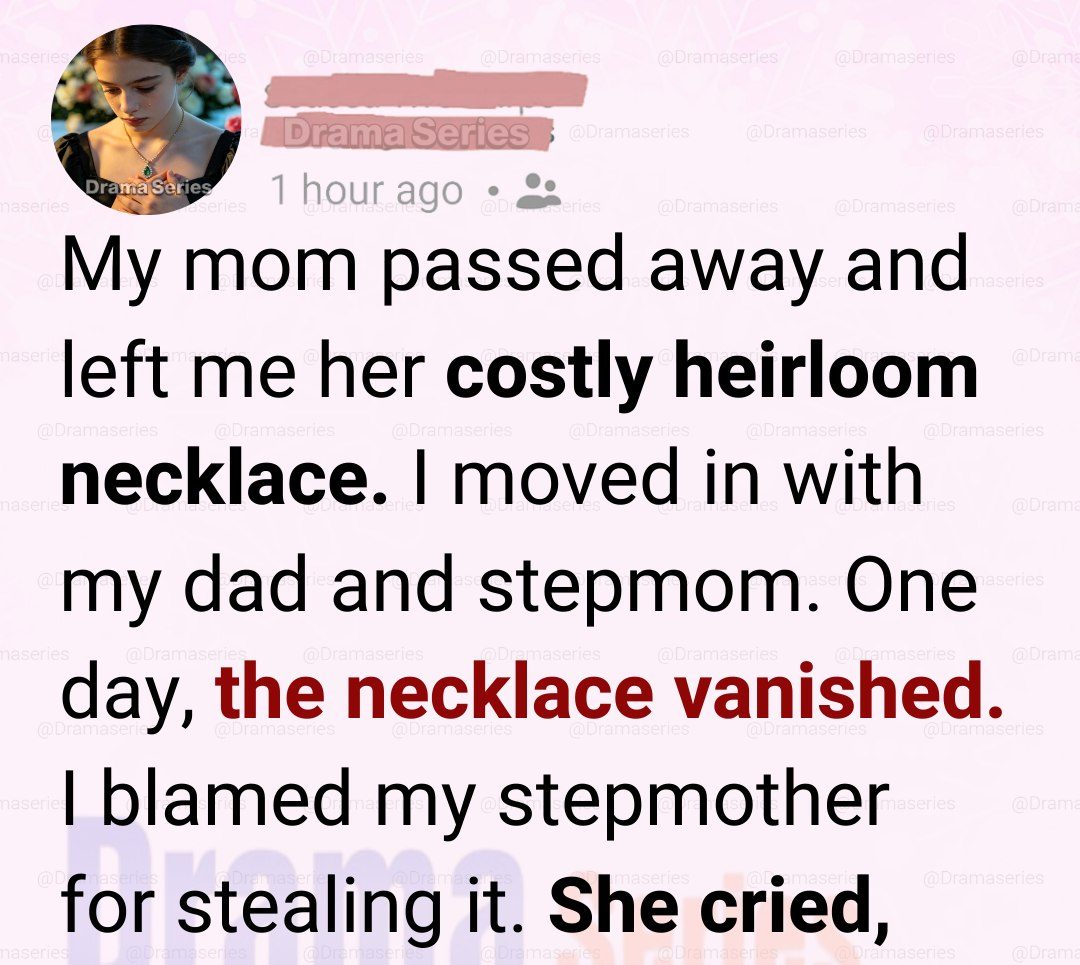
Maybe blaming Marianne had been easier than facing what I’d done.
“I—I don’t remember,” I stammered, but even as I said it, the truth clawed its way up my throat.

Dad stared at me, shock turning slowly into heartbreak.
The officer’s voice softened. “Grief can make people act in ways they don’t understand.”
I collapsed onto the couch, sobbing. “I thought she took it. I wanted it to be her.”
Dad dismissed the officers after they explained the necklace would be returned. No charges would be filed — the shop owner had agreed, given the circumstances.
The silence in the house afterward was unbearable.
“I asked her to leave,” Dad said finally, his voice thick. “I chose you without question.”
Guilt burned through me. “I’m sorry.”
That afternoon, we drove to Marianne’s sister’s house. When she opened the door and saw us, her eyes were red and swollen.
I couldn’t meet her gaze.
“It was me,” I whispered. “I sold it. I don’t even know why. I’m so sorry.”
For a long moment, she just looked at me.
Then, to my surprise, she pulled me into her arms.
“I know you’re hurting,” she said softly. “I would never take something that precious from you.”
I cried harder than I had at the funeral.
The necklace was returned the next day. I held it differently this time — not just as a memory of my mother, but as a reminder of how easily grief can twist love into suspicion.
And how forgiveness, when given freely, can stitch a broken family back together.


One Comment on “Part3: I Accused My Stepmother of Stealing My Late Mom’s Necklace—Then the Police Knocked on Our Door”