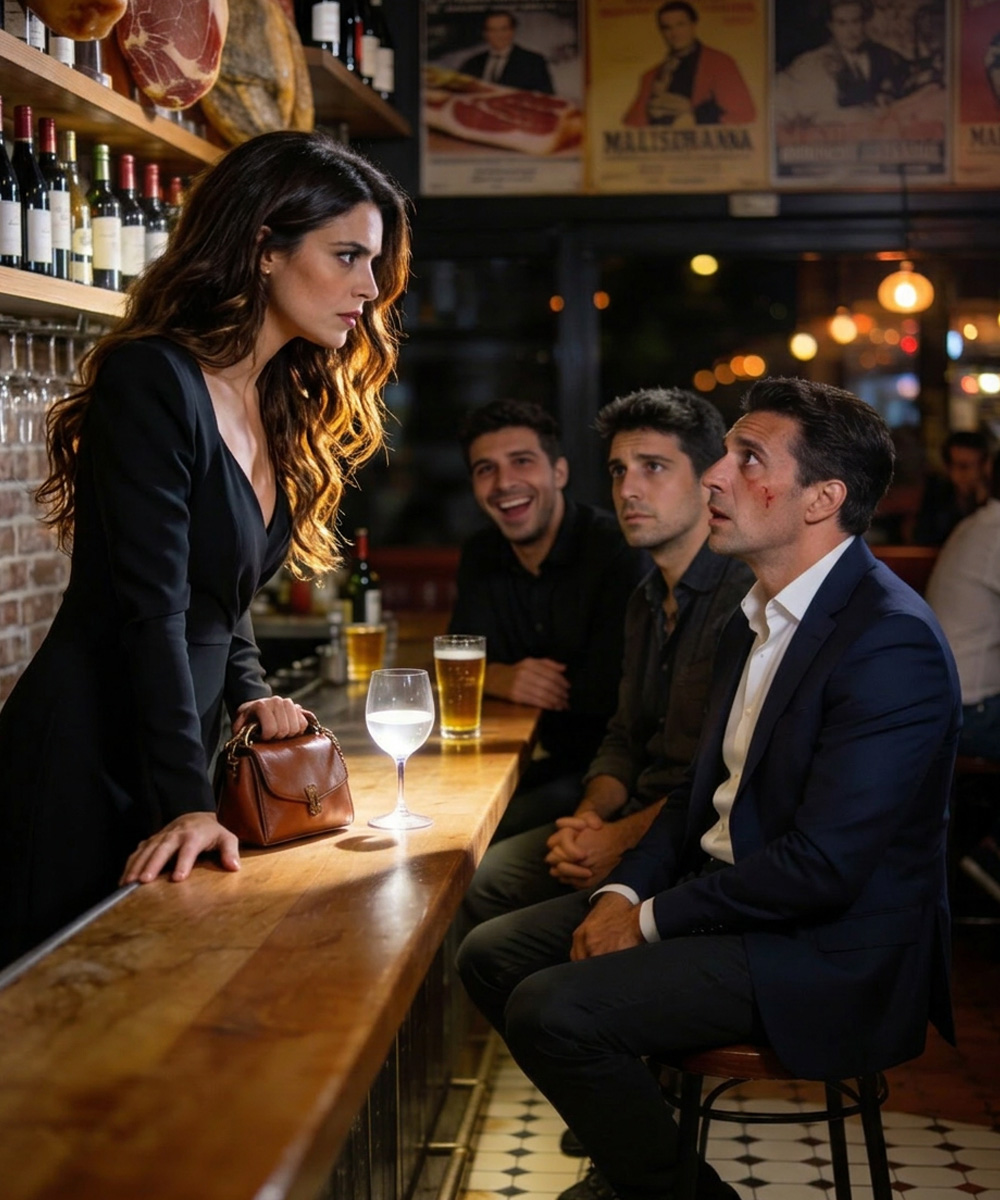
“Then let’s start from the beginning,” I whispered. “Tell me everything.”
In the weeks that followed, my life split into two layers. In one—the visible one—I was the wife who had left the marital home; I attended meetings with a lawyer in Chamberí, gathered pay stubs, bank statements, messages. In the other—the invisible one—I listened as Diego, night after night, unraveled Javier’s small empire of lies.
We met in discreet places: a café near Retiro in the late afternoon, a tavern in Lavapiés always full of tourists, a bench in Parque del Oeste. He brought a USB drive, notes in a notebook, and his memory. I brought questions.
“Here’s the contract with the Barcelona studio,” he explained one day, pointing at my laptop screen. “The bonus clause. If his reputation is compromised, they can terminate it without paying him a cent.”
Another afternoon he showed me emails in which Javier mocked me with his colleagues:
“The poor thing, Lucía, still teaching at that high school in Vallecas. As if I couldn’t support her on my own.”
I read every word with a strange sense of distance, as if they were talking about someone else. That other Lucía no longer existed; the one left now was learning how to turn pain into strategy.
“I don’t want to do anything illegal,” I clarified one night. “Let’s make that clear.”
“You don’t have to,” Diego replied. “You just have to stop protecting him.”
My lawyer, Nuria, didn’t know anything about Diego, but she knew how to read numbers.
“Your husband thinks he’s untouchable,” she said while reviewing the documents. “But if we prove he’s hidden income and used you as a tax cover, things change. And if the architecture firm finds out before he can cover his tracks… even better.”
The plan didn’t appear overnight. It formed like a spreading ink stain. I sent Nuria the emails Diego passed on to me. Nuria explained what could legally be used and what couldn’t. Diego, without knowing the details, kept feeding that silent archive.
Meanwhile, Javier insisted on interpreting everything as a passing tantrum.
“I’m sorry,” “I exaggerated,” “I miss you,” “come home and we’ll talk,” filled my WhatsApp. He began leaving flowers at my sister’s house, calling my parents in Toledo, showing up at the door of my school.
One afternoon, leaving class, I found him leaning against my car with a bouquet of red roses.
“Lucía, please,” he said, stepping closer. “That night was stupid. You know how guys are when we’re with friends.”
I looked at him as if he were a stranger offering me a flyer on the street.
“Exactly, Javier. Now I know.”
“We can go to therapy, change things…” he insisted, lowering his voice. “You’re not going to throw seven years away over a sentence taken out of context.”
I thought about the bet. About the “transition to a woman at his level.” A faint smile touched my lips.
“I’m not throwing them away,” I replied. “I’m using them.”
A few days later, Javier received an email from his boss summoning him to an urgent meeting. I wasn’t there, but Diego described his face when he came out of the office: pale, his jaw tight. The studio had received an anonymous folder containing copies of emails, suspicious account movements, and a formal complaint from “an affected party” regarding his sexist remarks. The Barcelona contract was frozen “pending further review.”
I hadn’t sent the folder myself. Nuria had handled everything, following the legal timing as if she were directing a play.
Soon after, the divorce negotiations began. Javier arrived at the first meeting with a wrinkled suit and red eyes.
“You don’t have to make this so difficult,” he spat when the lawyer explained our terms.
“You didn’t have to turn our marriage into a bet either,” I replied calmly.
His eyes locked onto mine, for the first time without arrogance.
“Diego?” he asked, barely moving his lips.
I didn’t answer. I didn’t need to.
The final agreement was better than I had imagined: I kept the apartment in Lavapiés, received reasonable financial compensation, and—most importantly—a document in which Javier renounced any future claims. His firm didn’t fire him, but the Barcelona project went to another architect, and his name stopped coming up in important meetings.
The last time I saw him was when we signed the papers before a notary in an old building on Alcalá Street. He seemed about to say something, but swallowed the words. He signed. I signed too. The notary looked up, recited the formal phrases, and with that, the “joke of a marriage” officially ended.
Outside, Diego was waiting for me, leaning against a streetlamp with a takeaway coffee in each hand.
“So… what now?” he asked, handing me one.
I looked at the traffic, the people crossing the street, the overcast Madrid sky. Javier still existed—with his wounded ego and his career on pause. The world hadn’t collapsed. But he no longer had power over mine.
“Now there are no bets,” I said. “Only decisions.”
Diego smiled, for the first time without guilt in his eyes. We walked down Alcalá without touching, like two people who knew the future wasn’t written—but at least it was no longer a joke told in a bar full of other people’s laughter.
And for the first time in a long time, when I thought about my life, I didn’t feel shame or fear. Only a clear silence—like a blank page waiting to be written by me, and by no one else.