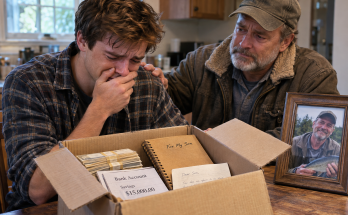
I filled several pages that evening.
Some sentences came easily.
Others took a long time.
I found myself crossing out words that sounded harsher than I intended.
Then I stopped doing that.
There was no reason to make the letter easier for Dad to read.
He would never read it.
The point was to be honest.
I told him that I had spent years feeling unwanted.
I admitted that I had confused his silence with a complete absence of affection.
I explained that the money had changed my understanding of his intentions.
But I also explained that I would have preferred an honest father to a secret savings account.
I would have preferred knowing he was proud of me.
I would have preferred being able to ask for help without worrying that he considered me weak.
Those things would have mattered more than interest earned at a bank.
I wrote that I wished he had bought me shoes when I was younger.
Then I wrote something that surprised me.
I told him I wished I had bought him something too.
Something he wanted.
Something unnecessary.
Something that would have made him happy without requiring him to earn it first.
I thought about his fishing equipment.
Perhaps we could have gone fishing together.
Perhaps I could have learned enough about his interests to ask better questions.
There was no guarantee that he would have responded differently.
But I wished I had experienced some of the ordinary moments Hank remembered.
Eventually, I reached the bottom of another page.
I wrote that I loved him.
Then I sat looking at those words.
They were true.
They had probably always been true.
Even during the years when I had been most angry, there had been a part of me waiting for him to show me that I mattered.
I wouldn't have waited if I hadn't cared.
I closed my notebook.
The kitchen was quiet.
But it no longer felt quite as oppressive.
I had finally said what I needed to say.
Even if the only person who heard it was me.
The following morning, I returned to my financial plans.
The bank arrangements were being completed.
I had a clearer picture of what I would have available.
I also continued working my usual shifts.
Receiving the savings didn't mean I could suddenly stop earning an income.
Fifteen thousand dollars was significant to me.
But it wasn't enough to live carelessly.
I wanted to use it well.
I began looking at available apartments.
I had done that many times before, usually just to remind myself what I was working toward.
This time, the numbers looked different.
I could consider places I previously dismissed because I couldn't afford the initial costs.
There were small apartments that would have been suitable.
Nothing luxurious.
Exactly the kind of place I used to imagine while sitting in my bedroom.
I arranged to look at one.
The apartment had a modest kitchen and a bedroom with a plain closet.
There was enough space for a small table.
The floors were clean.
The windows let in a reasonable amount of daylight.
I walked from room to room, imagining where my belongings would go.
The person showing me the property explained the rent and the other expenses.
I listened carefully.
I asked questions about the lease.
I had learned enough from Dad to take recurring obligations seriously.
I understood the importance of knowing what I could afford.
When the viewing ended, I stood outside for a moment.
I could have applied for the apartment.
For the first time in years, that possibility was real.
Yet I didn't experience the excitement I had expected.
I felt uncertain.
Not because the apartment was unsuitable.
Because I was no longer sure that leaving Dad's house immediately was what I wanted.
That realization disturbed me.
I had devoted so much energy to the idea of moving out.
It had become the clearest objective in my life.
Now that I could pursue it, I found myself questioning whether the objective still meant the same thing.
I drove home.
Dad's boots were near the entrance.
The cardboard box was on the kitchen table.
I placed the information about the apartment beside it.
Then I sat down.
There was nothing wrong with wanting a home of my own.
But I began understanding that much of my desire to leave had been about escaping the way I felt around Dad.
He was gone.
The house itself hadn't demanded rent from me.
The bedroom hadn't judged me.
The kitchen hadn't chosen silence.
I had attached those feelings to the rooms because that was where I experienced them.
Now I had an opportunity to decide whether those rooms could mean something different.
I wasn't obligated to stay.
I wasn't obligated to leave.
That was new.
When Hank visited later that week, I showed him the apartment information.
He studied it.
"Looks like a decent place."
"It is."
"Did you like it?"
"I think so."
He looked at me.
"But?"
I smiled slightly.
"But I don't know if I want to move right now."
Hank set the papers down.
"Then don't rush into it."
I explained that staying in the house made me feel as though I were abandoning the promise I had made to myself at eighteen.
For years, I had imagined leaving as proof that I had succeeded.
If I stayed, what did that mean?
Hank considered the question.
"Maybe it means you're making a different choice now."
I looked toward the hallway.
"I used to hate being here."
"I know."
"Sometimes I still do."
He nodded.
"That's understandable."
We talked about the estate.
There were still formal matters to resolve, including the ownership and future of the house.
Until those were settled, I needed to avoid making assumptions about what would happen.
Hank encouraged me to get proper advice and understand the financial responsibilities before deciding anything permanent.
I agreed.
I didn't want grief to make expensive decisions for me.
Nor did I want old anger to determine where I spent the next several years of my life.
For the time being, I continued living in my childhood bedroom.
But the arrangement felt different.
There was no payment waiting for Dad.
There was nobody requiring me to justify my presence.
Instead, I began setting aside money for household costs and my future.
I chose an amount that made sense alongside my wages and other expenses.
Sometimes I saved more.
Sometimes I needed to save less.
The important difference was that I understood where the money was going.
I had control over it.
One evening, I bought groceries and returned home with more than I usually purchased.
There were things I had previously avoided because they cost a little extra.
Nothing extravagant.
Just food I actually wanted.
I prepared dinner in the kitchen.
Then I turned on some music.
I remembered imagining this exact thing years earlier.
A kitchen where I could play music while cooking.
I had assumed it needed to be in an apartment somewhere else.
Instead, it was happening in the house where I grew up.
For a few minutes, I almost forgot how much sadness the room contained.
Then a song reminded me of Mom.
I couldn't remember whether it was one she used to sing.
But I recognized the feeling it brought back.
I turned the volume slightly higher.
I thought about how different the house might have sounded if Dad and I had allowed ourselves to enjoy it after losing her.
Perhaps we had both confused sadness with loyalty.
As though laughing too much would mean we had forgotten Mom.
I didn't want to live that way anymore.
I finished cooking.
I sat at the kitchen table.
Without thinking, I chose Dad's chair.
I had been sitting there occasionally since opening the box.
At first, it had made me uncomfortable.
Now it was simply a chair that carried memories.
I ate my dinner and listened to the music.
Nobody told me to turn it down.
Nobody counted money across from me.
Nobody asked me to explain myself.
I enjoyed the meal.
Afterward, I washed the dishes and returned to my bedroom.
I looked at the old work shoes.
They were still beside the new pair.
I had kept them through several more shifts.
I picked one up and examined the damaged sole.
The glue had started cracking.
I pressed it gently with my thumb.
There was a time when I would have immediately started thinking about how to repair it.
Now I recognized that its useful life was finished.
I carried both shoes downstairs.
I stood beside the trash for a moment.
It was harder than I expected to throw them away.
They represented years of effort.
Years of making things last.
Years of trying to manage without asking anybody for assistance.
But I didn't need to preserve every difficult experience in physical form.
I placed them in the trash.
Then I went upstairs and prepared my new shoes for the following morning.
That small decision felt surprisingly important.
I could appreciate what the old shoes had done for me without continuing to wear them.
Perhaps I could approach certain memories the same way.
The next time Hank came over, I offered him dinner.
He seemed surprised.
"You cooking now?"
"I've always been able to cook."
He laughed.
"I know. I just don't think you've ever invited me to dinner."
He was right.
When Dad was alive, I mostly kept to myself whenever Hank visited.
I considered their conversations none of my business.
Now I wanted to know him as more than my father's friend.
He had become somebody I could talk to.
We ate together at the kitchen table.
He told me about something that had happened during his week.
I told him about work.
Nothing profound.
Nothing especially emotional.
But I noticed how pleasant it was to sit in that room and have somebody ask questions about my life.
I told him about the new shoes.
He glanced down at them.
"Comfortable?"
"Very."
"Good."
That was all he said.
It was enough.
After dinner, he helped me clear the table.
Then we looked through the cardboard box again.
I wanted to organize everything more permanently.
The account records needed to be kept safely.
I had decided to retain Dad's notebook too.
Not because I expected to need every entry.
Because it was one of the few objects that showed his care in a form I could actually understand.
Hank watched me place the papers into a folder.
"You know, he worried about you more than you realized."
I nodded.
"I believe that now."
It was the first time I had said those words without immediately qualifying them.
Hank looked at me.
I continued.
"I still wish he'd done things differently."
"So do I."
"But I know he cared."
Hank smiled.
I wasn't declaring that the past no longer mattered.
I was simply accepting something I had previously been unable to believe.
There had been love inside that house.
There had also been distance.
The presence of one didn't eliminate the other.
When the papers were organized, I looked at the cardboard box.
It was empty except for a few loose scraps of packing tape.
I could have thrown it away.
It was only cardboard.
Instead, I folded the flaps closed and placed it inside a cupboard.
I wanted to keep it.
Perhaps someday I would feel differently.
For now, it belonged among the things I wasn't ready to lose.
Hank prepared to leave.
Before he reached the door, I called his name.
He turned around.
"Thanks for everything."
He waved his hand slightly.
"Of course."
"No. I mean it."
He stopped.
I told him how much it had mattered that he brought the box, stayed while I opened it, accompanied me to the bank, and listened when I became angry.
He hadn't insisted that I remember Dad a certain way.
He hadn't told me how quickly I should forgive him.
He had simply been there.
Hank looked uncomfortable for a moment.
Then he reached over and squeezed my shoulder.
"Your dad would have wanted me to help."
I nodded.
"And I'm glad you did."
After he left, I remained near the entrance.
Dad's work boots were still there.
I looked at them for a long time.
I remembered him arriving home after work.
I remembered the sound of those boots against the floor.
I remembered the countless evenings when I had heard him come inside without going downstairs to greet him.
I bent down.
This time, I picked them up.
They were heavier than I expected.
I carried them upstairs and placed them carefully inside his closet.
I wasn't throwing them away.
I wasn't trying to erase him.
I was simply accepting that they no longer needed to wait beside the front door.
When I returned downstairs, the entrance looked different.
There was an empty space where the boots had been.
I stood looking at it.
For several weeks, I had been afraid of that empty space.
Now I could see that making room for something new didn't require forgetting what had occupied it before.
I went into the kitchen and took out my notebook.
I added another line to the letter I had written Dad.
I told him that I was going to be all right.
I didn't know exactly where I would live permanently.
I didn't know what work I would be doing in another five years.
But for the first time, those uncertainties didn't frighten me quite as much.
I had some savings.
I had a friend I could call.
I had a better understanding of my father.
And I was learning that being responsible for my future didn't mean I had to face every part of it alone.
Click here to continue reading: PART 9: The Day I Finally Decided What to Do With My Childhood Home, I Understood Why Money Alone Had Never Been Enough
My Father Never Asked Whether I Was Happy, but on My Eighteenth Birthday, He Finally Told Me What He Expected
Part 8 of 10