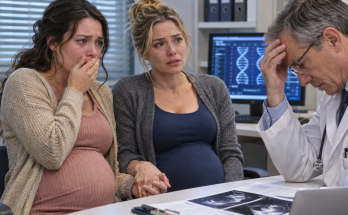
I had never been afraid of a computer screen before.
But that morning, the one on the doctor's desk seemed to hold every answer I wanted and every answer I feared.
I kept looking at it.
Two sets of genetic results.
Mine and Emily's.
Both connected to the babies we were carrying.
And somewhere in those results was something the doctor had found unusual enough to call us into his office together.
I wanted him to explain everything.
I wanted to understand why he had asked whether we were certain about Daniel.
There had been no hesitation when we answered.
We were certain.
We had chosen the same donor deliberately.
That was the whole reason our pregnancies were connected.
Yet the doctor had looked troubled when we confirmed it.
I could still picture his face.
He had spent twenty-seven years working in genetics.
He had said findings like ours were uncommon in his experience.
And he had told us that confirmation was necessary before he could explain what they might mean.
I didn't know what to do with those words.
I had entered the clinic expecting information.
Instead, I had discovered how frightening incomplete information could be.
Emily sat beside me.
For most of our lives, I had been able to understand her without asking what she was thinking.
That morning was no different.
She was frightened too.
I recognized it in her silence.
She was usually the one who found a way to make an uncomfortable situation feel manageable.
Even when we were younger, she had known how to make me laugh at things that seemed unbearable.
But neither of us was laughing now.
I thought about how different things had been only a short time earlier.
We had been choosing baby clothes.
Talking about names.
Imagining the day our children would finally meet.
We had spent years wanting those ordinary experiences.
Now I would have given anything to return to them without fear.
I remembered the first time Emily suggested using the same donor.
I had laughed because I thought she was joking.
Then I saw that she was serious.
She wanted our children to have a biological connection.
She wanted them to be brother and sister, or perhaps two sisters.
I had never considered anything like it.
But the more we discussed the possibility, the more it seemed to fit the future we had always imagined.
We had known each other for twenty-five years.
Our mothers had always said we behaved like sisters.
And we had shared almost every important part of growing up.
It seemed natural to want our children to experience something similar.
We didn't want them to be strangers who occasionally met because their mothers were friends.
We wanted them to grow up knowing they belonged to the same family.
At the time, it had felt like a generous idea.
A beautiful one.
I had not questioned whether I was expecting too much from a biological connection.
Now that question would not leave me alone.
Sharing a father would not guarantee our children became close.
It would not guarantee they liked the same things.
It would not guarantee they would understand one another the way Emily and I did.
I knew that.
I had always known it, somewhere beneath my excitement.
But I had been so eager to recreate the closeness of our friendship that I had treated genetics as a kind of promise.
It wasn't.
Genes could establish a biological relationship.
They couldn't determine the love two people would eventually feel.
Looking back, I wish I had understood that difference more clearly before we made our decision.
Not because I regretted wanting my child.
I never did.
But because I had been asking our children to carry a dream that belonged to us.
They hadn't been born yet.
They hadn't chosen one another.
They hadn't chosen Daniel.
And they hadn't chosen the unusual arrangement that brought their mothers into the same doctor's office.
Emily and I had made those decisions.
We had believed they were right.
Now we were responsible for understanding whatever consequences might follow.
I looked toward the doctor again.
He had not told us that our babies were sick.
I reminded myself of that.
He had not established a diagnosis.
He had not explained exactly what made the results unusual.
And he had not confirmed that our children faced a particular medical problem.
Those distinctions were important.
Without them, fear could turn a question into an answer.
I was beginning to understand how easily that could happen.
A doctor looked concerned.
A nurse sounded tense.
A medical result required confirmation.
And suddenly my mind wanted to imagine every possible disaster.
I had no evidence for those imagined outcomes.
Only fear.
It was difficult to admit that.
I wanted my worry to mean something.
I wanted it to help me protect my baby.
But worrying could not interpret a genetic test.
No matter how frightened I became, the information on the screen would remain the same.
I thought about Daniel.
The donor we had selected after months of medical preparation.
He was thirty-five.
He had been described as healthy.
And he had agreed to help us become pregnant.
Those were the things we knew.
We had built our plan around them.
But I realized how little those details could tell me about the findings in front of the doctor.
I had been comforted by the word healthy.
I had treated it as though it could answer every question about our children's future.
It couldn't.
No description of another person's health could guarantee that a pregnancy would unfold exactly as planned.
I understood that now.
It was not an accusation against Daniel.
It was not proof that anyone had overlooked something.
It was simply the limit of what I knew.
And that limit suddenly seemed enormous.
I remembered the months we spent attending consultations and completing tests.
At the time, I had been proud of how carefully we approached the process.
I had believed we were being responsible.
We weren't rushing into a decision based only on emotion.
We had sought professional guidance.
We had waited.
We had considered what we were doing.
All of that remained true.
But being careful did not mean knowing everything.
I had confused the two.
And sitting in that office, I felt the weight of that mistake.
I looked down at my hands.
I thought about my baby.
I had wanted to become a mother for years.
After my divorce, I had wondered whether the future I imagined would ever happen.
I had spent five years trying to accept that my life might not follow the path I once expected.
Then Emily had suggested another possibility.
And I had allowed myself to hope again.
That hope had become real.
I was pregnant.
She was pregnant.
Only three weeks separated us.
I had been so happy that I barely knew what to do with myself.
Now I couldn't stop wondering whether happiness had made me less willing to ask difficult questions.
I didn't have an answer.
Perhaps I had asked everything I knew to ask.
Perhaps there were questions I couldn't have anticipated.
The doctor still needed to confirm the findings.
Until that happened, I could not know what they meant.
And I was beginning to understand that guessing would only make the waiting harder.
Emily shifted beside me.
I turned toward her.
For a moment, I thought about how young we had been when our friendship began.
Two girls who had no idea what adulthood would demand of them.
We had imagined marriage.
Children.
Families living close together.
We hadn't imagined donor arrangements or genetic consultations.
We certainly hadn't imagined being pregnant at the same time and frightened by information neither of us could interpret.
But there we were.
Older than the girls who made those promises.
Still together.
Still trying to understand what came next.
I wanted to say something that would comfort her.
Something simple.
Something certain.
But there was nothing certain I could honestly say.
I could tell her that I loved her.
I could tell her that I wanted both babies to be healthy.
I could tell her that I wasn't going to pretend the doctor's concern meant nothing.
Those were truths I could stand beside.
Everything else remained unknown.
And I was tired of trying to fill the unknown with reassuring explanations.
I looked at the doctor again.
I wanted to ask him what confirmation would mean.
What questions the results raised.
What information we needed before drawing conclusions.
I wanted to understand the findings as they were, not as my imagination made them.
That was a change.
At the beginning of the appointment, I had wanted him to make my fear disappear.
Now I wanted him to help us distinguish what he knew from what he still needed to establish.
It wasn't as comforting.
But it was more useful.
I thought about the babies sharing a biological father.
That fact had once seemed to explain everything important about their relationship.
Now it was only one part of a much larger picture.
Our children would be related.
But their health, their futures, and the people they became could not be reduced to that single connection.
They were already more than the plan Emily and I had made.
I felt ashamed that it had taken a frightening medical appointment for me to understand something so simple.
We had wanted our babies to belong to one another.
But first, we needed to remember that each baby was a person whose life mattered independently.
I looked at Emily again.
I knew she loved her baby already.
I knew she had wanted motherhood as deeply as I had.
And I knew that whatever the confirmed results eventually showed, neither of us could undo the fact that our children were now depending on us.
We had entered this experience together.
We would have to face the facts together too.
Not because our friendship guaranteed a happy ending.
But because we had made the decisions together and owed our children the clearest understanding we could obtain.
For the first time that morning, I stopped thinking about whether our original plan had been perfect.
It hadn't needed to be perfect.
It needed to be responsible.
And responsibility did not end once we became pregnant.
It continued through every difficult question we were now facing.
The doctor had told us the findings required confirmation.
I could not make that process happen through fear.
I could not predict the outcome.
And I could not promise Emily that nothing was wrong.
But I could accept that we needed reliable answers before deciding what those results meant.
I looked once more at the computer.
Two sets of information.
Two pregnancies.
One donor.
And two women who had believed they understood exactly what they were choosing.
I no longer believed we understood everything.
That was painful.
But it was also the first thing I felt certain about.
Our babies deserved the truth.
Even if it was difficult.
Even if it changed the way Emily and I imagined their future.
And even if it meant admitting that the beautiful story we had planned for our children was not something we had the right to guarantee.
I turned away from the screen.
I looked at my best friend.
And I knew that whatever the results eventually meant, we would have to put the children ahead of the dream that brought us there.
Click here to continue reading: PART 8: The Doctor Still Could Not Confirm What Our Genetic Results Meant, and I Finally Understood What My Baby Needed From Me
I Thought Sharing a Father Would Bring Our Children Closer, Until One Doctor Made Me Question Everything We Had Planned
Part 7 of 10