
I had spent most of that morning waiting for someone to tell me everything was fine.
I wanted those words more than anything.
But the doctor had not said them.
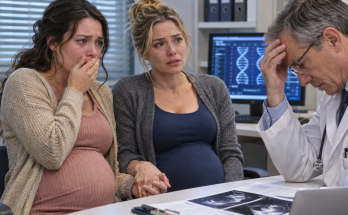
He had told Emily and me that our genetic test results showed something unusual.
He had explained that the findings needed confirmation.
And he had warned that the results might be important for our children's future.
That was all we knew.
I kept reminding myself of that.
There was no confirmed diagnosis.
No clear explanation of what had caused the unusual findings.
No answer to the question that mattered most to me.
Were our babies all right?
I looked at the doctor's computer again.
The results were still there.
Numbers and information I couldn't understand.
Two pregnancies.
Two expectant mothers.
And one biological father.
Daniel.
The man Emily and I had chosen because we wanted our children to share the same genes.
Five months earlier, I would have smiled at the thought.
Now I was frightened by how little I understood about it.
I sat beside Emily, trying to remember when our dream had started to feel so complicated.
It hadn't begun in a medical office.
It had begun with a conversation between two women who had known each other almost their entire lives.
I was thirty-two.
Emily was thirty-one.
We had spent twenty-five years growing up together, making mistakes, falling in love, and recovering when those relationships didn't last.
Our mothers had called us sisters.
We had liked that description.
We still did.
But somewhere along the way, we had begun wanting more than a friendship that felt like family.
We wanted children.
And we wanted those children to grow up together.
When Emily suggested using the same sperm donor, I had laughed.
I thought the idea was too unusual to take seriously.
Then she explained it.
Our babies could share a biological father.
They could be brother and sister.
Or two sisters.
The possibility had seemed almost beautiful in its simplicity.
We wouldn't have to wait for the right men to enter our lives.
We wouldn't have to postpone motherhood because our relationships had disappointed us.
We could pursue the family we wanted.
Together.
I remembered the excitement I felt when we finally agreed.
It had been years since I allowed myself to imagine becoming a mother with that much confidence.
My marriage had ended five years earlier.
I had spent a long time believing that divorce meant starting my life over from nothing.
But Emily's suggestion gave me another way forward.
We sought medical guidance.
We completed the consultations and tests.
And after months of preparation, we chose Daniel.
He was thirty-five.
He was described as healthy.
And he had agreed to become a donor.
I had taken those facts as reassurance.
Perhaps more reassurance than they could reasonably provide.
I remembered how relieved I felt when the selection was complete.
It seemed as though the difficult decisions were behind us.
We had followed the process.
We had found the donor.
Now all we could do was hope.
Then both pregnancies happened.
Three weeks apart.
I still remembered how impossible that news had felt.
For years, motherhood had seemed distant.
Suddenly, it was real.
There was a baby growing inside me.
And Emily was carrying a baby too.
We had been so happy.
We had shopped for tiny clothes, talked about names, and imagined our children becoming inseparable.
I had thought the most uncertain part of our journey was over.
Looking back, I can see how naive that was.
Pregnancy wasn't the end of responsibility.
It was the beginning of a different kind.
One that required me to think beyond my own happiness.
I looked toward Emily.
She was still quiet.
I knew she was thinking about her baby.
Just as I was thinking about mine.
I wanted to reach across the space between us and promise that everything would turn out well.
But I couldn't.
I didn't know.
And I had spent enough of my life making promises to myself that reality couldn't guarantee.
I had once believed marriage would give me a permanent family.
It hadn't.
I had believed that choosing a healthy donor and completing medical tests would leave us prepared for whatever came next.
Now I understood how much uncertainty could remain.
I didn't want to repeat the same mistake by promising Emily an outcome I couldn't know.
So I stayed quiet.
It wasn't easy.
Silence had always meant something different between us.
When we were children, silence could mean comfort.
When we were heartbroken, it could mean understanding.
Now it meant that neither of us had the answer.
And for once, I couldn't find a way to make that feel better.
The doctor had said he had worked in genetics for twenty-seven years.
I kept thinking about that number.
Twenty-seven years.
He had spent longer studying his field than Emily and I had spent being friends.
And even he had said the findings needed confirmation.
That should have helped me understand the importance of patience.
Instead, I felt an almost desperate urge to know everything immediately.
I wanted certainty before leaving the room.
I wanted to know whether there was something wrong with my baby.
I wanted to know whether Emily's baby faced the same concern.
And I wanted to understand why the doctor had reacted so strongly when we confirmed the same donor had been used.
But wanting those answers did not make them available.
The results were not yet confirmed.
I had to accept that.
I looked down at my hands.
They were resting together.
I hadn't realized how tightly I was holding them.
I loosened my fingers.
Then I thought about my baby again.
For months, I had been imagining what motherhood would give me.
A child to love.
A family.
A future that felt different from the one I had lost after my divorce.
Those wishes were understandable.
But sitting in that office, I realized I had been looking at motherhood mainly through my own hopes.
What I wanted.
What Emily wanted.
How we imagined our children would feel about each other.
The things we hoped they would share.
Our plans had always begun with us.
Now I had to think differently.
My baby had not asked to share a biological father with Emily's baby.
Neither child had chosen the arrangement.
We had chosen it for them.
We believed we were giving them something meaningful.
And perhaps they would one day see it that way.
But that was not something we could decide in advance.
They would have their own feelings.
Their own needs.
Their own futures.
I felt embarrassed that I had treated their relationship as though we could plan it as carefully as we planned the pregnancies.
We could choose the same donor.
We could hope to become pregnant close together.
We could raise our children with opportunities to know one another.
But we couldn't choose who they would become.
We couldn't decide whether they would be best friends.
And we couldn't control every medical uncertainty that might arise.
That realization hurt.
Not because it destroyed my dream.
Because it forced me to see the difference between a dream and a responsibility.
I wanted to become a mother.
I had wanted it for years.
But motherhood wasn't simply receiving the child I hoped for.
It meant caring for the child who actually arrived.
Whatever that child needed.
Whatever questions we faced.
Whatever difficult truths we had to understand.
I looked toward the doctor's screen once more.
The genetic results were still beyond my understanding.
I couldn't identify the unusual finding.
I couldn't explain its significance.
And I refused to invent an answer simply because the uncertainty frightened me.
The doctor hadn't confirmed what the results meant.
That was where the facts ended.
I needed to remember that.
I had already started imagining terrible possibilities.
But those fears were not medical conclusions.
They were thoughts.
Nothing more.
I could feel frightened without deciding that something awful had happened.
That distinction was important.
I wanted to hold on to it.
Emily finally looked directly at me.
I knew she was searching my face for something familiar.
The confidence we had always given each other.
The reassurance that we would find our way through whatever life put in front of us.
I wished I could give her that confidence.
But I had begun to understand that honesty mattered more than reassurance.
I couldn't promise the results would be harmless.
I couldn't say the doctor was worried about nothing.
And I couldn't tell her that our babies were healthy when the question had not yet been resolved.
What I could do was remain beside her.
That had always been the simplest part of our friendship.
Being there.
Not pretending to know more than we did.
Not turning away when the conversation became difficult.
Just remaining present.
I remembered how our mothers used to laugh at how closely we followed each other around.
We were little girls then.
We had no idea what it meant to make decisions that could affect another person's entire life.
Now we were women expecting children.
And the choices we had made were no longer just about our own happiness.
They were about the babies we were carrying.
I thought about that for a long time.
I had once believed our friendship would be enough to make the arrangement work.
It had certainly helped us reach this point.
Without Emily, I might never have considered the possibility of using a donor.
Without our conversations, I might have continued waiting for a relationship before pursuing motherhood.
But friendship couldn't interpret a genetic test.
It couldn't replace a medical explanation.
And it couldn't guarantee a particular outcome.
Those things required knowledge we did not yet possess.
I had to accept that.
So did Emily.
The thought made me feel sad.
Our plan had been built around the idea that we could share the happiest experience of our lives.
Instead, we were sharing one of the most frightening.
I hadn't expected that.
But it didn't make me love Emily any less.
And it didn't make me want my baby any less.
If anything, I understood those feelings more clearly now.
I wanted Emily to become a mother because I loved her.
I wanted my child because I already loved the baby growing inside me.
The genetic connection between our children had been part of the dream.
But it was not more important than their well-being.
I wished I had understood that with the same clarity from the beginning.
Perhaps I had always known it.
Perhaps I had simply been too excited to say it aloud.
Either way, I could see it now.
I no longer cared whether our future looked exactly as we had imagined.
I cared whether we could understand the medical information and respond responsibly.
I cared whether our babies received the attention they needed.
And I cared whether Emily and I could face the truth without turning against each other or blaming ourselves for things we didn't yet understand.
Blame would be easy.
I could blame myself for agreeing to the arrangement.
I could blame Emily for suggesting it.
I could question Daniel because he was the biological father.
Or I could blame the medical process because we had trusted it.
But none of those reactions would explain the results.
And without confirmed findings, they would be unfair.
I didn't want fear to make me careless.
We had been careful when planning the pregnancies.
Now we needed to be just as careful about the conclusions we drew.
The doctor's concern mattered.
So did his statement that the findings needed confirmation.
I couldn't ignore either part.
I thought back to the nurse's call that morning.
Her voice had sounded tense.
She had asked us to come immediately.
When I asked whether something was wrong with the babies, she hadn't given me an answer.
At the time, I thought her silence meant the worst.
Now I understood that silence could also mean an answer wasn't ready.
That didn't make the waiting pleasant.
But it changed how I interpreted it.
I had been treating every pause as proof that something terrible had happened.
I wanted to stop doing that.
I wanted to listen to what was actually said.
Not only what I feared was being left unsaid.
The doctor had identified unusual genetic findings.
He had asked about the same donor.
He had explained that confirmation was necessary.
And he had indicated that the results could matter significantly to our children's future.
Those were the facts.
I repeated them silently.
They were frightening enough without adding anything else.
I looked toward Emily again.
I remembered the woman who had first suggested our arrangement.
She had been hopeful.
Serious.
Certain that the idea was worth considering.
I had been surprised by her confidence.
Then I had found some of that confidence myself.
We had never expected our journey to bring us into a room like this.
But it had.
And I didn't want the uncertainty to erase everything good that had brought us here.
We had wanted to become mothers.
We had sought medical guidance.
We had chosen a donor.
And both pregnancies had happened.
Those things were real.
So was the doctor's concern.
I had to hold both truths at once.
I couldn't pretend the concern didn't exist simply because I wanted to protect our happiness.
But I also couldn't decide that our dream had ended when nobody had established what the results meant.
For the first time that morning, I understood what I needed from the doctor.
Not a comforting guess.
Not a frightening prediction.
A careful explanation based on confirmed information.
I needed to understand what the tests actually showed.
What remained uncertain.
And what those findings could mean for our children.
Until then, I couldn't make any conclusion about their health or future.
That wasn't the answer I had wanted when the nurse called.
But it was the only responsible position I could take.
I had to admit how little I knew.
I had to accept that fear could not supply the missing information.
And I had to remember that the children mattered more than the picture Emily and I had created in our minds.
I thought again about the baby inside me.
The child I hadn't met.
The child whose future I had spent months imagining.
I couldn't promise that future would be simple.
I couldn't promise it would look the way I planned.
But I could promise myself one thing.
I would not choose comforting assumptions over reliable information.
Whatever the confirmed results eventually revealed, I wanted to understand them.
I wanted to make decisions based on what was true.
Not what I feared.
Not what I hoped.
And not what would make our story sound more beautiful.
I looked at Emily.
For twenty-five years, we had been two friends who imagined their children growing up together.
Now we were two mothers-to-be who had to put those children first.
That was a different kind of closeness.
Less exciting.
More serious.
And more important than anything we had planned.
The results on the doctor's computer were still unconfirmed.
Our questions remained unanswered.
But I no longer believed that love meant being certain everything would work out.
Sometimes love meant admitting you didn't know.
Sometimes it meant listening carefully when the truth was difficult.
And sometimes it meant giving up the future you had imagined so you could care properly for the one that was actually unfolding.
I had entered the clinic wanting the doctor to protect my dream.
I now wanted him to help us understand the facts.
That was the decision I could make while we waited for confirmation.
And for the first time since the nurse called, it felt like a decision made for my baby rather than for myself.
Click here to continue reading: PART 9: I Finally Understood Why the Doctor Refused to Give Us an Answer, but Accepting the Uncertainty Was Harder Than I Expected
I Thought Sharing a Father Would Bring Our Children Closer, Until One Doctor Made Me Question Everything We Had Planned
Part 8 of 10

One Comment on “PART 8 – The Doctor Still Could Not Confirm What Our Genetic Results Meant, and I Finally Understood What My Baby Needed From Me”