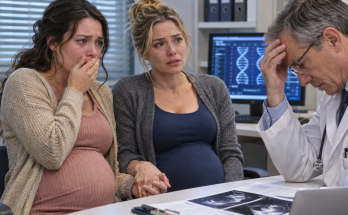
I used to think the worst thing a doctor could tell a pregnant woman was that something had gone wrong.
That morning, I discovered another kind of fear.
Not knowing.
Not knowing whether the baby growing inside me was healthy.
Not knowing why our genetic results had worried an experienced specialist.
Not knowing whether the future Emily and I had imagined would ever look the way we hoped.
I sat in the doctor's office with my best friend beside me.
Neither of us had expected to be there.
Five months earlier, we had been celebrating the fact that we were both pregnant.
Now I was struggling to understand what the medical information could mean.
The doctor had already told us that our results were unusual.
He had said he had rarely encountered findings like ours during his twenty-seven years in genetics.
And he had explained that the findings needed to be confirmed.
I kept returning to that last word.
Confirmed.
It sounded so simple.
As though the truth were already somewhere nearby, waiting for someone to uncover it.
But I didn't know what the confirmation would reveal.
And that frightened me.
I looked at Emily.
She was thirty-one years old.
We had been friends since childhood.
There had been a time when the biggest problems we faced together were school, first love, and the disappointment of discovering that growing up wasn't as exciting as we expected.
We had survived those years.
We had survived heartbreak.
We had survived the changes that came with becoming adults.
But this was different.
We weren't worrying only about ourselves anymore.
We were carrying children.
Children we had wanted for years.
I thought about my own marriage.
Five years had passed since my divorce.
I remembered how difficult it had been to accept that the family I imagined wasn't going to happen in the way I expected.
I had felt as though the future had been taken from me.
People told me I could start again.
They were right.
But they didn't understand how frightening it was to begin again when the first attempt had already left you disappointed.
For a long time, I had avoided making plans that depended on another person.
Then Emily suggested something I had never considered.
We could become mothers without waiting for marriage.
And our children could share the same biological father.
At first, I had laughed.
I remembered that clearly.
I had thought she was making one of those unusual suggestions that sounded wonderful until you considered what they actually required.
But Emily was serious.
She wanted our children to be siblings.
She wanted them to grow up with a connection stronger than the friendship we had shared for twenty-five years.
Eventually, I wanted the same thing.
We made the decision together.
We completed medical consultations and tests.
We chose Daniel.
Thirty-five years old.
Healthy, according to the information we had been given.
A man who had agreed to become a sperm donor.
For months, I had thought of his role as straightforward.
He would be the biological father of both babies.
Emily and I would become mothers.
And our children would grow up knowing each other.
Nothing about that arrangement had seemed frightening to me.
I had been excited.
Hopeful.
Almost relieved that my future was finally beginning to look like something I wanted.
Then we both became pregnant.
Only three weeks apart.
I remembered the happiness of that discovery.
I had wanted to tell the whole world that my best friend and I were expecting babies.
We talked constantly about the children.
We chose clothes.
Discussed names.
Imagined what their childhoods might look like.
Everything seemed possible.
And because everything seemed possible, I stopped thinking seriously about what could go wrong.
That was difficult to admit.
I had not ignored medical advice.
I had not deliberately acted without preparation.
But I had allowed the successful pregnancies to make me believe the most difficult questions were behind us.
They weren't.
I understood that now.
The fifth month had brought us into the genetics clinic.
The nurse's tense voice had made me afraid before I even understood why she was calling.
Then the doctor had brought us into his office.
Our results were displayed together.
He had looked at them for a long time.
He had closed the door.
And he had asked whether the same donor was used for both pregnancies.
I could still hear the question.
It had seemed so unnecessary.
Of course we used the same donor.
That was the plan.
That was the reason our children would share genes.
But the doctor's expression changed when we confirmed it.
I had watched his face grow pale.
And suddenly, the arrangement that had once made me so happy felt like something I needed to understand much more carefully.
The doctor spoke about genetic similarities.
He wanted to know whether we understood what those similarities might mean.
I had thought I did.
Our babies would be half-siblings.
That was what we wanted.
But the doctor was clearly concerned about something he had seen in the test results.
Something he had not yet been able to explain conclusively.
I kept searching his face for reassurance.
I wanted him to say there was nothing serious to worry about.
But he didn't.
He also didn't tell us that the babies were sick.
That distinction mattered.
I was beginning to realize how important it was not to confuse a doctor's concern with a confirmed medical finding.
Fear could make the two seem identical.
But they weren't.
I looked at the computer again.
The results had not changed.
Whatever information had brought us into that office was still there.
I wanted to understand it.
But I couldn't make myself a genetics expert simply by staring at the screen.
I had to depend on the people who knew how to interpret the information.
And I had to accept that even they sometimes needed more evidence before reaching a conclusion.
That was frustrating.
I wanted certainty.
But certainty couldn't be produced just because I needed it.
Emily shifted beside me.
I turned toward her.
I knew she wanted answers as badly as I did.
She had imagined this pregnancy for years.
She had wanted a child.
She had wanted us to raise our children together.
And now she was facing the same uncertainty.
I thought about reaching for her hand.
Then I hesitated.
I didn't know why.
Perhaps I was afraid that if I touched her, I would finally stop pretending I was calm.
I had been trying so hard to hold myself together.
I didn't want to cry.
I didn't want to make Emily more frightened.
But I was tired of pretending the doctor's warning hadn't shaken me.
I reached for her hand.
She held mine.
Neither of us spoke.
For a moment, it felt like we were children again.
Two girls who didn't always understand the world but knew they didn't have to face it alone.
I remembered our mothers joking that we were practically sisters.
I remembered how proud we had been of that description.
We had believed our friendship was something permanent.
Something life couldn't take away.
And perhaps that belief had made us too confident when we started thinking about our children.
We had wanted to give them the same kind of connection.
Only stronger.
We wanted them to share genes.
We thought that would make their relationship special.
But sitting there, I began to question what I had meant by stronger.
Emily and I were not biological sisters.
We had never needed to be.
Our closeness had grown through years of choosing to care about each other.
Through disappointments.
Through arguments.
Through the ordinary days that nobody remembers until they look back.
Shared genes had nothing to do with that.
And yet we had placed so much importance on giving our children a biological connection.
I still understood why we wanted it.
I didn't think our dream was foolish.
But I was beginning to see its limits.
A biological relationship could connect our children.
It couldn't promise them happiness.
It couldn't make every difficult experience disappear.
And it couldn't guarantee that their future would unfold exactly as we imagined.
I looked down at my stomach.
I thought about my baby.
For months, I had imagined the child growing up beside Emily's.
I had thought about their shared father.
Their childhood.
Their names.
But now I wanted something much simpler.
I wanted my baby to be safe.
I wanted Emily's baby to be safe too.
Everything else seemed less important.
I remembered how I had felt during the early months of pregnancy.
I was already planning years ahead.
I imagined our children growing older together.
I could see family gatherings and ordinary childhood moments.
I had allowed myself to believe those pictures were almost certain.
Now I realized they had only ever been hopes.
Beautiful hopes.
But hopes nonetheless.
I couldn't build a guarantee out of them.
And I couldn't expect a doctor to do that either.
The doctor had told us his concerns.
He had explained that the findings needed confirmation.
I had wanted him to say more.
But giving us a definite explanation without sufficient evidence would not have helped our children.
It might have frightened us unnecessarily.
Or reassured us without justification.
Neither would have been fair.
I began to understand that his caution mattered.
Even though it was painful.
Even though the uncertainty made me feel helpless.
I needed him to be careful.
I needed him to tell us what the evidence actually showed.
Not what would be easiest for us to hear.
I thought about how different that was from the conversations Emily and I had shared before becoming pregnant.
Back then, we could imagine whatever future made us happy.
We could talk about names and clothes and our children growing up as siblings.
We could picture everything working out beautifully.
Nobody had to challenge those pictures.
They were dreams.
But medical results were different.
They couldn't be interpreted according to what we wanted.
The facts had to come first.
And the facts were still incomplete.
I felt tears gathering in my eyes.
I didn't want the doctor to notice.
I didn't want Emily to worry.
But I couldn't stop them.
I had been trying to be strong since the nurse called.
I had answered questions.
I had listened.
I had tried to understand the difference between unusual findings and a confirmed diagnosis.
But beneath all that effort was one simple truth.
I was scared.
I was scared for my baby.
Scared for Emily's baby.
And scared that a decision we had made with so much happiness might carry implications we had never understood.
I didn't know whether that fear would turn out to be justified.
That was part of what made it so difficult.
I couldn't prepare myself for a specific outcome because no outcome had been established.
I could only wait for reliable information.
And waiting had never felt so heavy.
Emily squeezed my hand.
I looked at her.
For a moment, I wanted to apologize.
I wanted to say I was sorry for agreeing to the same donor arrangement.
Sorry for being so excited.
Sorry for imagining that because our pregnancies had happened, everything else would be easy.
But I stopped myself.
We had made the decision together.
We had sought medical advice.
We had acted on the information available to us.
And we still didn't know whether the genetic findings indicated a problem.
An apology would not explain the results.
It would only turn our fear into blame.
I didn't want to do that.
Not to myself.
Not to Emily.
Not to Daniel.
There was no confirmed medical explanation yet.
I needed to remember that before deciding someone had done something wrong.
I thought about the doctor again.
He had asked whether we understood what could happen to our children.
That question had frightened me.
But perhaps the most important thing I could do was admit that I didn't understand.
Not yet.
I couldn't answer it from memory.
I couldn't answer it by relying on the months of preparation we had completed.
And I couldn't answer it by imagining the worst.
I needed confirmed findings.
I needed an explanation.
And I needed to approach whatever came next as a mother whose responsibility was to learn the truth.
The thought settled slowly.
I had spent years wanting to become a mother.
I had imagined the happiness of pregnancy.
I had imagined holding my baby.
I had imagined the ordinary family life I once believed my marriage would give me.
But I had never imagined this part.
The part where loving a child meant sitting with uncertainty.
The part where I couldn't fix a problem simply because I wanted to.
The part where I had to listen carefully even when I was frightened.
I looked at Emily.
Our friendship had brought us to this point.
But friendship alone could not answer a medical question.
We needed professional knowledge.
We needed the findings to be confirmed.
And we needed to understand what the results actually meant before making assumptions about our children's future.
I was beginning to accept that.
Not comfortably.
Not easily.
But honestly.
The doctor had not given us the final answer.
The genetic findings remained unresolved.
And the future Emily and I had imagined was still uncertain.
I couldn't change those facts.
But I could change the way I responded to them.
I didn't have to pretend everything was fine.
I didn't have to imagine a tragedy before one had been established.
And I didn't have to blame myself for something I didn't yet understand.
I could remain beside Emily.
I could listen.
I could ask for accurate information.
And I could remember that our children were more important than the dream we had created for them.
I looked down at my stomach again.
I had once believed becoming a mother would make me feel certain about my future.
Instead, it had taught me how little I could control.
I still wanted the same thing I had wanted before entering the clinic.
My baby.
Healthy, if that was possible.
Loved, whatever happened.
And given every chance at a future that belonged to the child, not to my expectations.
That was what mattered.
I looked toward the doctor once more.
His warning still frightened me.
The unanswered questions were still there.
But I no longer wanted him to tell me something comforting simply to make the fear go away.
I wanted him to tell us what was true.
When the evidence could support it.
And as I sat beside Emily, holding her hand, I finally understood that accepting uncertainty was not the same as giving up hope.
I was still hopeful.
I was still frightened.
And for the moment, both feelings had to exist together.
Click here to continue reading: PART 10: I Thought Our Shared Dream Would End in a Terrible Discovery, but the Doctor’s Unconfirmed Findings Taught Me What Motherhood Really Meant
I Thought Sharing a Father Would Bring Our Children Closer, Until One Doctor Made Me Question Everything We Had Planned
Part 9 of 10