
I spent the next few days trying to put the record out of my mind.
It did not work.
Every time I sat down, I saw my name written in the old book.
Every time I thought about Rosella, I remembered the papers she had held in the sitting room.
I wondered what she had wanted to tell me.
I wondered whether she had intended to explain everything before she died.
And I wondered why her son had looked so uncomfortable when I mentioned the courthouse.
I had no proof that anyone was hiding anything.
I knew that.
Still, I could not return to the easy belief that the farmhouse had nothing to do with me.
The record existed.
My name was on it.
The property description matched the place where I had worked for twenty-six years.
Those facts did not disappear simply because I wanted a quiet life.
I called Rosella's friend.
I told her I needed to understand what we had found.
She listened without interrupting.
When I finished, she said we should go back to the courthouse and examine the record again.
I agreed.
I wanted to know whether there was something we had missed the first time.
I also wanted to know why Rosella had left me to discover this after she was gone.
The next visit felt different.
The courthouse no longer seemed like an ordinary public building.
It felt like a place where a private part of my life had been left waiting for me.
We returned to the same room.
The clerk brought out the heavy book, and we found the entry again.
I read my name slowly.
Elnora Ruthanne Whitsett.
There was no comfort in seeing it a second time.
I had hoped that another look might make the record seem less surprising.
Instead, the familiarity of the property description made the discovery harder to dismiss.
I knew the farmhouse.
I knew the driveway.
I knew the pecan trees and the fields.
I could picture the windows I had cleaned and the rooms I had swept.
The record referred to a place I could have drawn from memory.
Yet I had never been told that my name was connected to it.
Rosella's friend stood beside me.
She did not rush me.
I was grateful for that.
I had spent too much of my life pretending that I could handle anything as long as I did not speak about it.
That morning, I could not pretend.
"Why would Rosella keep this from me?"
My voice sounded smaller than I intended.
Her friend rested a hand on my shoulder.
"I wish I knew."
I looked back at the page.
There had to be some explanation.
A record could be old.
A name could be entered for reasons that were not immediately obvious.
A property description could be connected to a document whose purpose was not clear from a single page.
I reminded myself of those things because I needed something solid to hold on to.
But there was another thought I could not shake.
Rosella had known me for twenty-six years.
She knew I depended on my work.
She knew I was not a person who went looking for trouble.
If she had wanted me to remain ignorant, she could have left me that way.
Instead, she had spoken about explaining things.
She had held papers in her hands.
And now her friend had brought me to the courthouse.
I could not believe all of that meant nothing.
We examined the entry again, taking care not to assume more than it showed.
I asked whether the record alone established what I was entitled to.
Rosella's friend told me that we could not answer that question simply by looking at the name.
That was not what I wanted to hear, but I understood.
I had been tempted to leap from surprise to certainty.
My name appeared beside the property.
That did not mean I understood the circumstances behind it.
I had to be patient.
Patience was something I had learned through work.
It was also something I had used to avoid difficult questions.
This time, I tried to use it properly.
When we finished, I thanked the clerk and stepped away from the table.
I felt tired, though we had done very little.
The discovery had not given me an answer.
It had given me a responsibility to find one.
Outside, Rosella's friend asked whether I wanted to go home.
I said I did.
On the drive back, I watched the road and tried to decide what I should do next.
I could have walked away.
I could have accepted that Rosella's death had ended my connection to the farmhouse.
I could have told myself that whatever the record meant was for the family to settle.
For a moment, that seemed like the safest choice.
Then I remembered Rosella's sons discussing the land as though its future had already been decided.
I remembered the question about whether anyone had contacted me.
I remembered the way the conversation had stopped whenever I entered the room.
I could not prove those things were connected.
But I could no longer pretend they had not happened.
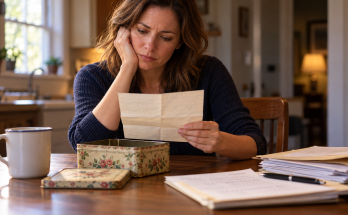
That afternoon, I went home and sat at my kitchen table.
I took out the notebook where I kept track of my household expenses.
The pages were filled with ordinary entries.
Groceries.
Electricity.
Repairs.
The small costs that add up when you have to count every dollar.
I stared at the notebook and thought about how much of my life had depended on Rosella's kindness.
I had never asked her for more than the wages she promised.
I had never expected her to leave me anything.
That was why the record troubled me so deeply.
If there had been a mistake, I needed to know.
If there was an explanation, I needed to hear it.
And if Rosella had intended to tell me something important, I could not let her silence become the only answer I received.
I was not interested in taking something that did not belong to me.
I was interested in understanding why my name had been placed beside that property.
There was a difference.
At least, I hoped there was.
Later that evening, I remembered the kitchen at the farmhouse.
The sugar jar.
The sitting room.
The folder Rosella had held on her lap.
I tried to recall whether I had seen any names on those papers.
I could not.
I had been too worried about losing my job to look closely.
Now I wished I had paid attention.
But regret does not give a person back the moments she failed to use.
It only makes the memory sharper.
The following morning, I contacted Rosella's friend again.
I told her I was ready to keep looking into the record, carefully and without making assumptions.
She agreed that we should proceed one step at a time.
I felt no sudden relief.
I was still frightened.
I still did not know what the record meant or how Rosella's sons might react if they learned I was asking questions.
But I had made a decision.
I would not pretend the discovery had never happened.
For twenty-six years, I had entered Rosella's house, done my work, and left the private matters of her family alone.
I had believed that was the respectful thing to do.
Now the woman who had employed me was gone, and the one thing she had left me to confront was a question written in an old courthouse book.
My name.
Her property.
No explanation.
I had spent years believing that my place in the farmhouse was temporary, something that could end whenever the family no longer needed me.
Now I understood that I could not decide what those years meant until I understood the record.
And I was finally willing to ask.
Click here to continue reading: PART 5: I Had Spent Twenty-Six Years Believing I Was Only an Employee, but the Old Record Made Me Question What Rosella Had Never Told Me
I Spent Twenty-Six Years Cleaning a Wealthy Woman’s Home Without Knowing Why She Never Let Me Leave It Behind
Part 4 of 20

One Comment on “PART 4 – I Returned to the Courthouse With More Questions Than Answers, and Every Familiar Detail of the Farmhouse Began to Feel Different”