I woke up the next morning thinking about the farmhouse.
Not the rooms I had cleaned or the furniture I had polished.
The land.
The old pike.
The pecan grove.
My name beside the description of a place I had never believed belonged to me.
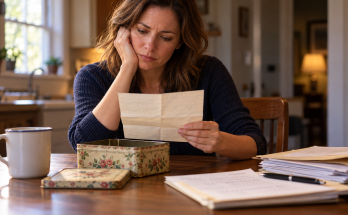
I made coffee and sat at my kitchen table.
The notebook where I kept my expenses lay open beside the cup.
For years, I had measured my life in small amounts.
What I earned.
What I spent.
What I could save.
What I would have to put off until another month.
I had never imagined myself connected to a property like Rosella's.
That was why I felt so uneasy.
I had not gone looking for an inheritance.
I had not asked Rosella for anything beyond my wages.
Yet there was my name, written in a book that had existed long before I knew it contained anything about me.
I tried to remember whether Rosella had ever spoken about the deed.
She had talked about the farmhouse often.
She had described the land as though every acre carried a memory.
But she had never told me that my name appeared in a property record.
Not once.
I wondered whether she had planned to tell me after the conversation in the sitting room.
Then I remembered how carefully she had placed those papers back inside the folder.
Perhaps she had intended to explain everything.
Perhaps she had changed her mind.
I had no way to know.
The only person who might have answered me was gone.
That thought hurt more than I expected.
I had known Rosella for twenty-six years, but I was only now beginning to understand how much I had never known about her.
By midmorning, I decided I could not sit at home waiting for answers.
I called her friend.
She agreed to meet me again.
When I arrived, she was already waiting.
She had brought a small notebook and a pen.
I sat across from her.
"I keep thinking I must have misunderstood something."
She shook her head.
"You read what was written there."
"But I don't understand why."
"Neither do I. Not completely."
She opened her notebook.
I watched her write down the name of the property and the description we had seen.
The careful movements of her hand reminded me of Rosella.
She had always kept her papers in order.
Even when she was tired, she made sure important things were put away properly.
I wondered whether the folder from the sitting room was still inside the farmhouse.
I asked Rosella's friend whether she knew what had happened to Rosella's papers.
She said she did not know where every document had gone.
The family had been handling the house and its contents.
I looked down at the notebook.
That meant I could not simply return to the sitting room and ask to see the folder.
I would have to be careful.
I did not want to accuse anyone of hiding something.
I did not even know whether there was anything to hide.
Still, I needed to understand what the record meant.
We agreed that the next step was to keep examining the information available to us rather than draw conclusions from a single entry.
That sounded sensible.
It also sounded slow.
I had spent years working hard because I believed effort would eventually lead somewhere.
Now I was being asked to wait while a question about my own life remained unanswered.
I found that difficult.
Rosella's friend noticed my frustration.
"You don't have to solve everything today."
"I know."
But knowing something and accepting it are different things.
I left our meeting with the same questions I had brought.
That afternoon, I drove past the old pike.
I did not enter the property.
I only wanted to see the farmhouse from the road.
The gravel driveway ran toward the house as it always had.
The pecan trees stood behind the tenant house.
The fields were quiet.
For twenty-six years, I had arrived there to work.
I had never imagined that one day I would stand outside wondering what right, if any, I had to ask questions about it.
I felt embarrassed by that thought.
I was not trying to claim something simply because I wanted it.
I was trying to understand why my name appeared in a record connected to it.
There was a difference, and I needed to hold on to it.
When I returned home, I sat down and wrote everything I could remember about Rosella's last months.
I wrote about the folder.
I wrote about the questions she had asked me.
I wrote about her sons discussing the land.
Then I wrote down the words I remembered from the sitting room.
There are things I should have explained a long time ago.
I stared at that sentence.
I had no proof that it referred to the property record.
But I could not stop wondering.
The next day, I contacted Rosella's friend again.
I told her I wanted to continue looking into the record.
She said we would take things one step at a time.
I agreed.
For the first time since Rosella's death, I felt I had made a decision that was not based on fear.
I still worried about money.
I still worried about what her sons might think.
But I was no longer willing to let those worries decide whether I deserved an answer.
I had worked in that house for twenty-six years.
I had earned my wages honestly.
I had respected Rosella's privacy.
Now I wanted to understand what she had left behind.
Not because I expected to become wealthy.
Because I could not bear the thought that the most important thing she had wanted to tell me might remain buried in a book I had never known to open.
Click here to continue reading: PART 6: The More I Remembered Rosella’s Quiet Questions, the Harder It Became to Believe That My Name in the Record Was an Accident
I Spent Twenty-Six Years Cleaning a Wealthy Woman’s Home Without Knowing Why She Never Let Me Leave It Behind
Part 5 of 20