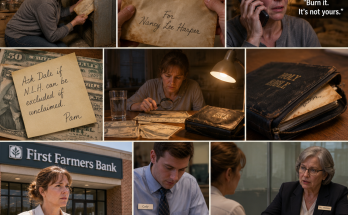
The request arrived on a Tuesday in October.
By then, the Harper Family Archive had become ordinary enough that I sometimes forgot how strange its existence was.
The workshop roof no longer leaked.
The old wiring had been replaced.
Robert’s drill press stood beneath the second bluebird, unplugged but cleaned.
Grandpa’s workbench sat across from it, scars and all.
The ledgers lived in acid-free boxes inside a locked cabinet.
Digital copies existed in two encrypted locations.
No one person controlled either.
Exactly as we intended.
The archive trustee emailed all three board representatives whenever an outside request arrived.
Usually they were simple.
A cousin wanting an old photograph.
A title researcher checking a property transaction.
Someone asking whether Grandpa had records from a long-closed hardware store.
This request was different.
The sender was a woman named Claire Porter.
Elaine Porter’s daughter.
I read the name twice.
Elaine.
Dale’s dead bookkeeper.
The woman whose signature image had been used in the false affidavit.
The woman whose notebook had helped expose what happened.
Claire wrote that she had recently learned her mother’s name appeared in records preserved at the archive.
She wanted to see them.
Not copies emailed without context.
She wanted to come in person.
The request went to the board.
Dale’s daughter, Rachel, represented Robert’s branch now.
Ben represented mine.
The independent trustee, Michael Stern, chaired.
None of them objected in principle.
The question was privacy.
Elaine’s notebook included company information.
References to Robert’s insurance.
Notes about Dale.
Fragments involving employees who had nothing to do with our dispute.
We could not simply hand Claire the whole thing.
Ben called me that evening.
“What do you think?”
“I think she should see anything directly involving her mother.”
“That’s what I think.”
“Then why are you calling?”
“Because Rachel thinks we should ask Dale first.”
I went quiet.
“Why?”
“Because some entries involve HPS.”
“Ask the company about company records. Don’t ask Dale whether Elaine’s daughter gets to see what happened to Elaine’s name.”
“That’s what I said.”
I smiled.
“Good.”
Ben hesitated.
“Mom?”
“Yes?”
“You know you’re not actually on the board.”
“I know.”
“You sounded like you were giving an order.”
I leaned against my kitchen counter.
He had caught me.
The old temptation.
Not greed.
Not secrecy.
Control dressed as experience.
“You’re right.”
“So?”
“So you decide.”
“With Rachel and Michael.”
“Yes.”
“You’re okay with that?”
I looked at the folder of my own estate documents sitting openly in the cabinet near my desk.
“I’m practicing.”
Ben laughed.
“Good answer.”
The board approved Claire’s visit with limited access to materials involving Elaine directly.
No one asked Dale for permission.
HPS counsel reviewed company-confidential pages and agreed to redactions unrelated to Elaine.
Structured access.
Not secrecy.
Claire arrived the following Saturday.
She was fifty-three, maybe fifty-four.
Dark hair streaked silver.
Same narrow chin as Elaine in the old employee photograph.
She carried no lawyer.
Just a notebook.
I met her because she had asked whether I would.
Dale did not come.
He had been told about the visit.
He responded with one sentence:
She deserves to know what involved her mother.
That was all.
Claire stood beneath the bluebird while Michael explained the archive rules.
No photographs of restricted material.
Notes allowed.
Copies available after review.
Nothing removed.
Claire nodded.
“I’m not here to cause trouble.”
I almost said trouble was sometimes useful.
I didn’t.
We started with Elaine’s notebook.
Claire recognized the handwriting instantly.
“That’s Mom.”
Her finger hovered above the plastic sleeve without touching it.
“She wrote everything down.”
“I gathered that.”
“Groceries. Gas mileage. Who borrowed twenty dollars.”
“That sounds familiar.”
She smiled faintly.
“Did you know her?”
“Not really.”
“Mom knew who you were.”
My stomach tightened.
“What did she say?”
Claire looked at me.
“That you were the person nobody wanted to explain things to.”
I stared.
“When?”
“Years ago.”
“Before Robert died?”
“I don’t know.”
Claire turned another page.
Elaine’s notes around Robert’s final week were terse.
Insurance call.
Dale upset.
Henry asking questions.
Do not witness what I did not see.
That line still struck me.
Elaine had refused one small thing.
A signature.
And because she wrote down why, her refusal survived her.
Claire read it twice.
Then looked up.
“Dale used her signature anyway?”
“An image of an older signature was used on an affidavit created after her death.”
“By Dale?”
“He admitted creating the document.”
Her jaw tightened.
“Did my mother know about the beneficiary form?”
“She knew there was a dispute.”
“Did she know Dale completed it?”
“We don’t know.”
That answer disappointed her.
I understood.
The archive had many facts.
It did not have every answer.
Claire continued reading.
Then stopped at an entry we had already seen but never fully understood.
H.H. says E.P. has copy. Keep separate from company.
Claire frowned.
“What copy?”
“We never found out.”
“E.P. is Mom.”
“That was our assumption.”
“H.H. is Henry?”
“Yes.”
Claire sat back.
“My mother had a safe.”
My pulse increased despite myself.
Not again.
I almost laughed.
Of course somebody had a safe.
Claire saw my expression.
“What?”
“Nothing.”
“No, what?”
“This family has conditioned me to fear containers.”
She smiled.
“My mother’s safe isn’t dramatic. It’s a little firebox.”
“Where?”
“My garage.”
Of course.
“Have you opened it?”
“Yes.”
“What’s inside?”
“Birth certificates. Dad’s military papers. Mom’s will. Some old work things.”
“What work things?”
“I never really looked.”
Michael immediately stopped the conversation from turning into an expedition.
“If Claire owns those materials, what she does with them is her decision.”
I appreciated that.
No grabbing keys.
No rushing to her house.
No assumption that because the records might help us, they belonged to us.
Claire looked at him.
“I’d like to check.”
“Take your time.”
She returned three days later.
With counsel.
Good.
I respected her for that.
Inside Elaine’s firebox had been an envelope marked:
HENRY—COPY ONLY.
Claire’s lawyer had scanned it before bringing the original.
The envelope contained six pages.
The first was a copy of Robert’s beneficiary confirmation naming me.
Already known.
The second was Robert’s handwritten note stating I remained beneficiary.
Already known.
The third was new.
A memorandum Elaine wrote two days before Robert died.
It described a conversation with Dale.
Not a transcript.
Not signed by Dale.
Elaine’s contemporaneous account.
According to her, Dale asked whether an old blank form signed by Robert could be completed if Robert later gave verbal instructions.
Elaine wrote that she told him she did not know and that he should ask the insurer.
Dale allegedly said:
They’ll make Dad do everything again.
Elaine responded:
Then maybe everything needs doing again.
I could hear the woman in that sentence.
Practical.
Unimpressed.
The memorandum continued.
Dale asked whether she would witness that Robert had signed the blank form months earlier.
Elaine wrote:
I told him I could confirm seeing Robert sign forms generally but could not identify that specific sheet.
Again.
Precision.
Then the final line:
Told Dale not to use my name for anything I did not personally see.
Claire stopped reading.
Her face changed.
“He knew.”
“Yes.”
“He knew she specifically refused.”
“Yes.”
The later false affidavit became worse emotionally.
Not merely using a dead employee’s stored signature.
Using the name of someone who had expressly told him not to.
Claire wiped her eyes.
“I kept thinking maybe Mom had helped.”
“She didn’t.”
“You’re sure?”
“As sure as these records allow.”
That mattered to her.
I watched the tension leave her shoulders.
Not entirely.
Enough.
The fourth page was a photocopy of an internal HPS capital statement.
The same family-growth account we later reconstructed.
The fifth was a note from Grandpa asking Elaine to keep copies outside the company until he spoke to Mr. Creighton.
The sixth was why.
Dale has started removing duplicate records. I do not know whether from anger, fear, or because he believes they are his to manage. Keep this set until Nancy receives full accounting.
I read it twice.
Grandpa had trusted Elaine.
Not because she was family.
Because she documented.
Claire said, “Why didn’t Mom give this to you?”
“She died before Grandpa.”
“Yes.”
“And maybe she thought Grandpa handled it.”
Claire nodded slowly.
“She had cancer. Last year was awful.”
Another delayed handoff.
Not malicious.
Life.
Illness.
People believing there would be another day.
I knew that pattern too.
Claire donated digital copies to the archive.
She kept the originals.
Correctly.
They were hers.
Michael updated the record.
Source identified.
Custody documented.
No mystery drawer.
No secret ownership.
Then Claire asked whether she could add a statement about her mother.
“What kind?”
“Just who she was.”
The archive had turned Elaine into evidence.
Bookkeeper.
Witness.
Signature image.
Notebook.
But she had been a person.
Claire wrote one page.
Elaine Porter worked for Harper businesses for nineteen years. She raised two daughters, hated bananas, kept peppermints in every purse, and believed a number written down should be a number someone could explain later.
I smiled at that.
We placed a copy beside her notebook.
A week later, Dale came to the archive.
He read Claire’s statement.
Then Elaine’s memorandum.
He stood silently for a long time.
I was cataloging photographs at the opposite table.
Eventually he said, “I remembered her telling me not to use her name.”
I looked up.
“You never said that.”
“I didn’t want to remember it.”
“That isn’t the same as forgetting.”
“No.”
He stared at Elaine’s page.
“She was good to Dad.”
“Yes.”
“And me.”
I waited.
“I used her because she couldn’t object anymore.”
There was no defense in his voice.
“No.”
“I’m going to write Claire.”
“That’s your choice.”
He looked at me.
“You think I shouldn’t?”
“I think you should not ask me to decide whether she wants your apology.”
He nodded.
“Right.”
Another small correction.
He wrote.
Claire later told me she read the letter.
She did not tell me whether she replied.
That belonged to them.
The archive closed at five.
I walked outside with Dale.
Autumn wind moved dry leaves across the gravel.
He stopped beside his truck.
“You know what bothers me?”
“What?”
“If Elaine’s papers hadn’t survived, I could’ve kept telling myself I didn’t remember that conversation.”
I understood.
Records could be merciless.
“That’s why the archive exists.”
“Yeah.”
He opened his door.
Then looked back.
“Dad’s letter said not to argue over the last dollar.”
“Yes.”
“Maybe he should’ve said not to argue with the last document either.”
I smiled.
“Robert liked shorter sentences.”
Dale laughed.
Then drove away.
I locked the workshop.
Logged the time.
And for the first time, the archive had done something I had not anticipated.
It had not merely preserved what happened to me.
It had returned another woman’s name to her daughter without forcing either of them to accept our family’s version first.
That felt worth preserving.
Click here to continue reading: PART 38: Pam Asked Me to Read the Statement She Planned to Give Her Children, and I Refused to Let Our Family Create Another Official Version for Them
Three Hundred Dollars for Grandpa’s Basement Sounded Like Charity Until Dale Made Sure I Understood Exactly What I Was Allowed to Touch
Part 37 of 44