Julia Reeves had not taken the children.
That fact became the first thing investigators established.
The second was that she had never intended to.
When Derek approached her, he told her Adam was involved in something dangerous.
He claimed Adam had stolen confidential records from violent people.
He said Emily’s children might become targets if Adam released those records.
Julia believed Derek was trying to protect them.
He gave her cash.
Fifty thousand dollars.
Enough to leave town quickly.
He gave her instructions.
If Adam sends anything to Emily, take the children and disappear until I call.
Julia thought “take the children” meant help Emily relocate them.
She did not realize Derek meant remove them without Emily’s knowledge.
“How do you know what he meant?” Rachel asked.
The investigator showed us Derek’s CONTINGENCY notes.
One section was titled KIDS.
If A sends archive:
J collects from school.
Use emergency contact override.
Tell school E hospitalized.
Move north.
No phones.
Contact after 72 hrs.
J.
Julia.
A.
Adam.
The plan was unmistakable.
Derek had intended to use Julia as an unwitting courier.
She had no criminal record.
She was a mother.
She knew the children socially through school events.
If she arrived saying Emily had been hospitalized, staff might trust her—especially if official emergency-contact records had been altered.
Adam could alter those records.
Or Derek could pressure him.
Except Adam had begun resisting.
So Derek bypassed him.
Investigators checked the school system.
Three weeks earlier, someone had attempted to add Julia Reeves as an authorized emergency pickup.
The request was rejected because Emily’s digital confirmation was missing.
A second request succeeded two days later.
Using Emily’s credentials.
Emily stared at the screen.
“I never approved this.”
“We know.”
“Who logged in?”
“Your home internet connection.”
Derek.
Again.
A small administrative change.
A name on a school form.
Nothing that would have looked dangerous by itself.
That was the pattern.
The conspiracy survived by hiding extraordinary intent inside ordinary paperwork.
Emily pressed both palms against the table.
“He was going to have someone take my children before I died?”
“Possibly after an incident began.”
The investigator pointed to the timeline.
If Adam released evidence, Derek feared arrest before the planned accident.
In that scenario, he wanted the children outside immediate reach.
Why?
Leverage.
Sympathy.
Control.
Perhaps escape.
Perhaps all three.
Julia cried through most of her interview.
She had kept the money because Derek told her she might need it suddenly.
She had not told Adam because Derek warned that Adam’s life could be endangered if he knew.
Another manipulation built from selective truth.
Adam really was involved with dangerous people.
Derek simply omitted that he was one of them.
Julia surrendered the cash.
Serial numbers matched withdrawals from an account tied to insurance proceeds.
She also surrendered the note and a prepaid phone Derek had given her.
The phone contained only one saved number.
Derek’s.
No calls had been made.
“She believed him,” Emily said afterward.
“Yes.”
“I hate that I understand how.”
So did I.
Derek was persuasive because he rarely needed to invent an entire reality.
He took something true.
Adam is in danger.
Then built the lie around it.
Your children need protection.
Your mother is helping voluntarily.
The money is a family benefit.
Emily is stressed.
Margaret signed.
Each false story contained enough truth to make questioning feel unnecessary.
That afternoon, Emily asked to see the children’s emergency forms.
Rachel hesitated.
“Why?”
“Because I need to know what else he changed.”
Investigators produced copies.
Derek had listed himself first.
Normal.
Me second.
Normal.
Then Julia.
Not normal.
A fourth person had also been added.
Linda Mercer.
Emily stared.
“She could pick them up too?”
“For approximately six weeks.”
“Did she?”
School logs showed Linda collected my granddaughter once.
A Tuesday.
The same Tuesdays my granddaughter had mentioned.
The lady with the red car.
Emily covered her mouth.
I remembered the child saying Auntie came when Mommy worked.
We had assumed Linda visited the house.
Sometimes she had.
But once she had collected my granddaughter directly from school.
“Where did they go?” Emily asked.
The school did not know.
My granddaughter did.
We asked through the child specialist, not directly.
She remembered Auntie taking her for ice cream.
Daddy met them there.
Then they went to “a house with no furniture.”
My stomach tightened.
The burned property?
No.
Investigators showed photographs carefully.
The child identified another house.
One owned through a shell company.
Derek had taken his daughter there.
Why?
The answer came from insurance records.
The property was supposedly occupied by a family.
A child’s bedroom had been staged.
Photographs submitted to the insurer showed toys.
Children’s clothing.
A drawing taped to the wall.
My granddaughter’s drawing.
Derek had used his own child to make a fraudulent property appear inhabited.
He had taken photographs while she ate ice cream in the kitchen.
He had created evidence of family occupancy.
Then removed everything.
Emily whispered, “He used her.”
Yes.
Not physically harmed.
Not consciously involved.
Used.
The investigator said, “We will not question her more than necessary.”
“Good.”
Emily’s voice was sharp.
“No more.”
That became a boundary.
The children would not become investigators simply because adults had placed them near evidence.
My granddaughter had already carried enough.
At four, Linda requested a meeting with prosecutors.
Her cooperation had become more valuable because the emergency-contact evidence showed she was deeper in Derek’s plans than she admitted.
She confessed that Derek asked her to pick up the child and stage the property.
She claimed she believed it was for a mortgage inspection.
“Did she know the house was fraudulently insured?” I asked.
“She knew documents were false.”
“Then she knew enough.”
“Yes.”
Linda also admitted knowing about Julia.
She had followed Derek because she suspected he was planning to leave without her.
The photograph of Derek paying Julia convinced Linda he had another escape arrangement.
She confronted him.
He told her Julia was “insurance.”
That word again.
Not policy.
Person.
Everyone became insurance against everyone else.
Linda asked whether Emily was really going to die.
Derek did not answer directly.
He said:
Saturday changes everything.
Linda understood.
She stayed.
That mattered.
Knowing enough to leave and choosing not to is still a choice.
Then Linda revealed another detail.
Derek had told her that after Emily’s accident, the children might stay with me permanently.
Not temporarily.
Permanently.
“Why?” Emily asked.
“Because he did not actually want custody.”
The room went still.
Derek’s planning documents discussed custody as appearance.
His private conversations apparently told a different story.
Linda said he intended to petition for custody publicly, then rely on me for most day-to-day care.
After enough time, he planned to relocate gradually.
The children would remain with me while he traveled.
Eventually, he believed they would prefer stability.
Meaning me.
He expected me to raise them.
Again.
My labor.
My home.
My love.
Free infrastructure.
I had spent six years believing I was helping my daughter build a life.
Derek had looked at that same devotion and seen something he could budget around forever.
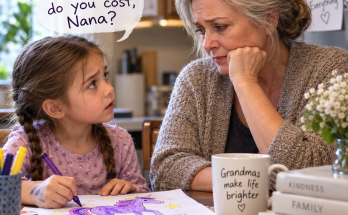
“How much do you cost, Nana?”
The question returned.
I finally understood why it had hurt so deeply before I knew anything else.
The child had accidentally named the entire problem.
Derek believed everything had a cost.
Care.
Marriage.
Trust.
Identity.
Silence.
Loyalty.
People.
If something did not demand money immediately, he called it free.
And free things, to him, were available for use.
At five-thirty, Rachel received notice that Derek’s defense wanted to negotiate.
Emily laughed.
“Now?”
“The video changed things.”
“Which one?”
“Several.”
Derek faced overwhelming evidence on financial charges and substantial evidence regarding the planned attack.
His attorney wanted to discuss a global resolution.
No trial on some counts.
Plea on others.
Potential cooperation against Samuel.
“What could Derek possibly give them on Samuel that they do not already have?”
“Details about Thomas.”
I felt the room sharpen.
“He knows?”
“His attorney says Derek has information Samuel told him privately.”
I looked at Rachel.
“Another trade.”
“Yes.”
“Thomas for Emily.”
“Not exactly.”
“It feels exactly like that.”
Rachel did not argue.
Derek claimed Samuel had described what he put into Thomas’s medication.
Dosage.
Timing.
Method.
He also claimed Samuel kept a physical item from Thomas’s house as proof.
“What item?”
Rachel did not know.
Prosecutors wanted to hear the proffer.
I did not object.
Truth first.
Punishment later.
Derek’s statement came that evening.
Samuel told him he crushed additional tablets and placed the powder inside Thomas’s weekly medication compartments.
Not enough, Samuel supposedly believed, to guarantee death.
Enough to cause dizziness, weakness, possibly hospitalization.
Samuel wanted Thomas delayed and discredited.
A sick older man might appear confused.
An investigation could be postponed.
But Thomas’s heart reacted catastrophically.
Samuel panicked.
He returned later, after emergency services left, hoping to retrieve the medication organizer.
He could not because I remained home.
So he waited.
At Thomas’s funeral, Samuel attended.
I had forgotten.
The investigator found a photograph.
There he was in the background.
Dark suit.
Standing near Martin.
Watching me accept condolences.
I stared at his face.
He had entered my home days earlier.
Tampered with my husband’s medication.
Then stood at his funeral.
The physical item Samuel kept?
Thomas’s spare house key.
A brass key with a blue plastic cap.
Samuel supposedly took it from a kitchen drawer during the break-in.
A trophy?
Insurance?
Derek did not know.
Investigators searched Samuel’s possessions again.
Inside a locked box beneath old fire-investigation files, they found a blue-capped key.
I recognized it immediately.
Thomas had painted a tiny white dot on the cap because we had two similar keys.
My knees weakened.
Evidence can be ordinary.
That is sometimes what makes it unbearable.
Not a weapon.
Not blood.
A house key.
Something Thomas touched hundreds of times.
Something Samuel had no legitimate reason to possess.
Rachel asked whether I wanted a break.
“No.”
Not yet.
Derek’s proffer continued.
Samuel had bragged about Thomas when explaining how to create accidents.
That was why Derek wrote:
Worked once. Can work again.
He was referring to Samuel’s ability to make deliberate harm appear natural.
The explanation did not save Derek.
It made the note worse.
Derek knew.
He learned how Thomas died.
Then applied the lesson to Thomas’s daughter.
Emily sat absolutely still.
When the statement ended, she said, “He knew Grandpa was killed before Mom did.”
“Yes.”
“For how long?”
“Approximately eighteen months.”
“And he came to family dinners.”
“Yes.”
“He sat beside Mom.”
“Yes.”
“He let her talk about Dad.”
“Yes.”
I remembered Derek helping carry boxes from my attic.
Moving Thomas’s old tools.
Once he held Thomas’s fishing rod and asked what kind of man he had been.
I had told him.
Patient.
Stubborn.
Good with machines.
Terrible dancer.
I had given Derek memories of a man whose death he already knew was not natural.
That betrayal had no legal category I knew.
But it had weight.
At eight, prosecutors made no deal.
Not yet.
Derek had provided useful corroboration, but they wanted the full archive.
His attorney claimed there was more.
A final recording.
Samuel describing Thomas.
Derek had hidden it separately.
“Where?” I asked.
Derek would reveal the location only as part of negotiation.
Rachel shook her head.
“Prosecutors will not buy evidence they can locate independently.”
Investigators searched.
Digital accounts.
Properties.
Vehicles.
Children’s belongings again.
Nothing.
Then I remembered Derek’s pattern.
Where E never looks.
He hid things not simply in private places.
He hid them inside relationships.
Objects people would not violate.
“Does Derek have anything of Thomas’s?” I asked.
Emily frowned.
“Not that I know.”
I thought back.
After Emily’s wedding, I had given Derek something.
A gift.
Thomas’s old watch.
Not valuable.
Stainless steel.
Scratched face.
Thomas wore it for twenty years.
I told Derek that if Thomas had lived, he would have been proud to see Emily marry.
The memory made me ill now.
“His watch.”
Emily stared.
“What?”
“I gave Derek your father’s watch.”
Investigators searched the property inventory.
The watch had been seized from Derek’s dresser.
A technician examined it.
The back plate was thicker than original.
Modified.
Inside, behind the mechanism, was a microSD card.
Derek had hidden Samuel’s confession inside Thomas’s watch.
The recording began with laughter.
Samuel’s.
Derek asked:
“So you really went into the house?”
Samuel:
“Three in the morning. They slept through everything.”
Derek:
“And the pills?”
Samuel:
“Easiest part.”
Derek:
“You meant to kill him?”
Long silence.
Then Samuel said:
“I meant to stop him.”
Derek:
“That’s not an answer.”
Samuel laughed again.
“It was enough of one for me.”
The recording continued.
Samuel described crushing the medication.
Described the dosage.
Described watching Thomas’s obituary appear online the next day.
Then Derek asked:
“Did you feel bad?”
Samuel answered:
“For a while.”
A pause.
“Then we made money.”
I turned the recording off.
No one asked me to continue.
I had heard enough.
For eleven years I had wondered only why Thomas’s heart failed.
Now I knew another human being had entered our home and deliberately altered the medicine keeping that heart alive.
Whether Samuel used the word kill no longer mattered to me.
He had made a choice.
Thomas paid for it.
At ten, the prosecutor called.
Samuel had been confronted with the recording.
His attorney requested another meeting.
This time Samuel did not ask for a reduced charge first.
He asked to confess.
Click here to continue reading: PART 20: Samuel’s Confession Finally Told Me What Happened the Night Thomas Died, but Derek’s Case Took a Turn That Put My Grandchildren at the Center
My Granddaughter Asked a Simple Question at My Kitchen Table, and Suddenly Four Years of Family Favors Looked Completely Different
Part 19 of 30