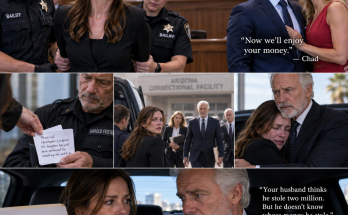
“Your grandfather asked me to give you this if Arthur challenged the will within sixty days.”
I stared at the folder.
“And if he didn’t?”
“Then he hoped you would never need it.”
I touched the edge of the file.
“What is it?”
Renner’s face was grave.
“Evidence that your father attempted to access estate-linked credit lines before your grandfather died.”
The room seemed to narrow.
“What?”
“Not successfully.”
He slid a page toward me.
“But repeatedly.”
I looked down.
Bank inquiry.
Authorization attempt.
Rejected signature.
Power of attorney request.
Denied.
Another.
And another.
My father had not waited for inheritance.
He had tried to reach into my grandfather’s accounts while he was still alive.
The coffee I had drunk turned bitter in my stomach.
“Grandpa knew?”
“Yes.”
“When?”
“Three months before his death.”
I closed my eyes.
Three months.
That meant some of our last conversations had happened after he knew his son was trying to take from him.
And he still sat with me at the coffee shop.
Still talked about municipal bonds.
Still asked if I was sleeping enough.
Still tipped the barista too much.
“How did he handle it?”
Renner sighed.
“Quietly.”
Of course he did.
That was the tragedy of strong old men.
They often mistook silence for dignity, even when they deserved to rage.
“He changed passwords.”
“He revoked old authorizations.”
“He updated the will.”
“He documented the attempts.”
“And he added the sealed court letter.”
I looked at the red folder.
“Why didn’t he confront my father?”
Renner leaned back.
“He did.”
My head lifted.
“When?”
“The week before he died.”
No one had told me that.
Not my father.
Not Renner.
Not anyone.
“What happened?”
Renner looked toward the window.
“Arthur denied everything.”
“Then he accused your grandfather of being manipulated.”
I almost laughed.
The same word.
Always the same word.
Manipulated.
Men like my father could not imagine being distrusted unless a woman had caused it.
“By me,” I said.
“Yes.”
My chest tightened.
Renner’s voice softened.
“Your grandfather told him something after that.”
“What?”
“He said, ‘Arthur, the saddest thing about you is that you think being my son should matter more than becoming a man I can trust.’”
I looked down.
My vision blurred again.
“That sounds like him.”
“It was.”
Renner pushed the red folder closer.
“Your father is not done.”
“I know.”
“He may appeal, challenge capacity, question undue influence, attack your employment, your education, your personal history.”
“I know.”
“He may try to intimidate you privately.”
I looked at him.
“He already did.”
Renner’s face hardened.
“Document everything.”
“I will.”
“And Cassandra?”
“Yes?”
“Do not let him make you defend your worth.”
I swallowed.
Renner tapped the red folder.
“Defend the documents.”
That became my rule.
Over the next months, my father tried everything.
He filed a capacity challenge.
Denied.
He claimed undue influence.
Failed.
He suggested I had isolated Grandpa.
Destroyed by visitor logs, phone records, and the small fact that my father had skipped eleven planned visits in the final year.
He claimed I was financially unsophisticated.
Then his own petition forced the court to examine years of my work.
He claimed I was greedy.
Then Renner produced letters showing I had repeatedly refused gifts from Grandpa when he tried to pay off my student loans.
My father claimed he had only wanted fairness.
The red folder suggested he had wanted access.
Each time he attacked, the documents answered.
But attacks still leave bruises.
Not legal bruises.
Human ones.
I kept working at the coffee shop.
People thought that was strange.
Some assumed I needed the money.
Some assumed I was making a point.
The truth was simpler.
I needed normal.
I needed the hiss of steam.
The smell of espresso.
Leo yelling that oat milk was not a personality.
Regulars asking for the same drinks.
The morning rush.
The tired woman who always tipped one dollar in quarters.
The banker who never made eye contact.
The construction worker who called me “boss” because I remembered his order.
I needed work that did not care about inheritance.
One morning, a man in a navy suit recognized me from court.
He had been in the gallery.
I knew because he had laughed.
Not loudly.
Small.
Neat.
He stood at the counter, avoiding my eyes.
“Medium coffee,” he said.
“Room for cream?”
“Yes.”
I poured it.
He paid.
Then he hesitated.
“I owe you an apology.”
The line behind him grew restless.
I looked at him.
“For what?”
He flushed.
“I laughed.”
“I remember.”
His face got redder.
“I was wrong.”
“Yes.”
The construction worker behind him muttered, “Move along, remorse has a line.”
I laughed despite myself.
The man stepped aside.
I served the next customer.
That was satisfying in a way court had not been.
Not because he apologized.
Because I did not need it.
By winter, the estate administration moved forward.
I kept the coffee shop job part-time.
Not forever.
But for then.
I also began working formally with Renner and a fiduciary advisor to structure the estate.
I did not pretend I knew everything.
That was one difference between me and my father.
I knew enough to ask experts.
I knew enough to read what they sent.
I knew enough to question fees, projections, risk, assumptions, and men who smiled too quickly.
The $11 million was not a pile of treasure.
It was responsibility.
Grandpa’s life converted into assets.
Properties.
Accounts.
Investments.
Old decisions.
Future consequences.
I handled it the way he had trained me.
Slowly.
Carefully.
Without confusing possession with wisdom.
The first major decision I made was to establish a scholarship fund for service workers pursuing finance, accounting, law, or business degrees.
Renner cried when I told him.
He pretended it was allergies.
I let him.
The fund’s name was simple.
The Whitaker Work Fund.
Leo said it sounded like something that should come with steel-toed boots.
I told him that was the point.
My father heard about it through an article in a local business paper.
He called me that evening.
I almost did not answer.
Then I did.
Mostly out of curiosity.
“Cassandra.”
“Arthur.”
I heard his breath catch.
I had never called him Arthur before.
Not once.
But fathers who take their daughters to court to humiliate them earn formal titles.
“So that’s it?” he said.
“You’re giving money to strangers?”
“Some of it.”
“Instead of family?”
“Family took me to court.”
“You’re punishing me.”
“No.”
“I’m honoring Grandpa.”
“He would have wanted his son included.”
I looked at the red folder on my desk.
“No, Arthur.”
“He wrote down what he wanted.”
His voice hardened.
“You think a few documents make you better than me?”
“No.”
“Then what do you think?”
I looked out my apartment window at the city lights.
“I think Grandpa spent years waiting for you to become someone he could trust.”
Silence.
Then:
“You don’t know anything about my relationship with him.”
“I know what he documented.”
His laugh was bitter.
“There she is. The waitress with documents.”
I smiled sadly.
“Yes.”
“And you lost to her.”
He hung up.
I did not cry.
Not that time.
Something had shifted.
There is grief when a parent fails you.
Then there is a later, quieter grief when you accept they may never become ashamed enough to change.
That second grief hurts less sharply.
But it lasts longer.
Years passed.
The estate settled fully.
My father lost every challenge.
Sterling withdrew from representing him after the second sanctions warning.
A new attorney lasted three months.
Then another.
Eventually, even my father’s rage became too expensive to maintain.
He did not disappear.
Men like him rarely do.
He hovered at the edges of family events.
Sent cold emails.
Made comments through cousins.
Claimed I had turned my grandfather against him.
But the story had changed.
Not because people suddenly became noble.
Because the documents were public enough.
Because court records have a way of making gossip nervous.
Because a judge who once smirked at a waitress had put certain findings into writing.
And writing has a longer memory than embarrassment.
One spring morning, I stood in the coffee shop at 6:30 a.m., tying the same blue apron around my waist.
Leo leaned against the counter.
“You know,” he said, “most millionaires don’t open.”
“Most millionaires don’t know how bad your muffins are if left unsupervised.”
He pointed at me.
“Defamation.”
“Improvement opportunity.”
He grinned.
The bell over the door rang.
For half a second, I expected Grandpa.
I still did that sometimes.
Expected him to come in with his coat, legal pad, and questions.
Instead, a young woman entered.
Early twenties.
Tired eyes.
Work shoes.
She ordered a small coffee and counted coins twice before handing them over.
I recognized that kind of counting.
I had done it in college.
When I gave her the cup, I slid a card beside it.
Whitaker Work Fund — Applications Open.
She looked at it.
Then at me.
“I’m not really… I mean, I’m just working right now.”
“So was I,” I said.
She read the card again.
Something changed in her face.
Not relief.
Not yet.
Possibility.
That was better.
After she left, I stood in the back corner by Grandpa’s old table.
The morning light touched the chair he used to sit in.
For years, people had looked at that table and seen an old man drinking coffee.
They had not seen an education.
A partnership.
A grandfather building trust one conversation at a time.
They had not seen him teaching me how to read a balance sheet between orders.
How to distrust performance.
How to respect labor.
How to notice arrogance before it reached for your wallet.
They saw the apron.
He saw the person wearing it.
That was inheritance too.
Maybe the most important part.
Years after the hearing, I received a letter from Judge Harrison.
Not personal exactly.
Judges are careful.
It came through a formal channel connected to the scholarship fund.
He wrote that his granddaughter had applied.
She had worked as a hotel housekeeper while studying accounting.
He included a donation.
Not enormous.
But real.
At the bottom, in handwriting, he added one sentence.
The court should have listened before it laughed.
I read it twice.
Then placed it in the fund archive.
Not because it fixed the humiliation.
Because accountability, however late, should be filed properly.
My father died eight years after the hearing.
A heart attack.
Sudden.
Sterling sent a note.
We had not spoken in years.
I attended the funeral.
Not because he deserved the performance of a grieving daughter.
Because I needed to close the door myself.
The church was half-full.
People said kind things carefully.
My father had been generous, one man said.
Driven, said another.
Complicated, said a cousin.
Complicated is the word families use when truth would take too long at a funeral.
I sat in the back.
No tears came.
At the graveside, I placed one white envelope on top of the casket.
Inside was a copy of Grandpa’s letter.
Not the whole red folder.
Not every accusation.
Just the line:
The saddest thing about you is that you think being my son should matter more than becoming a man I can trust.
Maybe it was cruel.
Maybe it was mercy.
Maybe it was the only honest thing left between three generations.
I walked away before anyone could ask.
That evening, I went to the coffee shop.
Leo was older by then.
So was I.
The place had new lights, better muffins, and a framed photograph of Grandpa’s table on the wall.
I made one cup of coffee.
Black.
No sugar.
I sat in the back corner and lifted it slightly.
“To work,” I said.
Then, after a moment:
“To being seen.”
The chair across from me was empty.
But it did not feel lonely.
Not anymore.
My father once stood in court and said:
“She’s only a waitress.”
The judge smirked.
People laughed.
They thought the word waitress told the whole story.
They thought service meant simple.
They thought an apron meant absence of skill.
They thought money belonged naturally to the loudest man in the best suit.
Then I stood up.
And the truth stood with me.
I was not only a waitress.
I was the person my grandfather trusted.
The analyst he trained in plain sight.
The granddaughter who listened when everyone else waited to inherit.
The woman who learned that honest work does not shrink you.
It sharpens you.
And when the courtroom finally went silent, I understood something my grandfather had been teaching me all along.
Money reveals people.
Mockery reveals them faster.
But patience, proof, and a well-kept folder?
Those reveal everything.
Part 3: The Hidden Beneficiary
Three weeks after finding Grandpa’s notebook, I thought the surprises were finally over.
I was wrong.
It happened on a rainy Tuesday.
I was reviewing scholarship applications in my office when Renner called.
His voice sounded strange.
“Cassandra, I need you to come in.”
“Is something wrong?”
“A bank contacted us this morning.”
My stomach tightened.
“What kind of bank?”
“The kind that doesn’t make mistakes.”
Twenty minutes later, I was sitting across from him.
A sealed envelope sat on his desk.
Renner pushed it toward me.
“They found a trust.”
“A trust?”
“Yes.”
“I already inherited the estate.”
“This wasn’t part of the estate.”
The room went silent.
I slowly opened the envelope.
Inside was a trust document dated twenty-seven years ago.
Twenty-seven.
The year I was born.
My heart skipped.
“What is this?”
Renner adjusted his glasses.
“That’s what I’m hoping you can tell me.”
I looked at the signature.
The first name made sense.
My grandfather.
The second name did not.
I stared.
Read it again.
Then a third time.
“No.”
My voice cracked.
“That’s impossible.”
Renner didn’t answer.
Because he had already checked.
The second trustee was a woman named Evelyn Hart.
I had never heard the name before.
But underneath it was something far more shocking.
Primary Beneficiary: Cassandra Whitaker.
Secondary Beneficiary: Daniel Hart.
I froze.
Daniel Hart?
Who was Daniel Hart?
Why was his name beside mine?
And why had Grandpa been sending money into this trust for nearly three decades?
I looked up.
“Do we know who he is?”
Renner hesitated.
Then he handed me a photograph.
A recent one.
A man around my age.
Dark hair.
Blue eyes.
Standing outside a bookstore.
Smiling.
I stared at the picture.
Then my breath caught.
Because the smile looked familiar.
Not familiar like a stranger.
Familiar like family.
Like Grandpa.
The same crooked grin.
The same eyes.
The same expression.
I looked back at Renner.
Neither of us spoke for several seconds.
Finally, I whispered:
“Who is he?”
Renner folded his hands.
“Cassandra…”
“The DNA records attached to the trust suggest that Daniel Hart may be your grandfather’s grandson.”
My heart stopped.
“What?”
“He may be your uncle’s son.”
“My uncle died before I was born.”
Renner nodded.
“Apparently he had a child nobody knew about.”
The office suddenly felt too small.
Too warm.
Too quiet.
All these years.
All these court battles.
All these inheritance fights.
And somewhere out there was another person Grandpa had been protecting.
Another person carrying the family name without even knowing it.
I looked at the photograph again.
The stranger’s smile seemed almost impossible now.
Like a ghost stepping out of a family story.
Then Renner said something that made everything worse.
“There’s one more problem.”
I looked up.
“What problem?”
“The trust was supposed to transfer to both beneficiaries six months ago.”
A chill ran down my spine.
“Supposed to?”
Renner nodded.
His face darkening.
“It never happened.”
“Why not?”
He slid another document across the desk.
My blood ran cold the moment I saw the signature.
Arthur Whitaker.
My father.
“He knew?”
Renner’s voice was barely above a whisper.
“Cassandra…”
“It appears your father found the trust before anyone else.”
The rain hammered the windows.
Neither of us moved.
Then I saw the final line in the report.
Beneficiary Daniel Hart — Current Location Unknown.
I stared at those words.
Somewhere out there was a man who didn’t know he belonged to our family.
A man my grandfather had spent twenty-seven years protecting.
A man my father may have deliberately hidden.
And for the first time since the courtroom battle ended…
A new mystery had begun.
To be continued…
Part 4: The Man Who Didn’t Know
For three days, I couldn’t stop thinking about the photograph.
Daniel Hart.
A stranger.
A possible cousin.
A man my grandfather had secretly protected for twenty-seven years.
And a man my father might have deliberately hidden.
The rain finally stopped on Friday morning.
At 8:14 a.m., my phone rang.
Renner.
“I found him.”
I nearly dropped my coffee.
“Where?”
“Oregon.”
“He’s alive?”
Renner laughed softly.
“That’s usually the preferred condition when locating someone.”
I didn’t smile.
My heart was beating too hard.
“What does he do?”
“Owns a bookstore.”
I blinked.
“A bookstore?”
“Small town. Independent business. According to public records, he bought it five years ago.”
A bookstore.
For some reason, that made me emotional.
My grandfather had loved books almost as much as numbers.
The coincidence felt too neat.
Too familiar.
Or maybe family worked that way.
Pieces of people appearing in unexpected places.
“Does he know?”
“No.”
The answer hit me harder than expected.
Daniel didn’t know.
He had no idea an old man had spent decades protecting him.
No idea a trust existed.
No idea he had family.
No idea he had almost inherited something that my father apparently tried to bury.
“Can I meet him?”
Renner was quiet.
“Are you sure?”
“No.”
“Good.”
“What?”
“Your grandfather used to say that certainty makes people stupid.”
Despite everything, I laughed.
“That sounds like him.”
“It does.”
A week later, I flew to Oregon.
I told nobody except Leo.
His response was immediate.
“If you get kidnapped, text me first.”
“That’s your concern?”
“I’m busy.”
I rolled my eyes and hung up.
The bookstore sat on a quiet street lined with old brick buildings.
The sign above the door read:
HART BOOKS
Simple.
Unpretentious.
The bell rang as I entered.
The smell hit me first.
Paper.
Coffee.
Wood.
Old stories.
My grandfather would have loved it.
A man stood behind the counter arranging books.
Dark hair.
Blue eyes.
The same crooked smile from the photograph.
My stomach tightened.
Not because he looked like Grandpa.
Because he looked like someone who had no idea his life was about to change.
He glanced up.
“Morning.”
I froze.
For a second, I heard Grandpa’s voice.
Not identical.
Just enough.
Just enough to hurt.
“Morning,” I managed.
“Can I help you find something?”
Family.
The word nearly escaped my mouth.
Instead I said:
“Actually, maybe.”
He smiled.
“What are you looking for?”
I looked at him.
At the face my grandfather had secretly watched over for decades.
At the man my father had hidden.
At the stranger connected to me by blood and secrets and thirty years of silence.
Then I answered honestly.
“I’m not completely sure.”
Something in my expression must have reached him.
His smile faded slightly.
“You okay?”
No.
Not even close.
But I nodded anyway.
And then something happened neither of us expected.
An elderly woman browsing nearby suddenly looked up.
Her eyes widened.
The book slipped from her hands.
It hit the floor with a loud thud.
She stared directly at me.
Then at Daniel.
Then back at me.
The color drained from her face.
“Oh my God.”
Neither of us moved.
The woman took one shaky step forward.
Her eyes filled with tears.
“No…”
Her voice trembled.
“It can’t be.”
Daniel looked confused.
“Mrs. Walker?”
The woman ignored him.
She was staring at me now.
At my face.
At my eyes.
At something she recognized.
Then she whispered six words that made the entire room freeze.
“You look exactly like your grandmother.”
Silence.
Daniel’s expression changed instantly.
The woman covered her mouth.
Realizing what she had just revealed.
My pulse thundered.
“How do you know my grandmother?”
The woman looked terrified.
Daniel slowly put down the book in his hand.
For the first time, he wasn’t smiling.
“What is going on?”
Mrs. Walker looked between us.
Then she said the last thing either of us expected.
“Because I was there the day your grandfather came looking for Daniel’s mother.”
And suddenly, the mystery became much bigger than a hidden trust.
Much bigger than inheritance.
Much bigger than my father.
Because someone in this town knew a secret that had been buried for nearly thirty years.
And judging by the fear in her eyes…
It was a secret somebody had worked very hard to keep hidden.
To be continued…
Part 5: The Secret Mrs. Walker Kept
The bookstore went completely silent.
Even the old clock on the wall seemed louder.
Daniel stared at Mrs. Walker.
“What did you just say?”
The elderly woman looked like she wanted to take the words back.
But some truths, once spoken, refuse to return.
She lowered herself into a nearby chair.
Her hands trembled.
“Oh Lord…”
Daniel moved closer.
“Mrs. Walker.”
She looked up at him.
I’ve never seen a person’s face carry so much guilt.
Not fear.
Not shame.
Guilt.
The kind that grows for decades.
“I promised,” she whispered.
“I promised I would never tell.”
My heart pounded.
“Tell what?”
Her eyes moved between us.
Then she said something neither of us expected.
“Your grandfather came here every year.”
Daniel frowned.
“What?”
“Every single year.”
I felt my breath catch.
Mrs. Walker nodded.
“He came on Daniel’s birthday.”
Nobody spoke.
The bookstore suddenly felt too small.
Too warm.
Too quiet.
“He would drive all the way here.”
Her voice cracked.
“Sometimes he’d sit outside for hours.”
Daniel looked stunned.
“My grandfather?”
“Yes.”
“He knew me?”
Mrs. Walker began crying.
“Oh honey… he knew everything about you.”
I saw Daniel grip the edge of a bookshelf.
Like he needed something solid.
Because the ground beneath him had just disappeared.
Mrs. Walker pointed toward the back office.
“There are boxes.”
Daniel blinked.
“What boxes?”
“The ones I told you never to throw away.”
His eyes widened.
The color left his face.
“No.”
She nodded.
“Yes.”
For years, Daniel had stored several old boxes in a back room.
Boxes that had belonged to his late mother.
Boxes he never opened because they hurt too much.
Boxes Mrs. Walker had insisted he keep.
Now she was looking at them like they contained a ghost.
Daniel disappeared into the back room.
Seconds later he returned carrying a dusty cardboard box.
Then another.
Then another.
Three boxes.
Untouched for years.
Mrs. Walker pointed.
“The blue one.”
Daniel carefully opened it.
Inside were hundreds of envelopes.
Hundreds.
Every one addressed to the same person.
Daniel Hart.
The room spun.
Daniel grabbed the first envelope.
The handwriting was unmistakable.
I recognized it instantly.
Grandpa.
His hands began shaking.
“My God.”
The envelope was postmarked twenty-eight years earlier.
Daniel opened it carefully.
Inside was a birthday card.
A simple card.
A little boy holding balloons.
Written inside:
Happy 1st Birthday, Daniel.
I hope one day I can tell you who I am.
Until then, know that someone loves you very much.
— Grandpa
Nobody moved.
Daniel stared at the words.
Then opened another.
Age 2.
Then age 3.
Then age 4.
Birthday cards.
Christmas cards.
Letters.
Photographs.
Twenty-eight years of them.
All unopened.
All hidden.
All waiting.
Mrs. Walker began sobbing.
“I couldn’t break my promise.”
Daniel looked up.
“What promise?”
She buried her face in her hands.
“The promise I made your mother.”
The bookstore fell silent again.
Daniel’s voice was barely audible.
“What did she ask you to do?”
Mrs. Walker took a long breath.
Then finally revealed the truth.
“Your mother was dying.”
Daniel froze.
“I know.”
“No, honey.”
She shook her head.
“You don’t.”
A chill crawled up my spine.
Mrs. Walker’s eyes filled with tears.
“Before she died, she told me your grandfather found her.”
The words hit like lightning.
“He found her?”
“Yes.”
“After all those years.”
Mrs. Walker nodded.
“He begged her to come home.”
I couldn’t breathe.
Daniel couldn’t either.
The woman continued.
“He wanted to introduce you to the family.”
“He wanted to help.”
“He wanted you to know where you came from.”
Daniel stared at her.
Then whispered:
“Why didn’t we go?”
Mrs. Walker looked away.
The answer seemed to physically hurt her.
“Because your mother was afraid.”
“Of what?”
Mrs. Walker looked directly at me.
Then at Daniel.
Then she spoke the name neither of us expected to hear.
“Arthur.”
My father.
Daniel took a step back.
“What does Arthur have to do with anything?”
Mrs. Walker wiped her eyes.
“Your mother believed Arthur would destroy your life if he knew you existed.”
The room went still.
Dead still.
Because suddenly everything made sense.
The hidden trust.
The secret beneficiary.
The annual visits.
The buried letters.
The fear.
The secrecy.
My grandfather hadn’t been hiding Daniel from the family.
He had been protecting him from one member of it.
My father.
And then Mrs. Walker revealed the final bombshell.
The truth Grandpa had carried to his grave.
The truth hidden for nearly thirty years.
She looked at Daniel and whispered:
“Arthur knew about you.”
The bookstore disappeared around us.
I heard Daniel inhale sharply.
“No.”
Mrs. Walker nodded.
Tears streaming down her face.
“Arthur found out when you were three years old.”
My blood turned cold.
Daniel stood frozen.
Unable to move.
Unable to speak.
Unable to understand why a man he had never met had spent nearly three decades pretending he didn’t exist.
Then Mrs. Walker reached into the box.
And pulled out one final envelope.
Unlike the others, it wasn’t addressed to Daniel.
It was addressed to Arthur.
Still sealed.
Never opened.
Never sent.
And written across the front, in Grandpa’s handwriting, were seven words:
“If you have any decency left, read this.”
To be continued…
Part 6: The Letter Arthur Never Read
Nobody moved.
The sealed envelope sat between us.
A simple piece of paper.
Yet somehow it felt heavier than the entire $11 million estate.
Daniel stared at it.
Mrs. Walker stared at it.
I stared at Grandpa’s handwriting.
If you have any decency left, read this.
Twenty-eight years.
Twenty-eight years that letter had remained unopened.
Untouched.
Waiting.
Daniel finally spoke.
“What is it?”
Mrs. Walker swallowed.
“Your grandfather left it here.”
“For Arthur.”
“Why didn’t you send it?”
Her eyes filled with tears again.
“Because your grandfather changed his mind.”
The answer shocked me.
“What?”
“He came back two days later.”
Mrs. Walker’s voice trembled.
“He told me not to mail it.”
“Why?”
She looked at the envelope.
Then at us.
“Because he said Arthur wouldn’t listen.”
The words hurt because they sounded exactly like Grandpa.
Practical.
Painfully practical.
Daniel carefully picked up the letter.
His hands were shaking.
“Should we open it?”
For a moment nobody answered.
Then I heard Grandpa’s voice in my head.
Not literally.
Just memory.
The way he always approached hard truths.
Facts first. Emotions second.
I nodded.
“Open it.”
Daniel broke the seal.
The paper inside had yellowed with age.
He unfolded it carefully.
Then began reading.
Halfway through the first paragraph, his face changed.
“What?”
I asked.
He swallowed.
Then started reading aloud.
Arthur,
If this letter reaches you, then I have failed to convince you face-to-face.
Daniel exists.
He is your nephew.
He has done nothing wrong.
Whatever anger you carry toward his father belongs to you, not him.
If you punish a child for the mistakes of adults, then you become smaller than the people who hurt you.
The bookstore was silent except for Daniel’s voice.
He continued.
I know what you threatened.
I know what you said to his mother.
I know why she is afraid.
And I know you are better than this, even if you have forgotten it yourself.
Daniel stopped reading.
His hands trembled violently.
I felt cold.
Very cold.
My father had threatened Daniel’s mother.
Not financially.
Personally.
Enough that she spent years afraid.
Enough that she refused to bring her son into the family.
Mrs. Walker was crying openly now.
“I heard it.”
Daniel looked up.
“What?”
“The phone call.”
The old woman buried her face in her hands.
“Your mother let me listen.”
The room seemed to tilt.
“What did he say?”
Mrs. Walker closed her eyes.
For several seconds she couldn’t speak.
Then finally:
“He told her that if she came looking for money, lawyers would bury her.”
Daniel stared.
“He said that?”
She nodded.
Tears running down her cheeks.
“He said nobody would ever believe her.”
The words hit me like a punch.
Because they sounded exactly like the man who laughed at waitresses in court.
Exactly like the man who confused power with being right.
Daniel sat down heavily.
His face had gone pale.
For the first time, I realized something.
I wasn’t the only child my father had damaged.
I was just the one who stayed close enough to see it happen.
Then Daniel found another page inside the envelope.
A second letter.
Smaller.
Shorter.
Written in Grandpa’s handwriting.
But this one wasn’t addressed to Arthur.
It was addressed to Daniel.
And at the bottom, Grandpa had written:
Give this to him if he ever finds the truth.
Daniel unfolded it.
His voice broke as he read.
Daniel,
If you are reading this, then life finally found a way to bring you home.
I am sorry it took so long.
None of this was your fault.
Not your father’s death.
Not your mother’s fear.
Not the distance.
Not the silence.
Children inherit consequences they never deserved.
You did.
And for that, I am sorry.
Daniel stopped.
A tear hit the paper.
Then another.
Then another.
Nobody looked away.
Nobody pretended not to notice.
Because some grief deserves witnesses.
He continued.
You may wonder whether I loved you.
The answer is yes.
Every birthday.
Every Christmas.
Every year.
Without exception.
Love does not disappear simply because circumstances separate people.
Sometimes it becomes patience instead.
Daniel couldn’t finish.
His shoulders shook.
The letter slipped from his fingers.
And suddenly the man who had spent his entire life believing he had been forgotten…
Was crying for the grandfather who never forgot him.
Mrs. Walker moved first.
She hugged him.
Then I did.
Three strangers connected by one old man.
One hidden truth.
And three decades of waiting.
For several minutes nobody spoke.
Then Daniel looked at me.
His eyes red.
His voice rough.
“Do you think he would’ve liked me?”
The question shattered my heart.
Because it was the question of a little boy.
Not a grown man.
The question of someone who had spent his life wondering if he belonged.
I smiled through tears.
“No.”
Daniel blinked.
For a second he looked hurt.
Then I laughed softly.
And said the truth.
“Daniel, he spent twenty-eight years trying to find ways to stay in your life.”
I pointed at the boxes.
The letters.
The birthday cards.
The photographs.
The trust.
The evidence.
“People don’t do all that for someone they merely like.”
Daniel looked down.
And for the first time in his life…
He smiled the same crooked smile Grandpa had.
The exact same one.
Mrs. Walker gasped when she saw it.
I nearly cried again.
Because for one impossible moment…
It felt like Grandpa had walked back into the room.
And none of us knew that another secret was waiting inside the final box.
A secret that would reveal why Grandpa left Daniel and Cassandra far more than money.
A secret connected to a photograph taken thirty-two years earlier.
A photograph that showed three people.
One of them was Grandpa.
One of them was Daniel’s father.
And the third person…
Should have been impossible.
To be continued…
Part 7: The Impossible Photograph
The final box sat on the floor between us.
None of us wanted to open it.
Not because we were afraid of what we’d find.
Because every discovery seemed to bring Grandpa back for a moment…
And then take him away again.
Daniel wiped his eyes.
Mrs. Walker poured coffee with trembling hands.
I knelt beside the box.
Slowly, I lifted the lid.
Inside were photographs.
Dozens of them.
Old photographs.
Polaroids.
Film prints.
Memories frozen in time.
Daniel picked up the first one.
His mother.
Young.
Smiling.
Holding him as a baby.
Another showed Grandpa sitting beside them in a park.
I smiled.
“Look at his tie.”
Daniel laughed.
“What about it?”
“Grandpa wore that tie for fifteen years.”
Mrs. Walker nodded.
“He was cheap.”
“He was practical,” I corrected.
“He was cheap,” she repeated.
For the first time all day, we laughed.
Then Daniel reached the bottom of the box.
His smile disappeared.
“There’s something underneath.”
A large envelope.
Yellow with age.
The corner was marked:
PRIVATE — AFTER MY DEATH
Grandpa’s handwriting.
We opened it carefully.
One photograph slid onto the table.
And suddenly nobody breathed.
Three people stood in the picture.
Grandpa.
A young man I recognized immediately as Daniel’s father.
And a woman.
A very pregnant woman.
The date on the back read:
May 17, 1994
Mrs. Walker gasped.
“Oh my God.”
I looked closer.
Then my blood turned cold.
The woman wasn’t Daniel’s mother.
It was someone else entirely.
Someone none of us recognized.
Daniel frowned.
“Who is she?”
Mrs. Walker looked horrified.
“No…”
Her voice barely existed.
“No, no, no…”
“What?” I asked.
She covered her mouth.
“She wasn’t supposed to exist.”
The words hung in the air.
Daniel stared at her.
“What does that mean?”
Mrs. Walker sank into a chair.
For a long moment she said nothing.
Then she whispered:
“Because there were two babies.”
The room stopped.
Two babies.
I felt my pulse pounding.
“What are you talking about?”
Mrs. Walker looked at the photograph.
At the pregnant woman.
At Daniel.
Then at me.
And suddenly I knew.
Before she even said it.
A terrible possibility.
A completely impossible thought.
“No.”
Mrs. Walker nodded slowly.
Tears running down her face.
“Your grandfather’s son had twins.”
Daniel froze.
The color vanished from his face.
“What?”
“Two children.”
“Not one.”
The bookstore became silent.
The clock ticked loudly.
Nobody moved.
Mrs. Walker pointed at the photograph.
“The woman in that picture was carrying twins.”
Daniel looked confused.
“But my mother…”
“Wasn’t carrying you.”
His jaw dropped.
The world seemed to tilt.
Then Mrs. Walker said the words that changed everything.
“The babies were separated after the accident.”
My heart stopped.
“What accident?”
Mrs. Walker stared directly at me.
“The accident that killed Daniel’s father.”
Every hair on my arms stood up.
Daniel couldn’t speak.
Neither could I.
Mrs. Walker continued.
“It happened six months before the twins were born.”
I felt sick.
“Twins…”
The word barely escaped my mouth.
She nodded.
“There was a custody dispute.”
“A legal mess.”
“Then the crash happened.”
I looked at the photograph again.
At the pregnant woman.
At Grandpa.
At Daniel’s father.
Something terrible was beginning to form.
Something impossible.
Then Daniel whispered:
“What happened to the second baby?”
Mrs. Walker closed her eyes.
For a long time she said nothing.
When she finally spoke, her voice broke.
“No one ever found her.”
Silence.
Absolute silence.
Then Daniel laughed nervously.
A broken sound.
“That’s crazy.”
Nobody answered.
Because it wasn’t crazy.
It was documented.
Inside the envelope was another paper.
A newspaper clipping.
Missing Infant Feared Lost After Hospital Transfer Error
My hands shook as I read.
One infant located.
Second infant unaccounted for.
Investigation ongoing.
Case unresolved.
Date: 1994.
Thirty-two years ago.
I slowly lowered the paper.
My heart was racing.
Because Grandpa had spent decades searching for Daniel.
But maybe…
Just maybe…
He had spent decades searching for someone else too.
Mrs. Walker looked directly at me.
Her eyes filled with tears.
Then she whispered:
“Cassandra…”
I swallowed hard.
“Yes?”
She pointed at the photograph.
At the pregnant woman.
At the date.
At the newspaper clipping.
Then she said the one sentence that changed my life forever.
“Your grandfather always believed the missing child was a girl.”
The room disappeared.
Daniel stared at me.
I stared at him.
And for the first time…
We both understood the same terrifying possibility.
The missing child.
The one never found.
The one Grandpa searched for his entire life.
Might not be a stranger at all.
It might be me.
To be continued…
Part 8: The DNA Test
Nobody spoke.
Not me.
Not Daniel.
Not Mrs. Walker.
The possibility hung in the air like a storm cloud.
Impossible.
Ridiculous.
Terrifying.
And yet…
Neither of us could ignore it.
I looked down at the newspaper clipping again.
The words seemed to blur.
Second infant unaccounted for.
My hands were shaking.
“No.”
The word escaped before I could stop it.
Mrs. Walker looked at me sadly.
“Honey…”
“No.”
I stood up so quickly my chair nearly fell.
“I’m Arthur Whitaker’s daughter.”
“You are,” she said softly.
“My birth certificate says so.”
“Yes.”
“My mother gave birth to me.”
“Did she?”
The question hit me like ice water.
I froze.
Because suddenly I realized something.
I had never actually seen the hospital records.
Only the birth certificate.
Only the paperwork.
Only what I had always been told.
Daniel looked just as shaken.
“What are you saying?”
Mrs. Walker took a deep breath.
“I’m saying your grandfather never proved anything.”
“He only suspected.”
I sat back down.
My legs felt weak.
“What made him suspect it?”
Mrs. Walker looked toward the envelope.
“There should be another letter.”
We searched through the papers.
Photographs.
Receipts.
Notes.
Then finally…
A sealed envelope.
My name written on the front.
Not Cassandra.
Not Ms. Whitaker.
Not granddaughter.
Just:
Cassie
The nickname Grandpa used when nobody else was around.
My throat tightened.
I opened it.
Inside was a single page.
Cassie,
If you are reading this, then Daniel has probably found the photograph.
If so, you are likely asking the same question I asked for thirty years.
Could you be the missing child?
The answer is: I don’t know.
I stopped breathing.
Daniel leaned closer.
I continued reading.
I never had proof.
Only instincts.
The older you became, the harder it was to ignore.
You looked like family.
You thought like family.
And every time I sat across from you at the coffee shop, I felt as though I was looking at someone I had already lost once before.
Tears filled my eyes.
Grandpa had wondered.
For years.
Alone.
Without certainty.
Without evidence.
Just hope.
The letter continued.
I never told you because hope can become a burden.
I wanted you loved for who you were.
Not for who you might be.
But if the truth ever becomes available, I hope you pursue it.
Not for money.
Not for inheritance.
For peace.
At the bottom was one final sentence.
If you discover we are wrong, nothing changes.
If you discover we are right, nothing changes either.
You were already family.
Nobody spoke after I finished.
Because Grandpa had done what he always did.
He had somehow found the wisest possible answer.
Then Daniel broke the silence.
“We should find out.”
I looked at him.
He wasn’t talking about the letter.
Or the photograph.
Or the trust.
He was talking about the truth.
A DNA test.
The room became very quiet.
Because once you open that door…
You can’t close it again.
Two weeks later, Daniel and I sat in a laboratory waiting room.
Neither of us talked much.
The technician called our names.
Samples were taken.
Forms were signed.
Questions were asked.
Then came the waiting.
Three weeks.
Twenty-one days.
Five hundred and four hours.
Every one of them felt longer than the court case.
Longer than probate.
Longer than grief.
Finally, the call came.
I was in the coffee shop.
The morning rush had just ended.
Leo looked up from the espresso machine.
“You okay?”
My phone was ringing.
Renner.
I already knew.
My heart knew.
My hands knew.
I answered.
“Hello?”
Silence.
Then:
“Cassandra.”
His voice sounded different.
Not sad.
Not excited.
Something else.
Something deeper.
I gripped the counter.
“What did the test say?”
For a moment I heard only breathing.
Then Renner spoke.
And the world changed forever.
“Cassandra…”
His voice cracked.
“You need to sit down.”
The coffee cup slipped from my hand.
Shattering across the floor.
Because in that moment…
I already knew the answer wasn’t simple.
And whatever the truth was…
It was bigger than any of us imagined.
To be continued…
Part 9: The Truth Nobody Expected
The coffee cup exploded against the floor.
Ceramic shards scattered across the tile.
The entire shop went silent.
Leo rushed forward.
“Cass?”
I couldn’t move.
Couldn’t breathe.
Couldn’t think.
The phone trembled in my hand.
“Renner…”
My voice barely worked.
“What did the test say?”
On the other end, I heard him exhale.
Slowly.
Carefully.
Like a man choosing words that would change a life.
“Cassandra.”
“You’re not Daniel’s cousin.”
My heart stopped.
The world narrowed to a single point.
Not his cousin.
Then—
What?
My legs gave out.
I sank into a chair.
Across the room, Leo immediately understood this wasn’t an ordinary phone call.
He quietly pulled the CLOSED sign onto the door.
Then turned the lock.
Protecting me without asking questions.
I gripped the edge of the table.
“What am I?”
Silence.
Then Renner said it.
The sentence Grandpa had wondered about for thirty years.
The sentence nobody was prepared to hear.
“Cassandra…”
“Daniel is your brother.”
The room disappeared.
Everything disappeared.
The sounds.
The lights.
The smell of coffee.
Gone.
Only those four words remained.
Daniel is your brother.
I couldn’t breathe.
Couldn’t speak.
Couldn’t process it.
Thirty-two years.
Thirty-two years of living.
And suddenly the entire foundation of my life cracked open.
“No.”
The word escaped automatically.
Not because I didn’t believe him.
Because I did.
Too quickly.
Too deeply.
Too completely.
Renner continued.
“The DNA match is conclusive.”
“Ninety-nine point nine nine nine percent.”
My vision blurred.
“You’re saying…”
“Yes.”
“The missing child.”
I closed my eyes.
My entire body shook.
“Oh my God.”
Renner’s voice softened.
“Your grandfather was right.”
Tears spilled down my face.
Not graceful tears.
Not quiet tears.
The kind that come from somewhere ancient.
Somewhere beyond words.
The missing child.
The baby who vanished.
The girl nobody found.
The mystery that haunted Grandpa for three decades.
Me.
It had been me.
All along.
Three hours later, Daniel arrived.
He had taken the first flight available.
I heard the bookstore bell ring.
Then the door opened.
Then footsteps.
Neither of us knew what to say.
How do you greet a brother you met a month ago?
A brother you spent thirty-two years not knowing existed?
A brother who had been searching for answers at the same moment you were?
Daniel stopped across from me.
His eyes were red.
Mine probably were too.
For several seconds neither of us moved.
Then he laughed.
A broken laugh.
The kind people make when reality becomes too strange.
“This is insane.”
I nodded.
“Completely.”
“We’re siblings.”
“Apparently.”
“We missed thirty-two years.”
That one hurt.
We both felt it.
Thirty-two birthdays.
Thirty-two Christmases.
Thirty-two years.
Gone.
Then Daniel said something that shattered me.
“Do you know what’s making me cry the most?”
I shook my head.
His eyes filled.
“Grandpa found us.”
I froze.
Daniel smiled through tears.
“He actually found us.”
I looked away.
Because suddenly I couldn’t see anymore.
Tears blurred everything.
For thirty years Grandpa had searched.
Not because of money.
Not because of inheritance.
Not because of guilt.
Because he loved two children he refused to forget.
And somehow…
Against impossible odds…
He found both of us.
That evening, Daniel and I sat at Grandpa’s table in the coffee shop.
The same table.
The same corner.
The same chair where Grandpa used to teach balance sheets between coffee refills.
The sun was setting.
The shop was quiet.
And for the first time in my life…
I didn’t feel like an only child.
Daniel was turning Grandpa’s old notebook over in his hands.
Then something slipped from between the pages.
A folded piece of paper.
Neither of us had seen it before.
I opened it carefully.
Inside was Grandpa’s handwriting.
One final note.
The date was only four days before he died.
I began reading aloud.
To my grandchildren,
If this note has been found, then one of two things has happened.
Either Cassandra discovered the truth.
Or the two of you found each other.
Hopefully both.
Daniel and I exchanged a look.
Grandpa knew.
Maybe not for certain.
But he knew.
The letter continued.
If you are reading this together, then I received a miracle I was never promised.
Most people think wealth is measured in accounts.
They’re wrong.
Wealth is getting one more conversation with someone you love.
One more chance.
One more laugh.
One more day.
Neither of us spoke.
I continued.
I lost many things in my life.
Some through mistakes.
Some through pride.
Some through circumstances nobody could control.
But if you two are sitting together, then perhaps not everything was lost.
By now tears were falling freely.
Daniel wiped his eyes.
I couldn’t.
My hands were shaking too hard.
Then I reached the final paragraph.
The last words Grandpa ever left us.
Do not spend your lives mourning the years you missed.
Spend them building the years you still have.
The future is the only inheritance nobody can take away.
Love each other.
That will be enough.
The letter ended.
No signature.
None was needed.
We sat in silence.
The sun disappeared below the horizon.
The coffee shop lights flickered on.
And for the first time since Grandpa died…
The grief felt different.
Still painful.
But lighter.
Because the thing Grandpa had wanted most wasn’t the estate.
Wasn’t the trust.
Wasn’t the money.
It was this.
Two grandchildren.
Finally together.
Finally home.
But neither Daniel nor I knew that six months later, a woman would walk into the coffee shop carrying a faded photograph…
And reveal a secret even Grandpa never discovered.
To be continued…
Part 10: The Woman With the Photograph
Six months later, life had become something close to normal.
Not the old normal.
A better one.
Daniel and I talked almost every day.
Sometimes about family.
Sometimes about Grandpa.
Sometimes about absolutely nothing.
The lost years couldn’t be recovered.
But new years could be built.
And we were building them.
Slowly.
One conversation at a time.
Just like Grandpa taught us.
The scholarship fund had doubled in size.
The bookstore was thriving.
The coffee shop was still serving terrible muffins.
Some things never change.
It was a Thursday morning when she walked in.
I noticed her immediately.
Not because she was loud.
Because she looked terrified.
Late sixties.
Gray coat.
Carefully styled hair.
The kind of woman who had rehearsed something a hundred times and still wasn’t ready to say it.
She stood near the door for almost a minute.
Just holding an old photograph.
Watching me.
Finally, she approached.
“Are you Cassandra Whitaker?”
I smiled politely.
“I am.”
The woman swallowed.
Then looked around the coffee shop.
At Grandpa’s table.
At the photograph hanging on the wall.
At me.
And suddenly tears filled her eyes.
My stomach tightened.
“What is it?”
Her voice trembled.
“I think I knew your mother.”
I froze.
“My mother?”
She nodded.
Not Daniel’s mother.
Not the missing woman’s mother.
Mine.
Or at least the woman I believed was mine.
The woman who raised me.
The woman who died years ago.
The woman I could no longer ask questions.
The woman who had taken certain answers to her grave.
I gestured toward a chair.
“Please sit.”
The woman sat.
Slowly.
Carefully.
Then placed the photograph on the table.
My heart stopped.
The picture showed a hospital room.
A newborn baby.
A tired young woman in bed.
And standing beside her—
My mother.
Not holding the baby.
Looking at the baby.
Crying.
I stared.
Confused.
The date was visible.
Three days before my official birthday.
Three days.
Nothing made sense.
“Who took this?”
The woman looked down.
“I did.”
“Who are you?”
“My name is Eleanor Price.”
The name meant nothing to me.
Until she spoke again.
“I was a nurse.”
A chill ran through my body.
Not just any nurse.
A nurse.
At the hospital.
The hospital from the newspaper article.
The hospital where the missing infant disappeared.
The room suddenly felt colder.
“What are you trying to tell me?”
Eleanor’s hands shook.
“I’ve spent thirty-two years trying to forget.”
My pulse quickened.
“Forget what?”
She looked directly into my eyes.
Then whispered:
“The baby wasn’t lost.”
Everything stopped.
The coffee machine.
The conversations.
The world.
“The baby wasn’t what?”
“Lost.”
My heart hammered.
Eleanor began crying.
“The records said missing.”
“The investigation said missing.”
“The newspapers said missing.”
She shook her head.
“But that isn’t what happened.”
I couldn’t breathe.
Daniel arrived from the bookstore just then.
One look at my face and he knew something was wrong.
“What happened?”
Nobody answered.
Because Eleanor was already opening her purse.
Removing a yellowed envelope.
Hospital documents.
Original documents.
Documents that had never been filed.
Never submitted.
Never seen.
She pushed them toward us.
Then spoke the words that changed everything.
“The baby was taken.”
Daniel froze.
I froze.
Taken.
Not misplaced.
Not lost.
Taken.
The difference was enormous.
Terrifying.
Eleanor’s tears fell freely now.
“I was there.”
The room spun.
“What do you mean you were there?”
Her voice broke.
“I watched it happen.”
Neither Daniel nor I moved.
For thirty-two years we believed this was an accident.
A mistake.
A tragedy.
But Eleanor was telling us something far worse.
Someone had taken a newborn child.
Deliberately.
And hidden the truth.
Then she said something that made my blood run cold.
“There was another person in the room.”
I stared at her.
“Who?”
She closed her eyes.
As if saying the name still hurt.
As if she had carried it for decades.
Then finally:
“Your grandfather.”
Silence.
Absolute silence.
No.
That was impossible.
Grandpa spent thirty years searching.
Thirty years grieving.
Thirty years trying to find me.
Eleanor shook her head immediately.
“He wasn’t involved.”
“Then why was he there?”
Her answer came instantly.
“Because he tried to stop it.”
The world tilted beneath me.
Daniel grabbed the edge of the table.
Eleanor looked between us.
Then whispered:
“The man who took the baby wasn’t a stranger.”
I felt sick.
Truly sick.
“Who was he?”
Eleanor’s face turned pale.
For the first time since entering the coffee shop…
She looked genuinely afraid.
Then she reached into her purse one last time.
And removed an old hospital visitor log.
A single name had been circled in red ink.
A name both Daniel and I recognized immediately.
A name we thought was buried with the past.
A name that made my heart stop.
Arthur Whitaker.
My father.
And suddenly everything Grandpa never understood…
Was about to come to light.
To be continued…
Part 11: The Truth Arthur Buried
Nobody moved.
Nobody breathed.
The visitor log sat on the table.
One name circled in red.
Arthur Whitaker.
My father.
Daniel looked like he had been punched.
I probably looked the same.
“No.”
The word escaped my mouth automatically.
Eleanor nodded slowly.
“I wish I were wrong.”
My hands trembled as I picked up the document.
The signature was unmistakable.
Arthur Whitaker.
The date matched.
The time matched.
Everything matched.
Daniel stared at the paper.
“My uncle was there?”
Eleanor swallowed.
“Yes.”
The room seemed to shrink around us.
“What happened?” I asked.
Her eyes filled with tears.
For thirty-two years she had carried this secret.
Now it was finally coming out.
“Your grandfather arrived at the hospital after receiving a call.”
“A call from who?”
“Your father’s wife.”
My mother.
The woman who raised me.
The woman I loved.
The woman who was no longer alive to answer questions.
I felt my stomach twist.
“Why?”
Eleanor looked down.
“Because she was desperate.”
The words hung in the air.
Desperate.
Not evil.
Not cruel.
Desperate.
There was a difference.
A huge difference.
Then Eleanor opened another folder.
Inside was a handwritten statement.
Signed.
Dated.
Witnessed.
Her own testimony.
Never submitted.
Never seen.
Never forgotten.
She began reading.
“At approximately 2:15 a.m., Mrs. Margaret Whitaker informed me she had suffered multiple miscarriages and believed she would never successfully carry a child to term.”
My chest tightened.
I knew about the miscarriages.
Two of them.
Maybe three.
Mom rarely talked about them.
When she did, she cried.
Eleanor continued.
“Mrs. Whitaker appeared emotionally unstable and repeatedly stated that her husband was threatening to leave the marriage.”
I closed my eyes.
No.
No.
Please no.
Daniel was staring at me.
Neither of us wanted the story to continue.
But it did.
“At approximately 2:40 a.m., Arthur Whitaker arrived.”
Eleanor stopped reading.
The silence was unbearable.
“What happened next?” Daniel asked.
Her voice broke.
“He had a baby with him.”
The world stopped.
I couldn’t breathe.
Couldn’t think.
Couldn’t move.
“What?”
Eleanor nodded.
Tears running down her face.
“He was carrying a newborn baby girl.”
The room spun.
My hands went numb.
The baby.
The missing baby.
Me.
Eleanor continued.
“Your grandfather arrived ten minutes later.”
I looked up sharply.
“Grandpa knew?”
“No.”
“He had no idea what Arthur had done.”
The pain in her voice was real.
Very real.
She remembered.
Every second of it.
Even after thirty-two years.
“He thought Arthur was bringing the baby back.”
Daniel leaned forward.
“Back?”
Eleanor nodded.
“He was screaming.”
“What?”
“Your grandfather.”
I froze.
Screaming?
My grandfather?
The calmest man I had ever known?
Impossible.
And yet…
Maybe not.
Not if a child was involved.
Not if family was involved.
Not if it was me.
Eleanor continued.
“He kept yelling, ‘Put her back. Put her back right now.'”
My eyes filled with tears.
For one heartbreaking moment…
I could see it.
Grandpa.
Terrified.
Furious.
Trying to stop the disaster unfolding in front of him.
Trying to save a child.
Trying to save everyone.
And failing.
Then Eleanor whispered:
“Arthur refused.”
Silence.
Dead silence.
“He told your grandfather it was too late.”
My heart shattered.
Because suddenly I understood.
All those years.
All those searches.
All those investigations.
All those letters.
Grandpa wasn’t searching because he didn’t know what happened.
He was searching because he couldn’t undo it.
Then Eleanor revealed the truth nobody had expected.
The truth Grandpa had taken to his grave.
“He wasn’t looking for you.”
Daniel frowned.
“What?”
Eleanor looked directly at me.
“Not at first.”
I felt cold.
Very cold.
“What do you mean?”
Her voice trembled.
“For years your grandfather knew exactly where you were.”
I stared at her.
Impossible.
Then why—
Why search?
Why investigate?
Why leave clues?
Why spend decades trying to find answers?
Eleanor’s tears fell faster.
“Because he wasn’t searching for you.”
She pointed to Daniel.
Then whispered:
“He was searching for your real mother.”
The room disappeared.
Everything disappeared.
Because suddenly another possibility emerged.
A terrible one.
If I was the missing baby…
Then somewhere…
For thirty-two years…
A mother had been searching for me too.
And according to the file Eleanor had brought…
She never stopped.
Then Eleanor slid one final photograph across the table.
A recent photograph.
Taken less than six months ago.
A woman.
Late fifties.
Gray hair.
Blue eyes.
Holding an old newspaper clipping about the missing infant case.
On the back, written in faded ink, were eight words:
“Still looking for my daughter. Every day.”
And for the first time in thirty-two years…
The search was about to end.
To be continued…
Part 12: The Mother Who Never Stopped Looking
I couldn’t take my eyes off the photograph.
The woman looked ordinary.
Not famous.
Not powerful.
Not wealthy.
Just tired.
Tired in the way people become after carrying hope for too long.
Her blue eyes stared directly into the camera.
The same blue eyes Daniel had.
The same blue eyes I’d seen in old family photographs.
My hands shook.
“Who is she?”
Eleanor swallowed.
“Her name is Sarah Bennett.”
The name meant nothing to me.
Yet somehow it felt familiar.
Like a song I’d heard once as a child and forgotten.
Daniel stared at the photograph.
“You’re saying she’s…”
Eleanor nodded.
“Your mother.”
Then she looked at me.
“And yours.”
The words landed like an earthquake.
Nobody spoke.
The coffee shop disappeared around us.
For thirty-two years, I had believed I knew where I came from.
Who I was.
Whose daughter I was.
Now every certainty felt fragile.
I looked down at the photo again.
Sarah Bennett.
A stranger.
And maybe my mother.
“What happened to her?”
Eleanor wiped her eyes.
“She spent years fighting.”
“For what?”
“You.”
The answer nearly broke me.
Years.
Not months.
Not weeks.
Years.
“After the investigation collapsed, nobody believed her.”
Eleanor’s voice cracked.
“They said grief had affected her memory.”
“They said she was confused.”
“They said she needed counseling.”
My stomach turned.
A familiar story.
A woman telling the truth.
Powerful people deciding she was emotional.
The same thing that almost happened to me in court.
Only worse.
Much worse.
“She never stopped?”
Eleanor shook her head.
“Never.”
Then she handed me another document.
An old newspaper clipping.
Twenty years old.
Sarah standing outside a courthouse.
Holding a photograph of a baby.
Holding my photograph.
The headline read:
LOCAL WOMAN REQUESTS REOPENING OF MISSING INFANT CASE
Below it, a quote.
I read it aloud.
“I don’t need anyone to believe me. I only need one person to tell the truth.”
My voice broke halfway through.
Because suddenly I realized something.
For thirty-two years…
She had been waiting for exactly this moment.
Someone telling the truth.
Three days later, Daniel and I flew together.
Neither of us slept much.
The flight felt endless.
The entire time I kept looking at the photograph.
Trying to imagine her.
Trying to imagine what I would say.
Trying to imagine what she would say.
How do you meet your mother at thirty-two?
How?
There isn’t a guidebook.
There isn’t a script.
There isn’t a right answer.
Only fear.
Hope.
And a thousand unanswered questions.
When we landed, a rental car took us to a small coastal town.
The kind of place where everybody knows everybody.
The kind of place where secrets don’t stay hidden.
Except one had.
For thirty-two years.
The address led us to a modest white house overlooking the ocean.
Nothing fancy.
Nothing remarkable.
Just a home.
Daniel parked.
Neither of us moved.
My heart felt like it was trying to escape my chest.
“What if we’re wrong?” I whispered.
Daniel looked at me.
Then smiled sadly.
“We’re not.”
I nodded.
But I still couldn’t move.
Then Daniel did something Grandpa would have done.
He opened the door.
“One step at a time.”
The woman who answered looked older than the photograph.
Of course she did.
Life had happened.
Time had happened.
Grief had happened.
But the eyes…
The eyes were identical.
The moment she opened the door, something changed in her face.
Confusion.
Recognition.
Fear.
Hope.
All at once.
Nobody spoke.
The ocean crashed somewhere behind the house.
A gull cried overhead.
The world seemed to hold its breath.
Then Sarah looked at me.
Not Daniel.
Me.
And her hand flew to her mouth.
The color drained from her face.
“No…”
The word escaped like a prayer.
Or a wound.
Or both.
Tears immediately filled her eyes.
She took one shaky step forward.
Then another.
Staring at me the entire time.
As if looking away might make me disappear.
“Oh God.”
Her voice broke.
“Oh God.”
My own eyes filled.
I couldn’t speak.
Couldn’t move.
Couldn’t think.
Then she whispered seven words that shattered every wall inside me.
“You have my mother’s smile.”
And suddenly she was crying.
Not polite tears.
Not quiet tears.
Thirty-two years of tears.
All at once.
I stood frozen.
Because deep down…
Before the DNA.
Before the files.
Before the evidence.
Part of me already knew.
A mother knows.
And somehow…
A daughter does too.
Sarah reached toward my face.
Then stopped.
Afraid.
Terrified.
“What if I’m wrong?”
The question broke my heart.
Because it revealed everything.
Not certainty.
Fear.
The fear of hoping one more time.
The fear of being disappointed again.
The fear she had carried for thirty-two years.
I took her hand.
And whispered:
“You’re not.”
Sarah collapsed into tears.
And for the first time since I was taken from her arms…
My mother held me.
Thirty-two years late.
But not too late.
Never too late.
And neither of us noticed the framed photograph sitting on a table inside the house.
A photograph taken the day before I disappeared.
Because hidden behind that frame…
Was a letter.
A letter Sarah had never shown anyone.
Not the police.
Not the lawyers.
Not even Grandpa.
A letter written by Arthur Whitaker.
The day after the baby vanished.
A letter containing a confession so shocking…
It would change everything we thought we knew about him.
To be continued…
Part 13: Arthur’s Letter
The reunion lasted hours.
Maybe a lifetime.
Maybe a moment.
Time behaved strangely that day.
Sarah couldn’t stop looking at me.
Not in a strange way.
In a mother’s way.
Like she was trying to memorize every detail before fate changed its mind again.
Every few minutes she’d touch my hand.
Or my shoulder.
Or simply smile through tears.
As if proving I was real.
Daniel sat beside us quietly.
Watching.
Listening.
Understanding better than anyone what this moment meant.
Then, just before sunset, Sarah stood.
“There’s something you need to see.”
Her voice had changed.
The warmth remained.
But now there was fear beneath it.
Real fear.
She walked toward a bookshelf.
Reached behind a framed photograph.
And pulled out an old envelope.
Yellow with age.
Worn at the edges.
Protected for decades.
“I never showed anyone this.”
I stared at it.
“Not even Grandpa?”
She shook her head.
“No.”
“Why?”
Her eyes filled.
“Because I was afraid.”
The room became silent.
Slowly, she handed me the envelope.
The handwriting was unmistakable.
Arthur Whitaker.
My father.
The date made my blood run cold.
The day after I disappeared.
The day after my life changed forever.
My hands shook as I opened it.
Inside was a single page.
I began reading aloud.
Sarah,
By now you know the baby is gone.
I imagine you hate me.
You should.
The room froze.
Nobody moved.
Nobody breathed.
My heart pounded.
I continued.
I told myself I was saving my marriage.
I told myself I was helping my wife.
I told myself desperate people deserve desperate chances.
Every one of those things was a lie.
Sarah covered her mouth.
She had clearly read this many times.
But the pain remained.
I kept reading.
The truth is simpler.
I wanted something that wasn’t mine.
And once I took it, I couldn’t find the courage to undo it.
My vision blurred.
Tears filled my eyes.
Not because I forgave him.
Because I finally understood him.
For my entire life, I’d seen Arthur as powerful.
Confident.
Controlling.
Certain.
But this letter revealed something else.
A coward.
A man who made one terrible choice.
Then spent thirty-two years building walls around it.
My father tried to stop me.
He told me I would destroy lives.
He told me the truth always returns.
I was arrogant enough to believe I could outrun it.
Daniel closed his eyes.
Sarah began crying quietly.
I continued.
If you ever receive this letter, it means I failed.
Maybe that failure is deserved.
Maybe some things should fail.
The next paragraph nearly stopped my heart.
There is something you deserve to know.
Margaret never asked me to take your child.
She never knew.
I looked up.
“What?”
Sarah stared at me.
“What?”
I read it again.
The words hadn’t changed.
My mother.
The woman who raised me.
Hadn’t known.
The room tilted.
Arthur acted alone.
Completely alone.
The guilt.
The shame.
The fear.
He carried it himself.
For decades.
Then came the sentence that shattered everything.
When Margaret discovered the truth three years later, she wanted to return the child immediately.
I refused.
Sarah gasped.
Daniel stared.
I couldn’t move.
Couldn’t breathe.
Couldn’t think.
Three years later.
That meant my mother knew.
And wanted to give me back.
But Arthur stopped her.
My entire childhood suddenly looked different.
Every argument.
Every silence.
Every sadness I never understood.
Then I reached the final page.
The last part of the confession.
The truth Arthur had never told anyone.
If Cassandra ever learns who she truly is, tell her this:
The greatest shame of my life is not what I took.
It is that she became everything good in me despite my example, not because of it.
My tears finally fell.
Not for Arthur.
Not really.
For the tragedy of it all.
Because for the first time, I saw the whole picture.
Grandpa wasn’t the hero because he was perfect.
Sarah wasn’t brave because she never gave up.
My mother wasn’t innocent because she made no mistakes.
Arthur wasn’t a villain because he lacked humanity.
They were all human.
Broken.
Flawed.
Trying.
Failing.
Loving.
Hurting.
And somehow…
Through all that damage…
A family still survived.
Then Sarah whispered something none of us expected.
“There’s one more thing.”
I looked up.
“What?”
She wiped her eyes.
A small smile appearing.
“The reason I kept the letter.”
“Why?”
Sarah laughed softly through tears.
Because for the first time in thirty-two years…
It wasn’t a sad laugh.
It was hopeful.
Then she answered:
“Because the day I received it, your grandfather promised me something.”
My heart tightened.
“What did he promise?”
Sarah looked directly at me.
Then at Daniel.
Then toward the sunset glowing through the window.
And smiled.
“He promised that one day, somehow, he’d bring his grandchildren home.”
And against every impossible odd…
He had.
The End. ❤️