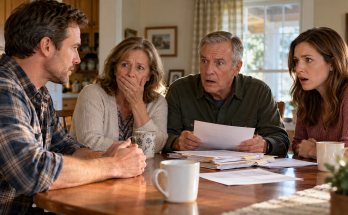
“We owed so much. Tyler was gambling. He was taking out loans. They threatened to take the kids. Sam said that if we sold your house, we’d buy you a smaller place later. That you wouldn’t even notice.”
I laughed.
I couldn’t help it.
“They were going to ‘buy’ me a smaller place with my own house.”
Paula knelt on the sidewalk.
People turned to look.
“Forgive me, Mom.”
I felt ashamed seeing her there.
Not for myself. For her.
“Get up,” I said.
“Not until you forgive me.”
“Then you’re going to be there a long time.”
She stood up slowly.
“I’m going to give a statement.”
I looked at her.
“Not for me. For your kids. And because Tyler is going to leave you to take the fall for everything.”
“For the first time, you’re going to tell the truth even if it stains you.”
She nodded.
“Yes.”
Paula’s truth opened the door.
Sam fell first.
They found him in a rented house in the suburbs, with two forms of identification, copies of my fake death certificate, and withdrawal receipts. He wasn’t the skinny boy who left with a backpack anymore. He was a bloated old man, with dyed hair and the eyes of a dog who still thinks it can bite.
I saw him at the DA’s office.
Not like a reunion.
Like acknowledging a rotten debt.
“Sharon,” he said, “I can explain.”
“Explain it to the prosecutor.”
“I loved you very much.”
“You killed me on paper.”
He lowered his voice.
“Paula signed too.”
“I know.”
“Then don’t act like a saint.”
I stepped close enough for him to hear me without shouting.
“I’m no saint. I’m the dead woman who came to report you.”
He didn’t speak to me again.
Tyler took longer.
He went into hiding. He sent messages. He threatened Paula. He said that if we sank him, we’d all go down. Brenda taught me how to save screenshots. The DA’s office granted protective orders. Paula, for the first time in her life, slept with her children in my house without giving orders. I let her in, but not into my room, not to my papers, not to my money.
“I’m not here to take anything from you this time,” she told me one night.
I was making rice for my grandkids.
“That is proven with years, not with hunger.”
She accepted the plate.
She didn’t complain.
That was new.
Getting my name back took longer than filing the report.
I went to the state capital once to check on the progress. I took the bus before dawn, with a sandwich wrapped in a napkin and my folder clutched to my chest. In one office, they told me the death certificate had to be annulled through administrative and judicial channels. In another, that the SSA would update my status when the Vital Records office notified them.
I just kept repeating:
“I am alive.”
Sometimes it seemed like that wasn’t enough.
Brenda accompanied me to another Social Security appointment when everything finally started to be corrected. Paula wasn’t grabbing my arm anymore. It was just me, in my blue blouse, my new ID being processed, and a more orderly kind of rage.
The same clerk closed the laptop, but this time she smiled.
“Ms. Mendez, your status is active.”
Active.
Never had such a cold word warmed my chest so much.
I didn’t cry there.
I cried outside, buying a hot drink.
Paula was with me.
She didn’t touch me.
She just stayed to one side.
“Mom…”
“Don’t ruin this moment.”
She shut her mouth.
Good.
Months later, Tyler was arrested in a nearby city for another fraud case. Our situation was added to his list. Sam agreed to give a partial statement when he saw that no one was coming to bail him out. He said everything was Tyler’s idea. Paula said her part. I said mine.
The house wasn’t sold.
I had the locks changed.
I installed a stronger gate with the help of a neighbor who let me pay in installments. On the living room wall, I hung a copy of the stay of execution for my death certificate—framed—not because it was beautiful, but because it was my bureaucratic resurrection certificate.
My grandkids asked what it said.
“It says your grandmother is alive,” I told them.
The youngest one hugged my waist.
“I already knew.”
That made me laugh.
In time, I received my benefits card.
I didn’t give it to anyone.
I went to the bank alone, learned to cover the keypad with my hand, and changed the PIN to one that wasn’t anyone’s birthday. When the first deposit hit, I bought heating oil, shoes for myself, and meat to make stew.
I didn’t give money to Paula.
I gave food to my grandkids.
There is a difference.
Paula got a job at a pharmacy on the avenue. She made little. She came home tired. Sometimes she cried at night, thinking I couldn’t hear her.
One morning, I found her in the yard.
“I killed you, Mom,” she said.
I stood by the laundry sink.
“Yes.”
I expected to tell her no.
I didn’t say it.
“I don’t know how to live with that.”
“Well, start by living without stealing anyone else’s life again.”
She cried.
“Will you ever forgive me?”
I looked at the dark sky over the corrugated metal roofs. I could hear dogs, a distant moped, a party dying down on some street. The neighborhood was still standing, stubborn, just like us.
“I don’t know,” I replied. “But if it comes, it won’t be because you asked for it. It will be because you changed.”
She nodded.
“I’m going to try.”
“Don’t try. Do it.”
A year passed.
A year of appointments, hearings, filings, therapy for Paula at a community center, school for the kids, and silence with Sam. He sent a letter from where he was being held. I didn’t open it. I put it in a box with the papers of my fake death.
Maybe one day I’ll read it.
Or maybe not.
One morning, Brenda came to visit me.
No ID badge this time, just a bag of bread.
“I wanted to see how you were doing, Ms. Mendez.”
I served her coffee.
Paula came out to greet her, looking ashamed.
Brenda looked at her seriously, but not cruelly.
In that house, we were all learning that shame is useless if it doesn’t change your hands.
We sat in the yard.
My grandkids were playing with a deflated ball. Paula was washing dishes. The sun beat down on the metal roof, making that heat noise that sounds like a hum.
Brenda looked at the wall where I hung my framed paper.
“It’s powerful to see it like that.”
“That I’m alive?”
She smiled.
“That you had to prove it.”
I took a sip of my coffee.
“Honey, poor women have to prove everything. That we work, that we pay, that we give birth, that we endure, that we don’t lie. Even to exist, they ask us for a copy.”
Brenda looked down.
“But here you are.”
I looked at my house.
It wasn’t big.
It wasn’t magazine-beautiful.
It had exposed concrete blocks, a crack in the kitchen, plants in old paint cans, and a small altar to the Virgin of Guadalupe next to a photo of me as a young woman, so I wouldn’t forget that before I was a grandmother, a mother, a fake widow, and an administrative corpse, I was Sharon.
Just Sharon.
“Yes,” I said. “Here I am.”
That afternoon, when Brenda left, Paula approached with wet hands.
“Mom, do you want me to go to the office with you tomorrow?”
I looked at her.
She corrected herself quickly.
“Just to walk with you. You sign. You speak. You keep the card.”
For the first time, it didn’t sound like a trap.
It sounded like learning.
“Yes,” I said. “You can walk with me.”
Her eyes filled with tears.
“Thank you.”
“Don’t get confused. Walking with me isn’t the same as managing me.”
“I know.”
I went into my room and took out my grocery bag, the same one where Brenda had slipped that little paper that gave me my life back. It still had a small orange juice stain on the corner.
I stroked it like someone touching a scar.
Paula had robbed me.
Sam had buried me.
Tyler had wanted to sell my roof.
But none of them could take the only thing that didn’t come from a Social Security number, or a certificate, or a card.
My name, spoken by me.
My house, defended by me.
My life, signed by me.
Because that day in the system, I stopped showing up as dead.
But the truth is, I had come back to life long before that.
I came back to life at the exact moment I looked my daughter in the eye, clutched my papers to my chest, and said, for the first time without asking for permission:
While playing at the park, my best friend’s son fell and broke his arm, so I rushed him to the ER. Just as I paid the hospital bill, the police handcuffed me. “You’re under arrest for child abuse.” My friend stood there sobbing, swearing she saw me deliberately push her son. I was completely frozen—until the doctor carried the boy out. Trembling, the little boy gripped the doctor’s coat, looked at the police, and whispered: “Officer… please take off my undershirt.”
Part 2 of 2