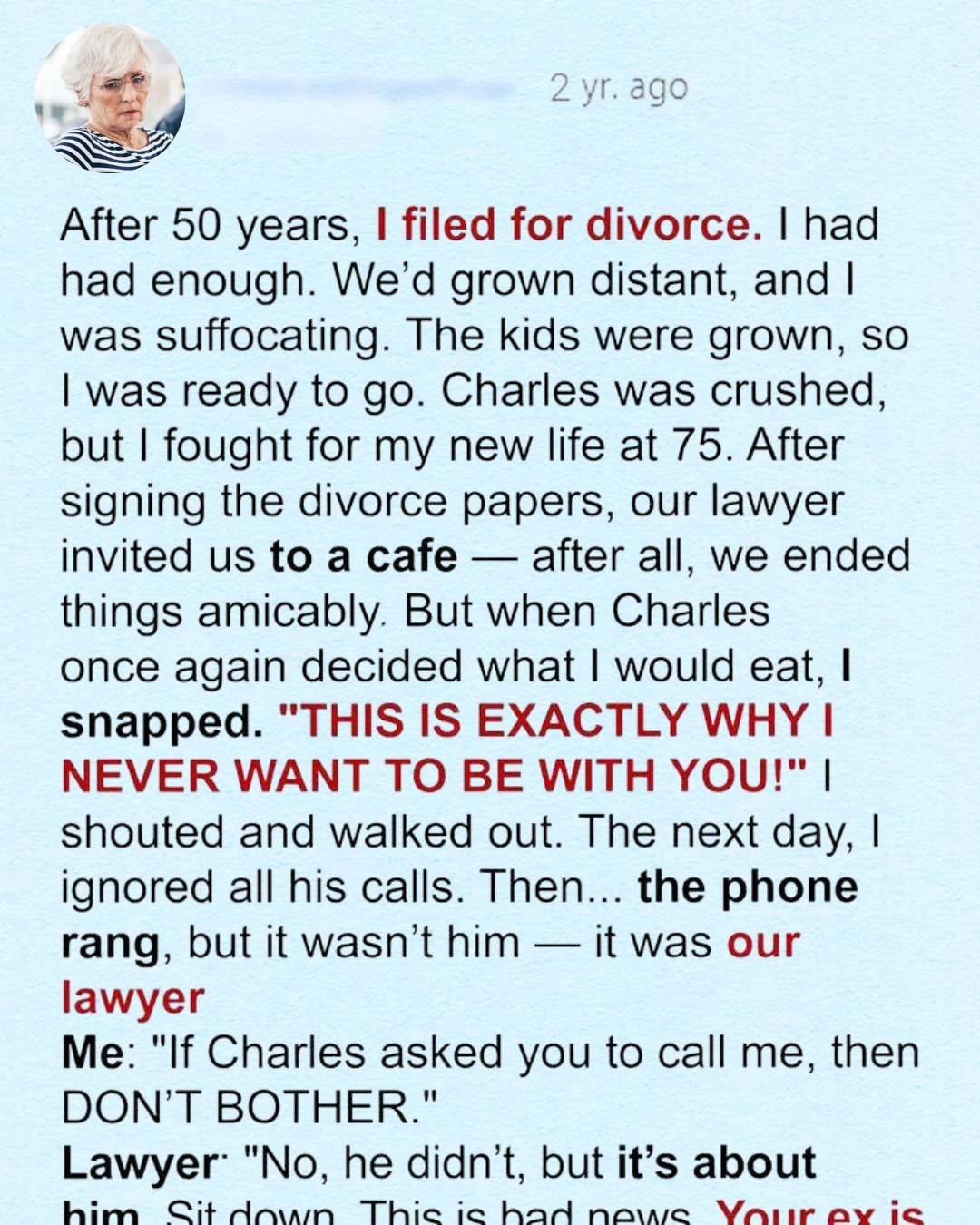
I had finally had enough. After more than fifty years of marriage, I, a seventy-five-year-old woman, wanted out. My husband Charles and I had been together since college—he was ten years older, but our love had bridged every difference. Everyone who knew us believed we’d be inseparable forever. And for the longest time, they were right.
We raised two beautiful children who grew up, started their own families, and made us proud. But somewhere along the way, despite our full and seemingly happy life, I began to feel trapped. I felt like I had never truly lived for myself. The feeling crept in slowly but deeply, and soon it showed in how I treated Charles.

He loved me deeply, always looking out for me in every possible way. But as I grew more distant and irritable, he became confused. I could see he didn’t understand why I’d begun picking fights and throwing tantrums over nothing. Eventually, he tried to talk to me, hoping we could resolve whatever was wrong between us.
One afternoon, he walked in on me muttering to myself.
“What’s the matter, honey?” he asked gently. “You’re talking to yourself again.”
“And it’s all thanks to you, Charles,” I snapped, my voice sharp with resentment. “You’re slowly driving me insane.”
“Come now, Rose, don’t say things like that to me,” he pleaded softly. “They break my heart.”
“You’re always playing the victim!” I shot back before storming out of the room, leaving him alone and bewildered.
Our quarrels grew more frequent after that. Eventually, I asked for a divorce—and to my surprise, Charles didn’t try to stop me. Perhaps he knew that at our age, the emotional strain wasn’t good for either of us.

When we met with our lawyer, Mr. Frank Evans, to discuss it, he tried to persuade us otherwise. He’d known us for years and genuinely thought we were perfect together.
But I wouldn’t budge. I wanted my freedom. And Charles, being the kind soul he was, agreed. He didn’t want to be the reason I lost my peace, even if it meant losing me.
On the day we signed the papers, Frank invited us to have a meal at our favorite restaurant.
“What could it hurt?” he said, smiling.
I hesitated, but Charles immediately agreed.
“We wouldn’t mind, Frank,” he said cheerfully. “We’re parting ways amicably. This could be our last supper.”
Against my instincts, I agreed, and the three of us went.
When we arrived, Frank ordered his meal and insisted on paying for both of us. Then the waiter came to take our orders—and that’s when Charles took over, as usual.
He asked the waiter to dim the lights around our booth “for my comfort” and ordered a salad for me while he chose a steak for himself.
I sat there seething. I couldn’t believe he was still making decisions for me—as if I wasn’t there, as if I couldn’t think for myself. To make matters worse, the dimmed lighting irritated the other diners, who began to complain. I hated drawing attention, and being at the center of it made my face burn with embarrassment.
I couldn’t take it anymore. In a flash of anger, I lashed out at Charles, saying things I didn’t mean, and then I walked out, leaving both him and Frank staring after me.
“Women, am I right?” Frank said awkwardly.
“Tell me about it,” Charles replied with a sad smile.

That night, when I returned home, I took most of my belongings and left. Charles stayed behind in our now-empty house. I later learned it broke his heart—not because of the things I’d said, but because he truly didn’t understand what had gone wrong between us.
Neither of us slept much that night. Sometime before dawn, Charles gave up on sleep and decided to write me a letter—one last attempt to reach out, to make me understand his heart. He poured all his emotions into that letter, crying as he wrote.
When morning came, he realized he didn’t know where I’d gone, so he couldn’t send it. He left the letter on the mantelpiece instead. That’s when he noticed I’d forgotten my daily pills—the ones I needed for my medical condition.
Worried, he picked up his phone and tried to call me. But I ignored his calls, convinced he was only trying to guilt me into coming back.
He doesn’t even know me after all these years, I thought bitterly as the phone rang again. We’ve spent decades together, raised children together, and yet he’s always tried to control me. I’m done with that. Now I’ll finally live my own life—my way, in freedom.
Meanwhile, Charles grew increasingly anxious when I wouldn’t answer. His fear for me, mixed with heartbreak, became too much for his weakened heart. The pain in his chest intensified until he realized he was having a heart attack.
He managed to dial for an ambulance before collapsing.
When the police contacted Frank, he immediately called me.
“Rose,” he said urgently, “Charles has been taken to the hospital. It’s serious.”
My heart froze. My Charles—lying helpless in a hospital? The thought of losing him filled me with terror. In that instant, all my anger evaporated, replaced by the overwhelming realization that I still loved him deeply.

I rushed back to our house to gather a few things he might need. That’s when I found the letter. My hands trembled as I unfolded it.
“Dear Rose,” it began, “first I’d like you to know I’ve loved you all these years, and I’ll love you until I leave this earth. I don’t know why you’ve decided to close your heart to me, but I wish you would open it again, because I can’t imagine a world where we’re apart.”
Tears blurred my vision as I continued to read.
“I’m sorry about what happened at the restaurant. I was only trying to look out for you, as I’ve always done. I know you hate the glare of bright lights because they hurt your eyes, so I asked that they be dimmed. And I know about your health issues—that’s why I ordered the salad. I’m sorry for taking such liberties, and I promise to do better if you return to me.”
By the time I reached the end, I was sobbing. Every word tore through me, revealing how blind I’d been. I suddenly saw how much love and care had been behind everything he did—how the very things I’d mistaken for control were, in truth, acts of tenderness.
I didn’t waste another moment. I ran to the hospital, desperate to see him. When I finally found him, frail but alive, I broke down beside his bed.
“Charles,” I cried, “please forgive me. I was wrong. I don’t want this divorce. I want to spend whatever time we have left together.”
He reached for my hand, his eyes wet. And in that moment, I promised myself I would never again take his love for granted. From that day forward, I would be the wife he deserved—the one who noticed, listened, and loved him as fiercely as he’d always loved me.

What did we learn from this story?
- Don’t ignore a loved one because you’ll regret it if you lose them. Rose ignored Charles’ call because she was mad at him, but she realized how much she would miss him when she came close to losing him.
- Avoid making decisions when emotions are high. Rose decided she wanted a divorce while she was angry with Charles, and it started the sequence of events that almost cost him his life. Thankfully, he lived long enough for her to realize her mistake and rectify it.
Share this story with your friends. It might brighten their day and inspire them.