When people talk about defining moments, they usually picture something loud—big announcements, dramatic scenes, doors slamming or opening.
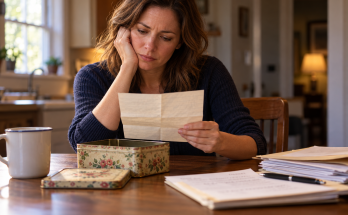
But the moment that changed Anna’s life arrived quietly, on a gray Tuesday morning, in the form of a half-empty gas tank and twenty-seven dollars in her checking account.
She sat in her car outside the grocery store, fingers gripping the steering wheel, staring at her handwritten list. Milk. Bread. Rice. Her son Caleb’s asthma medication. And the invoice for the electric bill tucked between the lines like a bruise.
She tried to do the math again, though she already knew the answer. Money didn’t magically multiply just because you were tired enough.
She rubbed her eyes. Choose what matters most. That’s what her mother always said, and now that she was gone, the words felt both comforting and sharp.
Anna went inside, moving slowly, as if the aisles themselves could feel her tension. She put the essentials into the cart—only the essentials—and hovered over the shelf with Caleb’s medication before placing it gently on top.
It would mean the electric payment would be late again.
It would mean another stern letter.
Maybe another shutoff notice.
But Caleb came first. He always had.
At the register, the cashier—a quiet woman named Ruth—scanned the items without judgment. She had kind eyes, the sort that noticed things but didn’t announce it.
“You all right today, hon?” she asked softly as Anna swiped her card.
Anna forced a small smile. “Just tired.”
The card reader beeped.
Declined.
Anna’s chest tightened. She felt the heat climb up her neck, the world narrowing in humiliation. “Can you try it again?” she murmured.
The cashier did, discreetly. The second beep sounded even louder.
Before Anna could stammer out an apology, Ruth gently placed a hand on the counter.
“Why don’t you try again in a minute,” she said, stepping away. She tapped something quietly into her register. When she returned, she gave Anna a warm, steady smile. “There we go. Looks like it went through this time.”
Anna blinked. She knew what had happened. She opened her mouth to protest, but Ruth shook her head.
“Don’t worry about it. We all have days like this.”
Tears threatened, but Anna swallowed them down, offering only a trembling “Thank you.”
When she got home, she set the groceries on the counter and sank into a chair. She felt the weight of the day pressing heavily on her. But then Caleb bounded in from his room, holding up a crooked drawing of the two of them standing under a sky full of red and blue scribbles.
“It’s a sunset,” he announced proudly. “Because I like when you say the world looks gold at the end of the day.”
Anna pulled him into her lap, pressing her cheek to his hair. She didn’t have much. Sometimes it felt like she had almost nothing at all.
But here, wrapped in small arms and the smell of crayons, she realized she had something enormous:
Quiet blessings—gentle, unannounced, easily overlooked but deeply felt.
The kindness of a stranger.
The warmth of a child’s love.
The strength to choose what mattered, even when the choices hurt.
Life didn’t give her easy days.
But it gave her these moments—enough to keep going, enough to keep hoping.
And sometimes, she realized, that was more than enough.