
The house went on the market the following week.
I received updates from the real estate agent whenever somebody expressed interest.
Several people came to see it.
One couple particularly liked the backyard.
Another admired the bedrooms.
I found it strange hearing strangers discuss the rooms where I had spent so much of my life.
But I also found it comforting.
Somebody might make new memories there.
Children might run along the hallway.
Someone might sit beside the kitchen window with a cup of coffee.
The house wasn't going to stop being a home simply because it stopped being mine.
Eventually, the agent called with an offer.
I was sitting on my balcony when the telephone rang.
She explained the amount and the proposed terms.
I wrote them down in my notebook.
Then I took time to consider everything.
I consulted the appropriate professionals and made sure I understood the financial consequences.
The offer was fair.
The buyers appeared serious.
There were the usual conditions and arrangements to complete before the sale could become final.
I accepted after reviewing the details.
When I hung up, I sat looking at my empty flowerpots.
I had bought them several days earlier.
I hadn't planted anything in them yet.
There seemed to be too many decisions happening at once.
Then I realized I didn't have to finish everything that afternoon.
There was nobody standing behind me asking when I would get something done.
I could plant my flowers tomorrow.
Or the next day.
I went inside and made lunch.
Several weeks later, the sale was ready to close.
I returned to the house one final time.
The dining table had been collected for donation.
The remaining rooms were empty.
Even the old curtains had been carefully packed away.
My footsteps echoed in the hallway.
I stood in the kitchen for a long time.
I remembered my husband standing beside the stove, insisting he knew how to prepare something he had never cooked before.
I remembered Sarah coming downstairs in her pajamas on Christmas morning.
I remembered ordinary Tuesday evenings when nothing particularly important had happened.
Those were the memories that surprised me most.
The ordinary ones.
I had spent so much time thinking about what had gone wrong during the final three years that I had almost forgotten how many good years came before them.
I was glad those memories returned.
I walked upstairs and stopped beside Sarah's old bedroom.
The pencil marks were still on the doorframe.
I touched them gently.
I didn't try to remove the wood or preserve anything that belonged to the property.
I had the photographs Sarah had taken.
They would be enough.
Downstairs, I stepped into the backyard.
The rosebush was flowering.
I stood beside it and remembered the afternoon my husband and I had planted it.
We hadn't known how large it would become.
We hadn't known what the years ahead would contain.
We had simply planted something together and hoped it would grow.
I smiled.
Then I returned inside.
The house was quiet.
I checked each room, closed the windows, and completed the remaining arrangements with the agent.
When the time came to hand over the keys, I held them for a moment longer than necessary.
The little metal ring had been replaced several times over the years.
The keys had changed too.
Yet I knew their weight without looking.
I placed them in the agent's hand.
She thanked me and wished me well.
I thanked her.
Then I walked to my car.
I didn't cry until I was seated behind the steering wheel.
I let myself cry.
There was nobody there to tell me I was being sentimental.
Nobody to suggest I was holding on to things for too long.
I had loved that house.
I was allowed to grieve leaving it.
After a few minutes, I dried my eyes and drove away.
When the sale was completed, I arranged for the proceeds to be managed in a way that protected my retirement.
I kept sufficient funds accessible for ordinary expenses and emergencies.
I sought professional guidance about the rest.
I wanted security rather than excitement.
I had no intention of suddenly becoming extravagant because a substantial amount of money was available.
I wanted the freedom to make ordinary decisions without fear.
Buying groceries.
Replacing an appliance.
Visiting a friend.
Taking a holiday if I felt like it.
I didn't want to become somebody else's financial solution again.
That was the most important part.
A few days after everything was settled, Sarah called.
She asked whether the house had officially been sold.
“Yes.”
“How do you feel?”
I thought about it.
“A little sad. Mostly relieved.”
She said she understood.
Then she asked whether I wanted company.
“I'd like that.”
We arranged for her to visit on Sunday.
She arrived shortly after lunch.
I heard a knock on the apartment door.
When I opened it, she was standing there holding a small bunch of flowers.
“Hi, Mom.”
“Come in.”
She handed me the flowers.
They weren't expensive.
There were several yellow ones mixed with white flowers and a little greenery.
“I thought these would look nice near your window.”
“They certainly will.”
I found a vase and filled it with water.
Sarah looked around the apartment.
My bookshelf was beside the wall.
My favorite chair was near the window.
There were photographs on the little table.
She smiled.
“It looks like you.”
I stopped arranging the flowers.
“What do you mean?”
She looked toward the bookshelf.
“Everything. It just feels like your place.”
I hadn't expected those words to affect me so deeply.
For three years, I had watched my belongings disappear into spare rooms and cupboards.
Now somebody had walked into my home and recognized me in it.
I thanked her.
We sat on the balcony with coffee.
She noticed the small container holding the rose cutting.
“Is it doing anything?”
“I think it's beginning to.”
There was a tiny amount of new growth.
I had been watching it closely.
Sarah leaned forward to examine it.
“Dad would have liked that.”
“Yes.”
We sat quietly for a little while.
Then she began telling me about her apartment.
Greg had started comparing prices before buying groceries.
They had worked out a monthly budget.
They were putting aside a little money whenever possible.
Their furniture didn't match.
The kitchen was smaller than they would have preferred.
But they were managing.
I listened with genuine interest.
I wasn't secretly calculating how much assistance they might need from me.
I wasn't preparing myself to offer money.
I was simply listening to my daughter talk about her life.
It felt remarkably pleasant.
“Greg says we should have done this ages ago,” she told me.
“Does he?”
She laughed.
“He wouldn't have said that a few months ago.”
“No.”
“He didn't realize how comfortable we'd gotten.”
I took a sip of coffee.
“Comfort can make people forget what other people are doing for them.”
She nodded.
“I know that now.”
Later, we walked to a nearby shop.
Sarah insisted on buying me a pastry.
I accepted.
It was a small gesture, but it mattered to me.
She wasn't purchasing something because she expected something larger in return.
She was doing something nice for her mother.
I had missed that simplicity.
When we returned to the apartment, she washed our coffee mugs before leaving.
I hadn't asked her to.
She dried them and put them back where they belonged.
Then she picked up her handbag.
“Can we do this again next weekend?”
“Certainly.”
“I'll call first.”
I smiled.
“That would be lovely.”
After she left, I sat beside the window and looked at the flowers she had brought.
The apartment was quiet.
I didn't feel abandoned.
I knew she would return.
I also knew that my happiness didn't have to disappear whenever she walked out the door.
There was a freedom in that which I hadn't understood before.
Over the following months, Greg began visiting occasionally too.
The first time, he arrived with Sarah and stood awkwardly inside the doorway.
He looked around the apartment.
“This is nice.”
“Thank you.”
He nodded toward the balcony.
“Good amount of light.”
“I thought so.”
We had coffee together.
Our conversation was polite.
A little uncomfortable.
I didn't expect a complete transformation from him simply because several months had passed.
I was willing to give him time.
Near the end of the visit, he asked whether he could speak to me privately.
Sarah went onto the balcony.
Greg remained beside the dining table.
He looked down at his hands.
“I owe you an apology.”
I waited.
He took a breath.
“I was angry when you gave us those papers.”
“I remember.”
He nodded.
“I thought you were taking something away from us.”
He paused.
“But it wasn't ours.”
I looked at him.
He seemed genuinely uncomfortable.
Not defensive.
Not angry.
Just embarrassed.
“I shouldn't have spoken to you the way I did.”
“Thank you for saying that.”
He glanced toward Sarah.
“We probably wouldn't have changed anything if you hadn't made us leave.”
I considered his words.
“Perhaps not.”
He nodded.
“I guess we needed to grow up a bit.”
I smiled faintly.
“There's always room for that.”
He laughed.
Then he thanked me again for allowing them to stay during the difficult period that had brought them to my house.
I accepted his thanks.
I didn't tell him that everything was forgotten.
I didn't need to.
He had acknowledged something important.
What happened next would depend on how he behaved over time.
When Sarah returned, we continued our conversation.
Before leaving, Greg noticed that one of the small handles on my kitchen cupboard was loose.
He offered to tighten it.
I fetched my husband's toolbox.
Greg recognized it immediately.
“You kept this.”
“Of course.”
He opened it and selected a screwdriver.
A minute later, the handle was secure.
He returned the screwdriver to its place and closed the box.
Such an ordinary act.
Yet I appreciated that he had noticed something that needed doing and offered to do it without being asked.
After they left, I put the toolbox away.
I thought of my husband.
I imagined how pleased he would have been that his tools were still useful.
Not abandoned behind somebody else's boxes.
Not forgotten in a garage.
They were part of my new home.
As autumn arrived, I planted more flowers on the balcony.
The little rose cutting survived.
Its growth was modest, but it was growing.
I checked it each morning while drinking coffee.
Sometimes I talked to it.
My husband would have laughed at that.
He used to say plants didn't need conversations.
They needed water and sunlight.
I gave mine all three.
My life gradually settled into a comfortable rhythm.
I read books I had been meaning to finish.
I walked whenever the weather was pleasant.
I bought groceries that I liked.
Once, I stood in front of the yogurt section at the supermarket and started reaching automatically for Greg's preferred brand.
Then I stopped.
I chose the one I wanted instead.
It made me laugh right there in the aisle.
Nobody around me understood why.
I didn't particularly care.
On another afternoon, I bought a new dress without considering whether the money might be needed for somebody else's household expenses.
It wasn't an expensive dress.
But I liked how I looked in it.
I brought it home and hung it beside the dark blue dress I had worn on my sixtieth birthday.
For a moment, I looked at both.
Then I closed the wardrobe.
That birthday no longer felt like something I needed to escape remembering.
It had been painful.
It had also been necessary.
Without that evening, I might have continued living in the same arrangement indefinitely.
I might have spent another decade apologizing for wanting privacy.
I might have allowed somebody else to decide what should happen to everything I had earned.
I was grateful I had finally stopped.
Almost a year after the birthday dinner, Sarah called me with a familiar question.
“What are you doing on Saturday?”
“Why?”
“Your birthday, Mom.”
I laughed.
“I haven't forgotten this time.”
She asked whether she and Greg could take me out for dinner.
For a second, I remembered the restaurant.
The folded napkins.
The cold food.
Her telling me I would no longer feel welcome.
Sarah must have sensed my hesitation.
“Just dinner,” she said.
I smiled.
“All right.”
She chose a different restaurant.
When we arrived, she asked whether I liked the table.
I told her it was lovely.
Greg ordered a drink.
Sarah handed me a small wrapped present.
Inside was a framed photograph.
It showed the rosebush beside the fence at the old house.
She had taken the picture before we left.
The flowers were open.
Sunlight fell across the brick wall behind them.
“I thought you might want this,” she said.
I touched the frame.
“Thank you, sweetheart.”
We ate dinner.
We talked about ordinary things.
Nobody mentioned property ownership.
Nobody discussed my savings.
Nobody suggested where I ought to live.
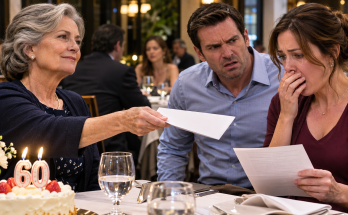
When dessert arrived, there was a candle in my cake.
Sarah smiled across the table.
“Make a wish, Mom.”
I looked at her.
Then I looked at Greg.
I thought about my apartment, the little balcony, the books beside my favorite chair, and the rose growing in its pot.
For the first time in years, I couldn't think of anything I desperately needed to change.
I blew out the candle.
Sarah reached for her handbag when the bill arrived.
I offered to pay my share.
She shook her head.
“It's your birthday.”
I accepted.
On the drive home, Greg asked whether I wanted them to walk me upstairs.
I told him I was perfectly capable of managing.
He smiled.
“We know.”
Those two words stayed with me.
A year earlier, they had treated my age as a reason to decide my future.
Now they were beginning to respect my ability to decide it myself.
Sarah hugged me outside the apartment building.
“Love you, Mom.”
“Love you too.”
I watched them drive away.
Then I went upstairs and opened my front door.
I placed the framed photograph beside my husband's picture.
There was room for it.
There was room for Sarah's graduation photograph too.
There was room for everything I wanted to keep.
The following morning, I woke before seven.
I made coffee and carried it onto the balcony.
A small bud had appeared on the rose plant.
I leaned closer to examine it.
Then I sat back in my chair.
My husband was gone.
The brick house belonged to another family.
My daughter lived with her husband in an apartment they paid for themselves.
Nothing looked quite the way I had once imagined my life would look at sixty-one.
But I was comfortable.
I was safe.
And when my daughter visited, she came because she wanted to see me.
Not because she needed my house.
Not because she wanted my money.
Not because she believed I owed her a particular kind of life.
The white envelope had changed all of us.
It had forced Sarah and Greg to accept responsibilities they had avoided.
It had forced me to recognize responsibilities I had been carrying that were never mine.
Most importantly, it had given our relationship a chance to become something healthier.
I finished my coffee and carried the mug inside.
The kitchen sink was empty.
I washed my mug, dried it, and returned it to the cupboard.
Then I opened the window and let the morning air into my little home.
For most of my life, I had believed that being a good mother meant always leaving the door open.
Now I understood that I could close it when I needed privacy.
I could open it when someone came to visit.
I could love my daughter without giving her control over my life.
And I could enjoy everything my husband and I had worked for without apologizing for still being here.
I looked around my apartment.
Nothing was particularly expensive.
Nothing was especially impressive.
But every photograph, every book, every flowerpot, and every piece of furniture had a place because I had chosen it.
Nobody could tell me I was unwelcome.
Nobody could ask me to disappear so they could be more comfortable.
I belonged there.
And after sixty-one years of trying to make everybody else feel at home, I finally knew what it meant to feel at home myself.
The End
Read more original stories on Feel Every Story.
I Had Spent Three Years Making Room for My Daughter Before I Realized There Was Almost No Room Left for Me
Part 10 of 10

One Comment on “PART 10 – Months After the White Envelope Changed My Family, My Daughter Knocked on My New Front Door and Finally Understood What Coming Home Meant”