The response about the original agreement did not arrive the way I expected.
I had imagined someone would simply produce the document.
A signed paper.
Something that could be examined.
Something that would explain why my sister was so certain I had accepted the obligation.
Instead, the matter became less clear.
The copy had been provided.
But the original was not immediately available.
There were questions about where it was kept.
And no one had yet supplied a complete account of how it had been signed.
I learned that through the attorney.
I read the update at my kitchen table.
My coffee was cold.
The folder was open beside me.
For days, I had been waiting for one simple thing.
A document that could be inspected.
I still didn't have it.
I called the attorney's office.
I asked whether that meant the agreement was fake.
The answer was careful.
Not producing an original immediately did not, by itself, prove forgery.
There could be explanations.
But the lack of an original and the unresolved questions about execution were important.
I understood.
I didn't want a conclusion that couldn't be supported.
I wanted the truth.
I asked what would happen next.
We discussed the available records and the continuing need for evidence.
I made another note.
Then I ended the call.
For a few minutes, I sat quietly.
I thought about how quickly my family had claimed the agreement settled everything.
My sister had treated it as proof that I was obligated to keep paying.
My father had referred to the paperwork as though it answered all my questions.
My mother had wanted me to stop challenging them.
But when I asked for the original, no one had provided it.
That mattered.
I looked at the copy again.
The signature still resembled mine.
The printed words still claimed an agreement I did not remember making.
And the people relying on it still had not explained when I supposedly signed it.
I couldn't declare the matter finished.
But I could stop treating their certainty as evidence.
That was a change for me.
For years, I had accepted my parents' version of things because they were my parents.
If Mom said something had to be done, I usually did it.
If Dad said an expense was urgent, I tried to help.
If my sister said I had misunderstood a comment about my daughter, I sometimes let it go.
I had confused confidence with truth.
And family status with authority.
Now I was learning to ask questions.
Even when the answers made people uncomfortable.
That afternoon, my mother called.
I answered.
Her voice was quieter than it had been.
“Barbara, this has gone too far.”
I leaned against the kitchen counter.
“I agree.”
She sounded relieved for a moment.
“Then you'll stop all this?”
“No, Mom. I mean it should never have reached this point.”
She sighed.
“You're holding Christmas against us.”
I looked toward the living room.
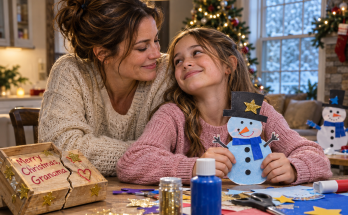
My daughter's blue snowman was still on display.
“I'm holding you responsible for the message you sent to my child.”
“She took it the wrong way.”
I closed my eyes.
There it was again.
The explanation that turned someone else's hurt into their mistake.
“Mom, you told her not to attend.”
“It was a difficult situation.”
“For whom?”
She didn't answer immediately.
Then she started talking about my sister's children.
Their feelings.
Their expectations.
The holiday plans.
I listened until she finished.
Then I spoke.
“My daughter is ten. Her father is gone. She made you a Christmas present and spent hours decorating it.”
My mother's voice softened.
“I didn't know she was making something.”
“You didn't ask.”
There was a pause.
“She could have given it to me another time.”
I looked down.
I remembered the broken lid in the trash.
The gold glitter.
The crooked heart.
I felt tired.
“That's not the point.”
Mom was silent.
“The present wasn't the problem. She thought you didn't want her.”
“That isn't what I meant.”
“Then why did you tell her to stay away?”
She didn't answer directly.
Instead, she said she wanted our family to stop fighting.
I wanted that too.
But not at the price of pretending nothing had happened.
I told her I would not discuss my daughter's feelings as though they were an inconvenience.
Then I asked about the financial agreement.
Her tone changed.
“Why do you keep bringing that up?”
“Because it has my name and a signature I don't recognize.”
“Your sister was trying to help us.”
I stood straighter.
“What does my sister have to do with preparing the document?”
Mom went quiet.
I waited.
She said the paperwork was supposed to make the arrangement clear.
I asked who had prepared it.
She didn't give me a complete answer.
I asked when I had supposedly signed it.
Again, there was no clear answer.
I didn't argue.
I told her those questions needed to be addressed through the attorney.
She became upset.
“Do you really want to do this to your own family?”
I looked at the folder.
Then at the photograph of my husband near the living room.
I thought about how much had changed since he died.
I had spent so much energy trying to keep everyone connected.
Trying to make sure my parents were comfortable.
Trying to prevent disagreements.
And somewhere along the way, I had forgotten that my daughter and I were a family too.
I answered my mother quietly.
“I want the truth about a document that claims I promised something I never knowingly agreed to.”
She didn't respond.
So I continued.
“And I want my daughter treated with respect.”
Mom said she needed time.
I told her she could take it.
Then we ended the call.
I stood in the kitchen for a while.
I hadn't raised my voice.
I hadn't insulted her.
I hadn't promised to restore the payments.
And I hadn't apologized for reclaiming the SUV.
That felt unfamiliar.
But it also felt necessary.
Later, I received another message from my sister.
She said the financial agreement was being misunderstood.
I asked her to explain what she meant.
She answered that the family had expected me to continue helping.
I read those words.
Expected.
That was different from agreed.
I wrote back.
“An expectation is not the same thing as a signed obligation.”
She didn't answer that directly.
Instead, she said Mom and Dad were under enormous stress.
I understood that.
They had lost access to a vehicle they depended on.
They had to reconsider expenses I had been covering.
And they were now facing questions about paperwork they had relied upon.
Those were real problems.
But I hadn't created their financial dependence in a single day.
It had developed over time.
And I had participated in it.
That was something I needed to acknowledge.
I had offered help without setting clear boundaries.
I had continued payments without reviewing them often enough.
I had made it easy for my parents to assume the assistance would always be available.
I couldn't blame them for every part of that arrangement.
But I could change what I agreed to do going forward.
I worked through the remaining financial records.
I followed the legal guidance about distinguishing voluntary support from any obligation that required separate handling.
I kept confirmation records.
I avoided making new promises.
And I refused to discuss disputed documents through angry late-night messages.
The work wasn't exciting.
There were no dramatic confrontations.
Just statements.
Dates.
Copies.
Questions.
But I began to feel more confident because I understood what I was doing.
I was no longer reacting to every accusation.
I was making decisions based on records.
One evening, Stacy came over.
She noticed the stacks of paperwork.
“Still working through everything?”
“Yes.”
She looked at me.
“How's your daughter?”
I smiled a little.
“Better some days than others.”
Stacy nodded.
Then she asked about Christmas.
I told her we were making our own plans.
Nothing complicated.
My daughter wanted pancakes.
She wanted to go skating again.
And she had been making decorations.
Stacy smiled.
“That sounds good.”
I looked toward the blue snowman.
“It does.”
After she left, I found my daughter in the living room.
She was arranging her craft supplies.
I sat beside her.
“Have you thought about what you'd like to do on Christmas morning?”
She looked at me.
“Are we going to Grandma's?”
“No. We're going to celebrate at home.”
She thought about that.
“Is that okay?”
“Of course.”
“Even if everyone else goes there?”
“Yes.”
She looked down at her supplies.
Then she asked whether we could make breakfast together.
I told her we could.
She wanted pancakes.
I wasn't surprised.
Then she asked about ice skating.
I promised we'd find another time to go.
She smiled.
And for a moment, I saw the girl she had been before the message arrived.
Not because she had forgotten.
But because she was beginning to understand that Christmas didn't depend on someone else's invitation.
We could make our own holiday.
She picked up a piece of blue paper.
“Can we make another snowman?”
“Sure.”
We sat together and worked.
She cut out the shape.
I helped with the smaller pieces.
We used the felt stickers she had chosen at the craft store.
The new snowman wasn't perfect.
Neither was the first one.
But she liked them.
She placed them side by side.
Then she stepped back to look.
I watched her.
There was no expensive gift involved.
No competition.
No discussion about which grandchildren deserved more.
Just a little girl making something because it pleased her.
I wished my mother could understand how much that mattered.
But I couldn't make her understand.
And I wasn't going to place that responsibility on my daughter.
Later that night, I checked my messages once more.
There was no new evidence about the financial agreement.
No original document.
No complete explanation of the disputed signature.
The attorney was still handling those questions.
I put the phone away.
For the first time in days, I didn't feel compelled to keep checking it.
The uncertainty remained.
I knew the document dispute might take more time.
I knew my parents might continue pressing me about money.
I knew my sister could still insist that I was the person making everything difficult.
But I no longer believed I had to answer every demand immediately.
I had records.
I had legal advice.
I had the right to make decisions about my own property and voluntary assistance.
And I had a daughter who needed me to be her mother before I tried to satisfy everyone else.
Before bed, she came into the kitchen.
“Mom?”
“Yes, sweetheart?”
“Are you sad we're not going to Grandma's?”
I considered the question.
“A little.”
She looked surprised.
“Really?”
“Yes. I wish things were different.”
She nodded.
“Me too.”
I moved closer.
“But wishing things were different doesn't mean we have to accept being treated badly.”
She thought about that.
Then she took my hand.
“Can we still have a good Christmas?”
I squeezed her fingers.
“Yes.”
She leaned against me.
We stayed there for a moment.
Then she went to bed.
I returned to the table and closed the financial folder.
The disputed agreement was still unresolved.
I wasn't going to pretend otherwise.
But the other decision had already been made.
My daughter's place in my life was not something anyone could negotiate.
And I would not ask her to earn an invitation from people who should have welcomed her without question.
Click here to continue reading: PART 9: My Sister Finally Explained Where the Financial Agreement Came From, and One Detail About My Signature Changed Everything I Believed About Our Family
My Daughter Had Made Her Grandmother a Christmas Present, but One Message Made Her Wonder Whether She Belonged in Our Family
Part 8 of 10