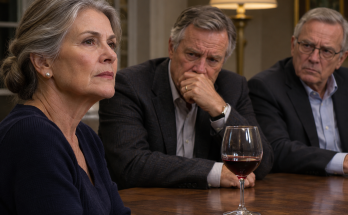
Gerald was the first to lose patience.
He pushed his chair away from the table again.
Not far.
Just enough to make the movement noticeable.
He looked at me as though I had interrupted something important.
"Terry, this doesn't have to become difficult."
I almost answered too quickly.
That was another old habit.
Someone accused me of making things difficult, and I immediately wanted to prove I wasn't.
I had done it so often that sometimes I hadn't even noticed.
But this time I heard what Gerald was saying.
He wasn't asking whether my memory was correct.
He was asking me to stop talking.
I kept my voice level.
"Then answer what I'm asking."
Gerald looked toward Walter.
Walter remained silent.
The silence bothered Gerald.
I could tell.
He had expected Walter to take over.
Walter usually did.
But Walter was still thinking about the agreement.
I knew it by the way his eyes kept returning to me.
Gerald sighed.
"You're bringing up an old company document without explaining why."
"I've explained which document."
"That's not the same thing."
"No," I said. "It isn't."
He seemed to dislike my agreement.
I understood why.
He wanted a disagreement he could control.
If I raised my voice, he could tell me to calm down.
If I became upset, he could suggest that I was confused.
If I made an accusation, he could demand proof.
But I hadn't done any of those things.
I was sitting across from two men who had signed an agreement.
And I was asking them to acknowledge it.
Walter finally spoke.
"Gerald, leave it."
Gerald looked at him.
For a moment, I thought Walter might explain.
Instead, he turned toward me.
"What exactly do you remember?"
I looked at his face.
That question told me more than he probably intended.
He was no longer pretending the agreement didn't matter.
He wanted to measure what I knew.
I answered plainly.
"I remember meeting Michael Bennett."
Walter waited.
"I remember you signing the paperwork."
Gerald looked away.
"And I remember Gerald signing it too."
Neither man corrected me.
That mattered.
I wasn't trying to win an argument by keeping score.
But I had learned something during the conversation.
The details were stronger than my anger would have been.
Names.
Signatures.
A place.
I didn't need anything more complicated.
Walter leaned back.
"That was a long time ago."
"Yes."
"Things change."
"Some things do."
He waited for me to continue.
I didn't.
I wanted him to say what he meant.
He looked irritated.
"What is that supposed to mean?"
"It means time passing doesn't erase what happened."
Gerald folded his arms.
"Nobody said it did."
I turned to him.
"Then we agree."
He stared at me.
I felt a strange sadness at that moment.
Not because Gerald had raised his voice.
He hadn't.
Not because Walter had insulted me.
He hadn't done that either.
It was because both men seemed more troubled by my memory than by the possibility that I had been kept outside a conversation that concerned me.
I didn't know whether either of them understood how that looked.
Perhaps they did.
Perhaps that was why they were so uncomfortable.
Walter picked up his glass.
This time he managed to hold it.
He looked down at the wine for a moment.
Then he spoke.
"I don't appreciate having old business discussed like this."
I watched him carefully.
"You were there."
"Of course I was."
"Gerald was there."
Gerald gave a short nod.
"And Michael Bennett was there."
Walter's expression tightened.
I had not said anything new.
I had merely put the same facts together.
But hearing them in order seemed to trouble him.
I had a clear memory of those facts.
Not every word spoken in the lawyer's office.
Not every page of the document.
But the essential things.
The meeting.
The men.
The signatures.
The safe deposit box.
I wouldn't pretend to remember details I couldn't honestly recall.
That would only give Walter another way to dismiss me.
So I stayed with what I knew.
Gerald spoke again.
"What do you expect us to say?"
I looked at him.
"That you remember."
He shook his head.
"That's all?"
"For now."
I saw Walter react to those two words.
For now.
I hadn't meant them as a threat.
I meant that I was not asking them to explain the entire agreement in a single conversation.
First, I wanted the simple truth established.
But Walter heard something else.
His shoulders stiffened.
"What happens after that?"
I took a moment before answering.
"I don't know yet."
That was true.
I didn't have an answer prepared for every question.
I wasn't interested in pretending otherwise.
I knew only that I wouldn't let either man make me doubt something I remembered clearly.
Walter looked toward Gerald.
Gerald looked back.
Again, they seemed to communicate without speaking.
I noticed how often that happened.
They were accustomed to understanding each other.
I was accustomed to being expected to understand them afterward.
The difference had never seemed quite so obvious.
Gerald stood halfway from his chair.
Then he sat down again.
I wondered whether he had intended to leave the room.
He didn't.
Instead, he placed both hands on the table.
"Terry, we're not saying the papers don't exist."
I felt my breathing settle.
There it was.
The first plain acknowledgment.
I looked at him.
"Thank you."
He appeared surprised.
"For what?"
"For saying that."
Walter didn't move.
Gerald looked uncomfortable again.
Perhaps he had not intended to give me anything useful.
But he had.
The papers existed.
It was no longer only my memory being discussed.
Now one of the men who signed them had acknowledged their existence.
Walter glanced at Gerald.
I saw irritation in his face.
Gerald noticed it too.
He pulled his hands away from the table.
"I only meant—"
"I heard what you meant," Walter said.
His voice was controlled.
Too controlled.
Gerald stopped speaking.
I sat quietly.
There was no pleasure in watching them turn against each other, even for a moment.
They had been united in trying to push the subject aside.
Now Walter seemed annoyed that Gerald had confirmed the obvious.
I found that revealing.
If the agreement was unimportant, why did acknowledgment matter so much?
If it was nothing more than ordinary paperwork, why did they avoid discussing it?
And if Walter truly remembered so little, why had he recognized the subject so quickly?
I didn't ask those questions aloud.
Not yet.
Walter spoke again.
"The papers were kept securely for a reason."
I looked at him.
"Yes."
He seemed to realize what he had said.
He had confirmed another detail.
The documents hadn't simply been misplaced.
They had been stored deliberately.
In a safe deposit box.
I remembered how certain that arrangement had seemed.
Papers placed somewhere secure were supposed to remain available.
That was the point.
Not forgotten.
Not erased.
Available.
Gerald rubbed his forehead.
The movement was quick.
He lowered his hand almost immediately.
I looked at the two men and felt something change in me.
For years, I had believed that important business conversations required a kind of confidence I didn't possess.
Walter had confidence.
Gerald had confidence.
Michael Bennett had held a professional position that made his words carry weight.
I had allowed those differences to make me cautious about my own questions.
But the agreement did not depend on confidence.
It depended on what had been signed.
I could remember that without anyone's permission.
Walter set down his glass.
"Enough about the bank."
I watched his hand move away from the table.
"All right."
He frowned.
My agreement seemed to confuse him.
I wasn't there to argue about the bank.
I was there to establish that the document existed and that both men knew it.
We had done that.
I didn't need to keep repeating myself.
Gerald straightened his jacket.
He appeared relieved that the subject might be ending.
But I noticed something else.
Neither man had asked whether I was mistaken anymore.
They had stopped challenging the memory.
Now they were challenging my reason for speaking.
It was a small difference.
But it was important.
Walter looked at me.
"You've said what you wanted to say."
I considered him for a moment.
"No," I replied. "I've said what I remember."
He looked at me without answering.
The two things were not the same.
And for the first time that evening, I thought he understood that I knew the difference.
Click here to continue reading: PART 3: Walter Wanted the Conversation to End Without an Answer, Until I Reminded Him Why the Papers Had Been Put Away
The Night Walter Asked About the Old Agreement, I Finally Saw the Fear He Had Been Trying So Hard to Hide
Part 2 of 8