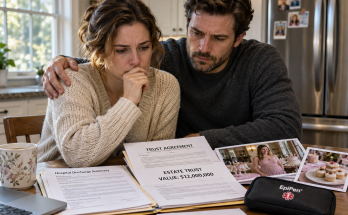
I had never thought one unanswered question could change the way I remembered two years of my life.
But it had.
The question wasn't complicated.
Had I received anything about my grandmother's trust?
No.
That was all I could say with certainty.
And I was tired of trying to make the answer sound less troubling.
I thought about how I had responded when the lawyer first mentioned my grandmother.
My reaction had been immediate.
She had been dead for almost two years.
I wanted to know why he was calling now.
That question still mattered.
But it wasn't the only one anymore.
The lawyer's response had shifted the conversation.
Before explaining why he had contacted me, he wanted to establish whether his office had communicated with me before.
He had been specific.
Correspondence.
Trust.
Certified letter.
I had answered each question as carefully as I could.
There was nothing to remember.
Nothing had reached me.
I hadn't confused one document with another.
I hadn't forgotten a conversation.
I simply had no knowledge of the correspondence he described.
I found myself wanting to say that again.
Perhaps because I worried he wouldn't believe me.
Perhaps because part of me still thought I had done something wrong.
But I hadn't.
I hadn't hidden a letter.
I hadn't ignored a notice.
And I hadn't knowingly avoided a discussion about my grandmother's affairs.
I could only account for what had happened to me.
Not what might have happened somewhere else.
That was the boundary I needed to keep.
I didn't know what his office had done.
I didn't know whether documents had been sent.
I didn't know whether another person had received anything.
And I didn't know whether the trust was being handled properly.
Those questions belonged to the facts that hadn't yet been shared with me.
I tried to imagine what the lawyer would say next.
Would he explain the trust?
Would he ask to meet?
Would he tell me there had been a delay?
I couldn't know.
And every time I tried to complete the conversation in my head, I ended up inventing an answer.
I didn't want an invented answer.
I wanted the real one.
I thought again about my grandmother.
I knew she was gone.
That was the one part of this situation I couldn't change.
But whether her wishes had been communicated was another matter.
If she had made arrangements that concerned me, I wanted to understand them.
Not because I expected something.
Not because I believed I was owed money.
I hadn't even been told what the trust contained.
I wanted to understand because the lawyer had raised the possibility that I should already know.
And I didn't.
The silence surrounding that fact had become impossible to ignore.
I wondered whether my grandmother's instructions were clear.
Whether they mentioned me.
Whether they had been available for nearly two years.
Questions again.
I caught myself and stopped.
I couldn't make the trust mean anything before I saw the terms.
I couldn't decide what had happened to any inheritance before learning whether one existed.
Even the amount connected to my grandmother's secret was not something the telephone conversation had established.
I understood that I was standing at the beginning of an explanation, not the end.
That realization helped.
A little.
It gave me something practical to hold on to.
The documents had to come first.
Then the dates.
Then an explanation for why I had received nothing.
Only after that could I decide whether anyone had misled me.
I thought about the temptation to confront someone immediately.
To demand that my family explain what I had just heard.
But what would I ask them?
Did you know about a trust I don't understand?
Did you receive a letter I haven't seen?
Did you keep something from me?
Those questions could do damage if I asked them without evidence.
And even if someone answered, I wouldn't know what to compare their words against.
I needed to be careful.
That didn't mean doing nothing.
It meant beginning with the one person who had raised the issue.
The lawyer.
He had referred to correspondence.
He had mentioned certified mail.
He had told me there was a trust.
Those were things he could explain.
I wanted to know what his office's records showed.
I wanted to know what the letters said.
I wanted to know why he expected me to have received them.
And I wanted to know why almost two years had passed before this conversation took place.
I couldn't decide what the answers would mean in advance.
I had to hear them first.
I kept remembering the way I swallowed before telling him how long my grandmother had been gone.
It was such a small thing.
My throat had tightened.
My voice had sounded uncertain.
I had been caught off guard by a stranger discussing a death I thought was already behind me.
Then he had begun asking about things I didn't know existed.
I wished I had sounded stronger.
More certain.
But looking back, I don't think sounding stronger would have changed anything.
The truth would still have been the truth.
I had received no correspondence.
I knew nothing about the trust.
And I couldn't explain the difference between what the lawyer appeared to expect and what had actually reached me.
I was beginning to understand that being honest about what I didn't know was more useful than pretending I understood.
No invented memories.
No accusations.
No conclusions without documents.
I wanted to keep those things clear because the situation already felt complicated enough.
There might have been an ordinary mistake.
There might have been something much more serious.
I had no evidence to choose between them.
But whatever the explanation, the missing information mattered.
It had mattered when my grandmother died.
It mattered when the lawyer's office expected correspondence to have reached me.
And it mattered now, almost two years later, when I was finally being asked about it.
The last sound I remembered from the call was the lawyer taking a breath.
He had heard my answer.
He knew I had received nothing.
I couldn't say what he would tell me after that.
But I knew what I needed before I could understand the rest.
The written record.
Not another guess.
Not another assumption.
Something that would show me what my grandmother had arranged and what had happened to the notices concerning it.
For the first time, I understood that I could not accept an explanation merely because it was offered with confidence.
I needed to see whether it matched the facts.
That was what the call had changed.
Before, I hadn't known there was anything to question.
Now there was.
And I wasn't going to fill the silence with an answer that nobody had proved.
Click here to continue reading: PART 5: The Lawyer Finally Explained Why His Office Had Been Trying to Reach Me, and One Missing Signature Changed Everything I Believed
The Lawyer Asked About My Grandmother’s Trust, and I Realized Someone Had Kept Her Final Wishes From Me
Part 4 of 8