I thought accepting the facts would make the questions easier.
It did not.
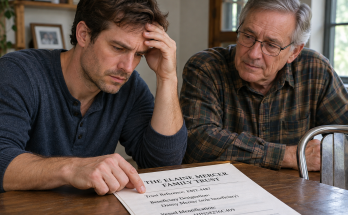
I was still sitting beside Hank, looking at the document that connected my mother's trust to the boat.
Nothing on the page had changed.
But something had changed in me.
I was no longer trying to prove the hull number was wrong.
I knew it was right.
I was no longer questioning whether I had read the beneficiary section correctly.
My name was there.
Alone.
What bothered me now was something the document did not explain.
Why?
I looked at Hank.
He was sitting quietly beside me, his chair pulled close enough that we could both read the page.
I remembered the sound of its metal legs dragging across the floor.
Such a small sound.
Yet I knew I would remember it whenever I thought about that moment.
I looked down.
Elaine Mercer.
My mother.
Those words had become the center of everything.
The trust carried her name.
The document identified me as its only beneficiary.
And below the trust reference was the same hull number I recognized from the boat registration.
Three facts.
One document.
An explanation I still did not have.
I moved my finger away from the heading.
“Hank, can I ask you something?”
He turned toward me.
“Go ahead.”
I hesitated.
There were several questions I wanted to ask.
I did not know which one mattered most.
Finally, I said the simplest thing.
“Why is my mother's name here?”
He looked at the paper.
I waited.
I wanted him to say something definite.
I wanted a sentence that would connect everything neatly.
But wanting an answer did not mean one was available.
I knew that.
Still, I watched him.
He had been the one who told me to continue reading.
He had seen how I reacted when I found my mother's name.
He had watched me examine the hull number again and again.
I wondered whether he understood how much trouble I was having with something that appeared so straightforward on paper.
I turned back toward the heading.
The words were formal.
There was no explanation of the person behind them.
No memory.
No conversation.
No indication of what my mother had been thinking when the trust received her name.
I felt ashamed of how badly I wanted the document to speak for her.
Looking back, that was my mistake.
I was asking a piece of paper to tell me things only a person could have explained.
I looked at the beneficiary section again.
My name was printed clearly.
It should have been enough to tell me what the document identified.
Instead, I kept asking what it meant about my mother.
Had she wanted me to know?
Had she expected me to understand?
Those questions came into my head before I could stop them.
But the document answered neither one.
I pressed my hands together.
The room remained quiet.
Hank stayed beside me.
I could feel my frustration building, although he had done nothing to deserve it.
I wanted him to know something I did not.
More than that, I wanted him to say it.
I wanted to stop feeling as though I were standing in front of a closed door.
But I had no reason to believe he possessed the answers to every question.
So I stopped looking at him.
I looked at the paper instead.
There was a difference between reading information and understanding a decision.
I had spent most of that time pretending they were the same thing.
They were not.
The document could identify the trust.
It could identify the beneficiary.
It could identify the boat.
It could not tell me why my mother had wanted those things connected.
At least, not in the portion I had read.
I knew I had to be careful.
If I began inventing explanations, I might eventually believe one of them.
And then I would stop looking for the truth.
I did not want that.
I moved the document slightly.
The edge made a soft noise against the table.
I straightened it again.
That was becoming a habit.
Whenever my thoughts got too far ahead of the facts, I found myself adjusting the paper.
As though making it straight would make everything else line up.
It never did.
I glanced at Hank.
“I keep thinking there's something I'm missing.”
He looked toward the document.
“Maybe you need to separate what it says from what you're asking.”
I considered that.
I had been doing the opposite.
I was taking every unanswered question and placing it on top of the few things I actually knew.
Then I wondered why the page seemed impossible to understand.
I read the heading again.
THE ELAINE MERCER FAMILY TRUST.
That was not an explanation.
It was a name.
I looked at the beneficiary designation.
That was not a description of my mother's intentions.
It was a record identifying me.
Then I checked the hull number.
That was not a story about the boat.
It was an identifying sequence.
The difference seemed obvious once I admitted it.
I felt foolish for needing so long to see it.
But I was not reading about a stranger.
I was reading about my mother.
That made everything harder.
I leaned back in the chair.
For a moment, I let myself feel disappointed.
I had wanted something that would tell me what she meant.
I had found something that told me what was recorded.
Those were not the same.
I wanted to ask Hank another question.
Instead, I stayed quiet.
I kept looking at my mother's name.
Elaine.
I had known that name long before I understood what a family trust was.
Long before I had any reason to examine a boat registration.
Long before I sat at that table.
That was why seeing it there felt so strange.
The name belonged to my life.
The document belonged to a world of official records and legal descriptions.
Now the two had met.
I was trying to understand how.
I placed my fingertip beside my own name.
I wondered whether I should feel grateful.
Then I wondered whether I should feel worried.
Neither feeling seemed quite right.
I did not know enough.
And I was beginning to understand how dangerous it could be to decide what something meant before knowing why it existed.
I turned toward Hank.
“I don't want to assume anything about her.”
He listened.
“Not just because her name is here.”
I looked down.
“I don't want to decide what she meant without knowing.”
That was the most honest thing I had said since beginning to read.
I had been looking for certainty.
Not about the hull number.
Not about the beneficiary designation.
About my mother.
And the page could not give it to me.
The realization hurt more than I expected.
I had wanted the document to close the distance between what I knew and what I did not.
Instead, it showed me exactly where that distance began.
I sat quietly for a while.
Then I placed one hand flat on the table.
I looked at the hull number again.
I had checked it enough times.
There was nothing left to prove.
The boat identified in the trust record was the same boat whose registration I recognized.
I could accept that.
I could accept my name appearing as the sole beneficiary.
I could accept that the trust bore my mother's name.
What I could not do was claim to understand her reasons.
I looked at Hank.
“I think I need to stop guessing.”
He did not rush to answer.
I appreciated that.
For the first time, I was not waiting for him to rescue me from the silence.
I was beginning to understand that some questions remained questions even after important facts had been established.
I looked at the paper one last time.
My mother's name was still there.
So was mine.
So was the boat's identifying number.
They belonged to the same document.
That much was real.
I decided I would not turn what I did not know into something I pretended to remember.
It was not a complete answer.
But it was a decision I could live with.
Click here to continue reading: PART 6: The Boat’s Number Had Given Me One Certain Answer, but I Was Still Afraid of What I Might Assume About My Mother
I Thought I Understood What My Mother Had Left Behind Until Hank Put a Document in Front of Me
Part 5 of 8