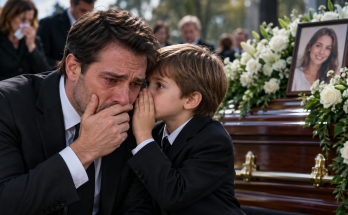
“Daddy, I heard Mommy calling me.”
My son said it while we were standing outside the cemetery, less than an hour after we had buried my wife.
I thought grief had confused him.
I wanted to believe that because the alternative was too frightening to consider.
I knelt in front of Ethan and brushed a strand of hair away from his forehead.
“What did you hear, buddy?”
He glanced toward the cemetery gates.
“Mommy called my name.”
I waited for him to explain.
He looked down at the little white flower in his hand.
“She told me not to let you leave her.”
For several seconds, I couldn't find anything to say.
My wife, Laura, had died three days earlier.
We had buried her that morning.
And now our seven-year-old son was telling me that she had called out to him during the funeral.
I was Michael Walker, a husband who had spent three days trying to understand how an ordinary evening could end with his entire life falling apart.
Laura and I had been married for eleven years.
We lived in Maplewood, Ohio, in a modest house with a small backyard and a kitchen that always seemed to need cleaning.
We weren't rich.
We weren't particularly adventurous.
But we were happy in the ways that mattered.
Laura worked as a medical records coordinator at Maplewood Community Hospital.
She was organized, patient, and unusually careful about details.
I was the opposite.
I misplaced my keys, forgot where I had left my phone, and sometimes needed three reminders to finish something she had asked me to do.
She used to laugh about it.
I used to pretend I found it annoying.
Now I would have given anything to hear her complain about my keys one more time.
The evening before she died had been ordinary.
Laura reminded Ethan to finish his homework.
We ate dinner together.
Our son played with his toy cars beneath the kitchen table while Laura cleaned up.
I went into the garage to sort through some tools I needed for work.
At one point, I heard Laura speaking.
I assumed she was on the phone.
I didn't ask who she was talking to.
I didn't even look up.
That small memory would return to me repeatedly in the days that followed.
Later that night, Laura said she was tired.
She went to bed earlier than usual.
When I joined her, she was lying quietly on her side.
I reached for her hand.
She held mine for a little longer than normal.
I thought she was simply exhausted.
I didn't realize how much I would later wish I had asked her what was wrong.
The next morning, I received a phone call that changed everything.
Laura had suffered a sudden medical emergency.
By the time I reached the hospital, a physician had informed me that she had died.
He spoke about the circumstances and explained that the initial assessment was consistent with cardiac arrest.
I remember standing in a corridor, staring at the floor.
I remember someone asking whether I needed to sit down.
I remember shaking my head.
I couldn't understand how the woman who had kissed our son goodnight a few hours earlier could suddenly be gone.
There had been no long illness.
No final conversation.
No chance to prepare ourselves.
I was simply expected to accept that Laura would never walk through our front door again.
The funeral arrangements began almost immediately.
Laura's mother, Margaret, stayed close to Ethan.
Her brother, Daniel, helped me make calls and organize the things I could barely bring myself to think about.
The funeral director, Mr. Collins, guided us through the arrangements.
I followed his instructions because I couldn't manage much else.
People arrived with flowers.
They offered condolences.
They told me Laura had been a wonderful person.
I thanked them, although most of their words passed through me without leaving a mark.
Ethan stood beside Margaret during the service.
He held a small white flower and watched his mother's photograph.
He didn't cry as loudly as some of the other children.
I assumed he was too young to understand what had happened.
I was wrong about that.
When the service ended, people began leaving.
I took Ethan's hand and led him toward the car.
He walked quietly beside me until he suddenly stopped.
That was when he told me he had heard his mother.
I asked why he hadn't mentioned it sooner.
He looked frightened.
"Everybody said Mommy was gone forever."
He wiped his cheek with his sleeve.
"I thought they'd get mad if I said she was talking."
I pulled him against me.
"Nobody is going to be angry with you for telling me something that scared you."
He held on to my coat.
I wanted to protect him from every painful thing that might come next.
I had no idea how to do that when I couldn't even explain what had already happened.
Then he asked me whether we could check on his mother.
He meant at the hospital.
I told him we had said goodbye.
He listened, but he didn't seem convinced.
Something about his memory had frightened him enough that he couldn't let it go.
I decided to seek further guidance rather than dismiss what he was telling me.
I contacted the people who had handled the funeral arrangements and explained my son's concern.
I also mentioned something that had bothered me earlier that morning.
When I had touched Laura's hand before the service, it had felt warm.
Mr. Collins had offered an explanation at the time.
I had accepted it because I was overwhelmed and trusted that the professionals involved understood what they were doing.
Now I wanted to be certain that nothing important had been overlooked.
With help from the appropriate medical professionals, we arranged for further assessment and review.
I wasn't expecting a miracle.
At least, I kept telling myself that.
I wanted to know what had happened to my wife.
I wanted someone to help me understand why my son believed he had heard her calling for help.
And I wanted to make sure he wasn't left alone with a frightening experience he couldn't explain.
We waited in a nearby medical facility while the specialists reviewed the situation.
Ethan sat beside Margaret on a small couch.
Daniel paced along the wall.
Mr. Collins stood near the doorway, checking his phone.
I remained close to the examination room.
I couldn't sit still.
I kept remembering the warmth of Laura's hand.
I also remembered the physician who had spoken to me after her death.
He had seemed rushed, and other medical activity had been taking place nearby.
At the time, I hadn't questioned anything.
I had been a husband in shock.
I had trusted the explanation I was given.
Now I wondered whether something had been missed.
Then Daniel approached me.
He looked as though he had been struggling with a decision.
"Michael, there's something about Laura I should have told you."
I turned toward him.
"What is it?"
He lowered his voice.
"She called me two days before she died."
I waited.
"She said she'd been feeling dizzy. She nearly fainted in the kitchen."
My chest tightened.
"Why didn't you tell me?"
"She asked me not to worry you. She thought she was just exhausted."
I stared at him.
"Did she see a doctor?"
"She said she'd made an appointment for Monday morning."
Laura had died before Monday.
Daniel rubbed his face.
"She also said she needed to talk to you about something important. She mentioned health insurance and some paperwork she'd found."
"What paperwork?"
"I don't know. She wouldn't explain over the phone."
I looked toward the examination room.
Until that moment, I had thought we were dealing with a terrible medical event and a grieving child's confusion.
Now I had another question.
Why had Laura been worried about paperwork shortly before her death?
I didn't have an answer.
I also had no evidence that anyone had done anything wrong.
I refused to turn my grief into an accusation.
But I needed the truth.
Eventually, the examination-room door opened.
A physician named Dr. Harris stepped into the waiting area.
Everyone stood.
He asked to speak with me.
I moved toward him, feeling Margaret's hand briefly close around my arm.
Dr. Harris explained that the initial reassessment had identified findings that did not fit comfortably with the original documentation.
The team had requested an independent medical review.
I stared at him.
"Are you saying my wife might still be alive?"
He paused before answering.
"We cannot give you a reliable answer until the assessment is complete. There are questions that need to be resolved first."
I gripped the edge of a nearby table.
I wanted him to say something definite.
I wanted an answer that would make the previous three days make sense.
Instead, I had to wait.
Dr. Harris explained that the appropriate authorities would review the records and determine what the findings meant.
He refused to speculate.
I appreciated that, even though uncertainty felt unbearable.
Then he spoke gently to Ethan.
He told my son that he had done the right thing by sharing something that worried him.
Ethan looked at the doctor.
"Are you going to help Mommy?"
Dr. Harris told him they would do everything appropriate to understand what had happened.
Ethan nodded.
Then he remembered something else.
"Mommy said not to let the man take her away."
The room became quiet.
Dr. Harris asked him who he meant.
Ethan twisted the sleeve of his black jacket.
"The man who came to our house."
I felt my heart begin to pound.
"What man, buddy?"
"The man Mommy talked to in the kitchen."
He explained that he had been playing with his cars under the table while his mother spoke to the visitor.
He remembered Laura saying she wouldn't do something.
The man had answered that she had no choice.
Ethan said the conversation had happened before Laura went to bed that final night.
Daniel stepped forward.
He reminded me that Ethan was only seven and had experienced a terrible shock.
I agreed that we needed to be careful.
I didn't want my questions to shape his memories or make him feel responsible for finding answers.
Dr. Harris advised us to leave any further questioning to a trained professional if an interview became necessary.
I knelt beside Ethan and held his hands.
"You don't have to explain anything else right now."
He leaned toward me.
"Are you going to let them take Mommy away again?"
I closed my eyes for a moment.
"I don't know what will happen next, buddy. But I'm going to keep asking questions until we understand what happened."
A short time later, an investigator named Rebecca Miller arrived.
She coordinated with the medical authorities and explained that the original assessment, the surrounding circumstances, and the decisions made afterward would be reviewed.
I told her about Ethan's memory.
I told her what Daniel had said about Laura's dizziness.
I also admitted that I had heard my wife speaking to someone in the kitchen on the night she died.
I had assumed she was on the phone.
I couldn't be certain I had heard a man's voice.
Rebecca listened carefully.
She reminded me that an unexpected medical finding did not automatically mean a crime had occurred.
She wanted evidence, not assumptions.
I understood.
She also asked about Laura's recent health, medications, and any unusual symptoms.
I told her about the tiredness I had noticed during the previous few days.
At the time, I had blamed her workload.
Now I wished I had paid closer attention.
Rebecca gave me her contact information and asked me to report anything else I remembered.
By evening, the medical review was still underway.
Nobody could provide a definitive answer.
Ethan eventually fell asleep against my side.
I carried him to the car and took him home.
After tucking him into bed, I sat beside him for a few minutes.
He stirred beneath the blanket.
"Daddy?"
"I'm here."
"Did they find Mommy?"
I brushed his hair away from his forehead.
"They're still trying to understand what happened."
He looked at me quietly.
Then he reached beneath his pillow and pulled out a folded piece of paper.
"Mommy gave me this before."
My body went still.
I took it from him.
The handwriting on the outside was Laura's.
I knew every familiar curve.
The note was addressed to me and asked me to read it if anything happened to her.
I unfolded it carefully.
Laura wrote that something was wrong and that she wasn't sure whom she could trust.
If she couldn't explain things herself, she wanted me to search for a small blue box hidden at the back of our bedroom closet.
She specifically asked me not to let anyone take it.
A date appeared beneath the message.
It was two days before she died.
I read the note again.
Then I looked at my son.
"Did Mommy tell you what was inside the box?"
He shook his head.
He had found the paper in her bedside drawer before the funeral but had forgotten to give it to me.
I squeezed his hand.
"Thank you for telling me."
After making sure he was settled, I returned to our bedroom.
Laura's reading glasses remained on the nightstand.
Her unfinished novel lay beside them.
A cardigan hung over the back of her chair.
Everything looked as though she might return at any moment.
I moved the suitcases and storage containers in the closet.
Behind a winter blanket, I found a small blue metal box.
It was locked.
I searched the shelves and the drawers where Laura kept household items.
Then I remembered the ceramic dish beside her jewelry box.
She always kept spare keys there.
A tiny silver key lay beneath the dish.
It opened the box.
Inside were several envelopes, printed medical documents, a flash drive, and a photograph.
The photograph showed Laura standing outside a building I didn't recognize.
A man in a dark coat stood beside her.
His face was turned partly away from the camera.
On the back, Laura had written a short message identifying him as someone who knew what had happened.
I sat on the bed and stared at the photograph.
Then I opened an envelope.
It contained copies of medical documents and notes about dates and conversations.
One handwritten sentence made my stomach tighten.
Laura had recorded that the man said certain results would disappear, and that she had refused to cooperate.
I didn't know which results she meant.
I didn't know what she had discovered.
I only knew she had been afraid.
Before I could open another envelope, my phone vibrated.
A message had arrived from an unknown number.
The sender knew I had found Laura's box.
Another message warned me to stop looking into my wife's death if I wanted to protect my son.
I read it twice.
Someone knew about the box.
Someone knew I had opened it.
And someone wanted me to stop asking questions.
I photographed the messages and contacted Rebecca.
I did not respond to the sender.
I did not attempt to identify the person on my own.
I followed the investigator's instructions and preserved everything.
Then I heard a quiet knock at the bedroom door.
Ethan stood there in his pajamas, holding the white flower from his mother's funeral.
He looked at the photograph in my hand.
"Daddy, I know that man."
I knelt in front of him.
He told me the visitor had come to our house wearing the same dark coat.
Then he explained why his mother had been crying.
She had told the man he was going to take something away from our family.
Ethan remembered another sentence.
He had heard Laura tell the visitor that if anything happened to her, I would eventually discover what he had done.
I pulled my son close.
I couldn't promise that his mother would come home.
I couldn't tell him what the evidence meant.
But I could promise that he would not have to carry the fear alone.
That night, after he returned to bed, I called Rebecca again.
I explained the threatening messages, the photograph, and the documents.
She told me to preserve the evidence, avoid contacting the sender, and keep Ethan safe while the investigation continued.
I agreed.
Then I sat beside Laura's empty pillow until morning.
For eleven years, I had believed I knew my wife.
Now I wondered how long she had been frightened without telling me.
Click here to continue reading: PART 2: The Hidden Recording Exposed the Pressure My Wife Had Faced, but the Final Medical Findings Forced Me to Accept a Truth I Wasn’t Ready to Hear
My Seven-Year-Old Son Remembered His Mother Calling for Help, and the Hidden Box She Left Behind Revealed a Secret Nobody Had Prepared Me to Face
Part 1 of 2