A month passed.
Mom began finding her own rhythm at home.
She still woke early, but she no longer rushed to get dressed for work.
Some mornings, she sat by the window with a drink and watched the neighborhood wake up.
Other days, she worked around the house.
She watered the plants.
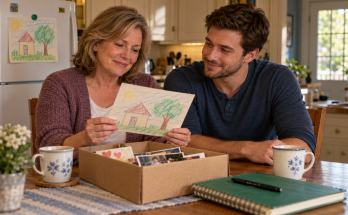
She sorted old photographs.
She called people she hadn't spoken to in a while.
She was learning how to live without the school setting the pace of her day.
It wasn't always easy.
I could tell she missed the routine, even when she insisted she was enjoying her freedom.
Sometimes, she would glance at the clock around the time lunch service would have begun.
Then she would look away.
I stopped teasing her about it.
I knew that forty-two years could not be put aside simply because a retirement party had ended.
One morning, she asked me whether I thought Daniel would come to visit again.
I looked up from the table.
"I don't see why not."
She smiled.
"I'd like to hear how he's doing."
I nodded.
Then I thought about something I had been meaning to ask her.
"Did you ever tell anybody what you did for him?"
Mom looked puzzled.
"Tell them what?"
"About the lunches."
She shook her head.
"No."
"Not even your friends?"
She gave a small laugh.
"Why would I?"
I didn't have a good answer.
She continued folding a dish towel.
"He was a student. He needed lunch. I worked in the cafeteria."
She looked at me.
"It wasn't a secret."
I understood what she meant.
She hadn't hidden the kindness.
She had simply never considered it a story worth telling.
For her, the important part was that Daniel had been fed.
She hadn't thought about whether he would remember her.
She hadn't imagined that he would become a surgeon.
She hadn't expected him to return decades later with a receipt folded inside his jacket.
The moment had belonged to the day it happened.
Then life had continued.
I sat quietly for a while.
Finally, I asked, "Were you ever worried that you couldn't help everybody?"
Mom put the towel down.
"Of course."
Her answer surprised me.
She explained that there had been days when the cafeteria had limited supplies.
There had been days when students needed things she couldn't provide.
She couldn't solve every problem.
She couldn't feed every person outside the school.
She couldn't make difficult circumstances disappear.
"But I could do what was in front of me," she said.
She picked up the towel again.
"That's what I tried to do."
I thought about Daniel.
He had not needed her to solve his entire life.
He had needed a meal.
She had provided one.
Then another.
And another.
The help had been limited, but its meaning had grown over time.
I wondered how often we failed to help because we couldn't do everything.
I had done that myself.
I had seen people struggling and assumed that whatever I could offer would be too small.
Mom had never used that excuse.
She had worked with what she had.
And she had trusted that doing something was better than turning away.
That afternoon, I accompanied her on a short walk.
We passed a small shop where a young employee was arranging boxes near the entrance.
Mom stopped to let a family pass.
She smiled at the children.
Then she continued walking.
It was such a small moment that I might once have forgotten it.
But now I noticed how naturally she paid attention to the people around her.
She wasn't searching for opportunities to be praised.
She wasn't trying to prove that she was still useful.
She was simply interested in the world.
When we returned home, she asked whether I wanted something to eat.
I laughed.
"Mom, I can make my own lunch."
"I didn't say you couldn't."
She headed toward the kitchen.
"There's food in the refrigerator."
I followed her.
She opened the refrigerator and began looking through the shelves.
I watched her take out a few things.
For a moment, I saw her behind the cafeteria counter again.
Not because the kitchen looked like the school.
Because the instinct was the same.
Someone was there.
Food was available.
She could make something.
So she did.
I leaned against the doorway.
"Do you think you'll miss it forever?"
Mom looked over her shoulder.
"Miss what?"
"The cafeteria."
She considered the question.
"I'll probably always miss parts of it."
She placed the food on the counter.
"But I'm glad I retired."
I nodded.
She smiled.
"You can be grateful for something and still be ready to leave it behind."
I thought that was a good answer.
I had been treating retirement as though it required one clear feeling.
Either she was happy to leave or sad to go.
But she could be both.
She could miss the students and enjoy her mornings.
She could be proud of her years at the school and look forward to something different.
She could carry the memories without needing to return to the job.
That evening, she took the retirement cards from the shelf.
She read a few of them again.
Then she placed Daniel's card on top of the stack.
I watched her do it.
"His visit meant a lot to you, didn't it?"
Mom nodded.
"It did."
She ran a finger along the edge of the card.
"I didn't know he had kept that note."
"Neither did I."
She smiled.
"I always wondered whether he had forgotten about me."
The admission surprised me.
I turned toward her.
"You wondered that?"
"Well, yes."
She looked at the card.
"Students grow up. They move away. They have their own lives."
She paused.
"I never expected him to remember a lunch lady after all that time."
I sat down beside her.
"But he did."
She nodded.
"Yes."
For a while, she said nothing.
Then she gave a quiet laugh.
"And he remembered the gravy."
I laughed too.
That small detail seemed to bring her particular pleasure.
She had remembered him asking for extra gravy.
He had remembered being fed.
They had each carried a different piece of the same experience.
And after all those years, the memories had met again.
I began to understand that the retirement party had given Mom something she had never asked for.
It had shown her that her work had lasted beyond the hours she spent doing it.
She had spent forty-two years serving meals.
But the meaning of those meals had traveled with people into lives she couldn't have predicted.
She would never know every place her kindness had reached.
She wouldn't know every person who remembered her.
She couldn't measure the effect of every word she had spoken.
But Daniel had returned.
He had shown her one clear example.
Sometimes, one was enough.
I looked at the cards stacked beside her.
"Mom, do you think you'll ever stop being Miss Bernie?"
She laughed.
"I certainly hope so."
I smiled.
She shook her head.
"I don't need to be Miss Bernie every minute of the day."
Then she looked at me.
"But I suppose I'll always be somebody's Miss Bernie."
I couldn't argue with that.
The name had become part of the lives of people who had known her.
It belonged to the school.
It belonged to the students.
And it belonged to the memories they carried.
Mom closed the box and returned it to the shelf.
We sat quietly together.
For once, I didn't feel the need to fill the silence.
I had spent years believing that the best way to honor somebody was to point out how much they had accomplished.
Now I understood that sometimes the best way was simply to notice what they had been doing all along.
Mom had been feeding children.
She had been paying attention.
She had been offering help without making people feel ashamed.
And she had done it long enough for those small acts to become part of her life's work.
I was grateful that Daniel had returned to tell her.
I was grateful that I had listened.
And I was grateful that retirement had given me the chance to see my mother without the familiar rush of her working day between us.
For years, I had watched her leave for school.
Now I was learning to appreciate the woman who came home.
Click here to continue reading: PART 8: I Finally Understood Why Daniel Had Kept the Receipt for So Long, and Why My Mother Had Never Needed to Know What That One Lunch Would Become
I Thought My Mother’s Retirement Would Be Just Another School Gathering Until Someone Walked In and Asked for Her
Part 7 of 20