The decision about the house came gradually.
There was no dramatic announcement.
There was no single conversation that made every doubt disappear.
I kept reviewing the practical details.
I kept asking questions.
I kept listening to what my children had to say.
And I kept asking myself what kind of life I wanted.
Eventually, I understood that I did not want to stay simply because leaving would hurt.
I also did not want to leave simply because I was frightened.
I wanted to make a choice based on the life I could reasonably manage.
That was different.
When I finally told my children I was ready to consider moving to a smaller place, I felt nervous.
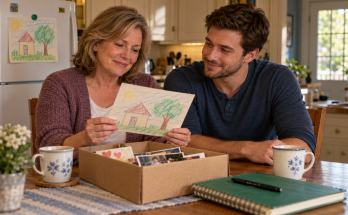
We were sitting around the kitchen table.
The same table where I had first spread out Walt's letters.
The same table where Michael had helped me organize the papers.
The same table where Stephanie and I had apologized to one another.
Danny sat beside Kayla.
Ethan was drawing in a notebook.
Noah was playing with a toy car on the floor.
I explained my decision as clearly as I could.
I told them I loved the house.
I told them I would miss it.
I also told them that I wanted a home that required less work and allowed me to spend more time with the people I loved.
When I finished, nobody rushed to answer.
Then Michael nodded.
"I think that makes sense."
Stephanie reached across the table and held my hand.
"You don't have to feel guilty."
Danny looked at me.
"We'll help you figure out the next steps."
I felt tears rise in my eyes.
"Thank you."
I had expected someone to object.
I had expected to defend myself.
Instead, my children accepted that the decision belonged to me.
I knew they would miss the house.
I would miss it, too.
But we could miss something without demanding that it remain unchanged forever.
Over the following weeks, I continued working through the details.
Michael helped me keep the documents organized.
Stephanie helped me sort the things I wanted to keep.
Danny offered to help with the physical work whenever I was ready.
Nobody pretended the process would be easy.
There were difficult afternoons.
There were boxes I could not bring myself to open.
There were days when I looked at the rooms and wondered whether I was making a mistake.
When those feelings came, I did not force myself to decide everything again.
I reminded myself why I had begun considering a change.
I wanted to live without being frightened by every repair.
I wanted to visit my children without worrying about leaving the house unattended.
I wanted a future that was manageable, not a life organized entirely around preserving the past.
Those wishes had not changed.
One Saturday, the family came over to help me sort through a cupboard.
The cupboard was full of old dishes, serving bowls, and kitchen tools I had collected over the years.
Stephanie held up a chipped plate.
"Do you want to keep this?"
I took it from her.
It had a small blue flower painted near the edge.
Walt had bought it for me at a local market years earlier.
I remembered teasing him because he had gone out to buy one thing and returned with a bag full of things we did not need.
I smiled.
"I think I'll keep this one."
Stephanie placed it carefully in the box of things I wanted to take with me.
Michael found an old kitchen timer.
He turned the dial.
It rang loudly.
Everyone laughed.
Danny held up a wooden spoon with a worn handle.
"Are you keeping this too?"
I looked at it.
"No."
He pretended to be offended.
"Mom, this spoon has been part of the family longer than I have."
"That's precisely why it has earned its retirement."
We laughed again.
The work continued.
We made decisions.
We took breaks.
We ate lunch at the kitchen table.
Nobody tried to turn the day into a lesson about letting go.
It was simply a day when my family helped me do something difficult.
I realized how different that felt from the evening when I had first called them and told them I had lost everything.
Back then, I had been waiting for someone to rescue me from my fear.
Now I was allowing people to stand beside me while I made decisions for myself.
The difference mattered.
One afternoon, while we were sorting the desk, I found the folder containing Walt's letters.
I stopped.
Michael noticed.
"Do you want me to put that somewhere safe?"
I looked at the folder.
"Yes, please."
He placed it in the box with my important documents.
I watched him close the lid.
For a moment, I remembered the broken red wax.
I remembered Danny opening his envelope.
I remembered Stephanie's anger and Michael's impatience.
I remembered my own fear.
Then I looked at my children standing around the desk.
They were older now.
They had their own families, worries, and responsibilities.
They were not the children who had once depended on Walt and me to explain the world.
They were adults who were still learning how to understand one another.
So was I.
The letters had not given us a perfect answer.
They had given us a reason to ask better questions.
I was grateful for that, even though I wished the conversation could have happened while Walt was still alive.
I could not change the timing.
I could only decide what to do with the time I had left.
When the day ended, the cupboard was nearly empty.
The desk was cleared.
The important papers were packed together.
The house looked unfamiliar.
I stood in the kitchen after everyone had gone.
The refrigerator hummed.
The curtains moved slightly near the open window.
Walt's coffee mug sat on the counter.
I picked it up.
For a moment, I considered packing it.
Then I decided I would use it the next morning before putting it away.
I made myself a cup of tea and sat at the table.
I thought about the first telephone calls.
I had told my children I had lost everything.
At the time, I had meant the money.
I had been frightened about the bills, the house, and the future.
But beneath those worries had been another fear.
I was afraid that without Walt, I would no longer know where I belonged.
I had wanted my children to prove that I still mattered.
I had wanted them to say the right things.
I had wanted reassurance that they would not leave me alone.
What I learned was more complicated.
Michael cared, even when his first response was shaped by worry and impatience.
Stephanie cared, even when her fear came out as anger.
Danny cared, even when he was struggling with his own responsibilities.
They were not perfect.
Neither was I.
We had hurt one another without always meaning to.
We had expected understanding without always offering it.
We had confused silence with peace.
But we had also learned to apologize.
We had learned to ask questions.
We had learned that helping someone did not mean taking over their life.
And we had learned that love was not proved by one grand promise.
It was shown in the next call.
The next visit.
The next honest conversation.
I finished my tea.
Then I washed the cup and placed it beside Walt's mug.
The next morning, I used his mug for coffee.
I sat at the kitchen table and looked at the boxes waiting near the wall.
I did not feel ready for every part of what came next.
But I felt ready to begin.
There would still be bills to manage.
There would still be decisions to make.
There would still be mornings when I missed Walt so much that the house seemed to hold its breath.
I would not pretend otherwise.
I had stopped expecting life to become simple before I could move forward.
That was perhaps the greatest change of all.
A few days later, I invited my children to dinner again.
I wanted us to have one more ordinary evening around the table before the next stage of my life began.
Michael arrived with Jenna.
Stephanie brought dessert.
Danny and Kayla came with the boys.
Ethan ran ahead of his parents and hugged me.
Noah showed me the toy car he had brought.
We ate together.
We talked about ordinary things.
We laughed.
At one point, Michael looked around the table.
"Dad would have liked this."
Nobody answered immediately.
Then Stephanie nodded.
"I think he would."
Danny looked down at his plate.
"I wish he could have seen us talk like this."
I reached for his hand.
"So do I."
We sat quietly for a moment.
Then Ethan asked whether he could have another piece of dessert.
Everyone laughed.
The moment passed naturally.
I did not need to make it mean more than it did.
Later, after the children had gone, I stood in the kitchen and looked at the table.
There were crumbs on the cloth.
A glass had been left beside a plate.
One of the chairs was pushed back farther than the others.
I began clearing everything away.
I did not rush.
When I finished, I took out my notebook.
The pages were full of lists, questions, and sentences I had written when I was afraid.
I turned to the last blank page.
For a long time, I held the pen without writing.
Then I wrote:
I thought losing everything meant losing my place in the world.
I paused.
Then I continued.
I was wrong.
I had lost my husband.
I had lost the certainty I once felt about our finances.
I had lost the belief that the future would look the way I expected.
Those losses were real.
They still hurt.
But I had not lost my right to make decisions.
I had not lost my ability to learn.
And I had not lost my family, even when we struggled to understand one another.
I closed the notebook.
Then I placed it in the desk drawer beside Walt's letters.
I did not lock the drawer.
I did not hide the past.
I simply put it where it belonged.
I turned off the kitchen light and walked toward the bedroom.
Tomorrow, there would be more work to do.
I would continue making calls.
I would continue asking questions.
I would continue deciding what kind of future I wanted.
And when I felt frightened, I would try to tell someone instead of pretending I was fine.
I could not promise that my children and I would never hurt one another again.
I could not promise that we would always agree.
I could not promise that grief would become easy.
But I could promise myself that I would keep speaking honestly.
I would keep listening.
I would keep making room for the people I loved to be human.
And I would allow myself the same kindness.
Before going to bed, I looked once more at the empty kitchen.
For years, I had believed that family meant keeping everything together.
Now I understood that sometimes family meant allowing things to change without walking away from one another.
Walt's letters had not given us the ending I once thought I needed.
They had not explained every silence.
They had not removed every regret.
They had not made the future certain.
But they had brought us to the table.
The rest had been our choice.
I turned off the final light.
For the first time in a long while, I did not feel that I was standing at the edge of an ending.
I felt that I was standing at the beginning of a life I still had a chance to shape.
And that was enough.
The End
Read more original stories on Feel Every Story.
After Forty Years of Marriage, I Discovered Which of My Three Children Would Stand Beside Me When I Had Nothing Left
Part 20 of 20