Sarah and I began talking more often after that evening.
Not every conversation was easy.
Some were about the past.
Others were about ordinary things that had been waiting for our attention.
We talked about the boys' schedules.
We talked about the bills.
We talked about the repairs we had postponed.
The difference was that I stopped treating every difficult subject as an argument I needed to win.
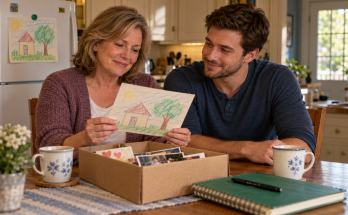
One Saturday morning, Sarah brought a box into the living room.
It contained some of my father's remaining belongings.
A few books rested at the bottom.
There was also a folded sweater and a small collection of photographs.
She placed the box on the coffee table.
"I thought we could look through these together."
I sat beside her.
The first photograph showed my father standing outside an old house.
He looked younger than I remembered him ever being.
His shoulders were straight.
His smile was broad.
One arm rested around my mother.
I stared at the photograph for a long time.
"I don't remember this day."
Sarah examined it.
"You were little."
I turned the photograph over.
There was no date.
Only a short note in my father's handwriting.
I put it back in the box.
The next photograph showed him holding me when I was a baby.
I looked so small in his arms.
He was smiling down at me.
I wondered whether he had been frightened when he first became a father.
I wondered whether he had ever worried that he wouldn't have enough money.
I wondered whether he had ever sat awake at night, counting the expenses of raising a child.
Of course he had.
I had simply never thought to ask.
Sarah picked up another photograph.
"This one was taken when the boys were younger."
My father sat between them on the sofa.
The younger boy was leaning against his side.
The older one had his head tilted toward him.
They were all smiling.
I remembered that afternoon.
I had been working in the garage when Sarah called me inside.
She wanted a picture of the three of them.
I had complained that I was in the middle of something.
Then I had taken the photograph myself and returned to work.
At the time, it had seemed like an interruption.
Now it was one of the few photographs we had of my father with both boys.
I placed it on the table.
"We should keep this one where we can see it."
Sarah nodded.
We continued through the box.
There were no dramatic discoveries.
No hidden fortune.
No final message tucked inside a book.
Just the small remains of a man's life.
And somehow, that made the afternoon more important.
I had spent years waiting for my father to explain himself in a way I could understand.
The letter had done that.
But the photographs showed me something else.
He had been more than the old man who needed help.
He had been a husband.
A young father.
A man who had once stood outside a house with his arm around the woman he loved.
He had held me before I could speak.
He had watched his grandchildren grow.
He had lived an entire life before I became responsible for helping him through its final years.
I had reduced that life to a problem I needed to manage.
I couldn't undo that.
But I could stop thinking of him that way.
Sarah lifted the folded sweater from the box.
"I remember him wearing this almost every evening."
I touched the sleeve.
It was softer than I expected.
"He said it kept the cold off his shoulders."
Sarah smiled.
"He said a lot of things about keeping warm."
I laughed.
My father had always been practical about the weather.
He kept blankets in every room.
He closed windows whenever the temperature dropped.
He believed that being cold was a problem a person could solve if he paid attention.
I folded the sweater carefully.
Then I placed it back in the box.
Sarah watched me.
"You know what I remember most?"
I shook my head.
"He thanked me."
"For what?"
"Almost everything."
She looked at the photographs.
"If I brought him water, he thanked me. If I helped him with his medicine, he thanked me. If I sat with him for a while, he thanked me again when I got up."
I looked down.
I remembered hearing those exchanges.
Sometimes I had thought he was being overly polite.
Now I wondered whether he had been trying to make sure Sarah knew he didn't take her kindness for granted.
"He knew you were doing a lot," I said.
"He did."
Sarah paused.
"But I didn't need him to thank me every time. I just wanted you to understand that I needed help, too."
I felt the truth of that settle between us.
My father had recognized Sarah's efforts.
I had often treated them as something that would happen whether I helped or not.
She had cared for him because she loved him.
She had also been tired.
Those facts had never contradicted each other.
I had acted as though they did.
"I should have listened when you asked me to do more."
Sarah nodded.
"Yes."
There was no anger in her voice.
That made it harder to avoid the truth.
I looked at the photographs again.
"I thought if I kept working, everything would be all right."
"I know."
"I didn't know what else to do."
Sarah reached for my hand.
"You could have talked to me."
I looked at her.
She was right.
I had talked about numbers.
I had talked about work.
I had talked about what needed to be done.
I had rarely talked about the fear underneath all of it.
I had expected Sarah to understand my exhaustion without letting her see my uncertainty.
That wasn't fair.
"I was afraid you'd think I couldn't handle things."
She squeezed my hand.
"I never expected you to handle everything alone."
I looked away.
I had spent so much time trying to prove that I was capable that I had made it difficult for the people closest to me to help.
I had mistaken accepting help for failing.
My father had needed me.
Sarah had needed me.
The boys had needed me.
And I had been so focused on being the person everyone could depend on that I had forgotten how to depend on anyone myself.
We sat together for a while.
The box remained open on the coffee table.
The photographs lay in a small pile between us.
Eventually, Sarah placed the picture of my father with the boys on the shelf near the television.
I watched her straighten it.
Then I moved it slightly so it faced the room.
"That's better," I said.
She smiled.
We left the rest of the belongings in the box until we were ready to put them away.
That evening, I called the boys into the living room.
I showed them the photographs.
They laughed at the pictures of themselves as toddlers.
My younger son pointed at the one where he was leaning against his grandfather.
"I remember that sweater."
I smiled.
"Your grandfather wore it all the time."
"He let me borrow it once."
I looked at him.
"When?"
"One winter, when I was cold watching a movie."
I hadn't known that.
My son continued looking through the photographs.
I realized there were still many things about my father's life in our home that I had never noticed.
The memories belonged to all of us.
I didn't have to be the person who knew them all.
I only had to be willing to listen when someone shared one.
Later, after the boys went upstairs, I returned the photographs to their box.
I left the picture of my father with his grandchildren on the shelf.
It wasn't a grand memorial.
It was simply a reminder that the man who had once needed our help had also given us years of ordinary moments.
I wanted those moments to remain visible.
Not because I wanted to punish myself with regret.
Because I didn't want to forget what the letter had taught me.
A person could need help and still have a great deal to give.
I had learned that too late for my father.
I didn't want to learn it too late for anyone else.
Click here to continue reading: PART 11: I Had Spent Years Believing My Father Understood Nothing About My Struggles, Until I Began Remembering the Advice I Had Ignored
I Thought My Father Had Taken Too Much From My Family Until One Letter Forced Me to Face What I Had Done
Part 10 of 20