I used to believe that helping my son was the same as loving him.
It took one message to make me question everything.
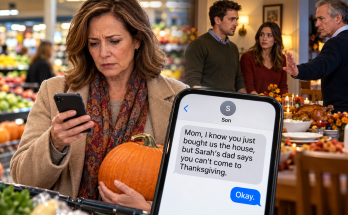
I was standing in a grocery store in Phoenix when my phone buzzed in my hand.
I had a pumpkin tucked against my arm and a shopping cart full of things I had bought for Thanksgiving.
It was the expensive store on Oak Avenue, the one I visited only when I wanted a holiday to feel special.
I glanced at my screen, expecting some ordinary question from my son.
Instead, I read a message that made me forget why I had come there.
“Mom, I know you paid for our house, but Sarah’s dad thinks it would be better if you stayed away from Thanksgiving.”
I read it again.
Then I read it a third time, hoping I had misunderstood the meaning.
I hadn't.
My son was telling me I wasn't welcome at a holiday dinner connected to the home I had just spent three hundred and fifty thousand dollars helping him buy.
I stood beside the produce display while other shoppers reached around me for apples and sweet potatoes.
Someone laughed near the bakery.
A child asked his mother for a cookie.
The world carried on as if nothing had happened.
I looked down at the pumpkin in my arms.
It had a pale orange patch near the stem, and one side was slightly flattened.
I had chosen it because I thought it would look nice on the table at my son's new house.
That was how my mind worked back then.
I saw something small and immediately imagined how it might make somebody else happy.
I pictured the pumpkin sitting beside the front door.
I imagined Sarah arranging flowers in a vase.
I could almost hear my son telling everyone that his mother had brought the decorations.
Then I looked at the message again.
The pumpkin suddenly felt ridiculous.
I had spent so much money trying to give my son a comfortable beginning.
I had told myself it was an investment in his future.
I had told myself that a mother should do whatever she could while she still had the chance.
But standing there in that grocery store, I wondered whether I had been teaching him something else.
Perhaps I had taught him that whatever he wanted would eventually appear.
Perhaps I had made it so easy for him to accept my help that he no longer thought about what it cost me.
I didn't know the answer.
Not yet.
I only knew that I was hurt.
And I was embarrassed by how deeply the message had reached inside me.
I had raised my son to believe that family mattered.
Apparently, I had forgotten to teach him that I belonged to his family too.
I put the pumpkin into my cart.
Then I took out my phone and opened the message again.
I wanted to ask him what he meant.
I wanted to remind him who had helped him secure that house.
I wanted to ask why Sarah's father had a say in where I could spend Thanksgiving.
Most of all, I wanted to know why my son had accepted this arrangement without even asking me how I felt.
My fingers hovered over the keyboard.
I started typing a longer response.
I deleted it.
I tried again.
That message disappeared too.
Every version sounded like a plea.
I didn't want to beg my own child to let me sit at a Thanksgiving table.
The thought alone made my stomach tighten.
So I wrote a single word.
“Okay.”
I sent it before I could change my mind.
Then I locked my phone and placed it in my purse.
That was all.
No argument.
No questions.
No reminder of the money.
I wish I could tell you that I felt strong the moment I sent it.
I didn't.
I felt small.
I felt as if I had been quietly pushed out of a room where I had spent months helping build the walls.
And I felt ashamed because a part of me still hoped my son would send another message.
Something like, Mom, wait. I didn't mean it that way.
Or, I'm sorry. Let's talk.
I waited while I finished shopping.
Nothing came.
I picked up a bag of potatoes, checked the price, and put it in my cart.
I chose cranberry sauce.
I chose rolls.
I chose a box of chocolates I knew my son liked.
That last choice made me stop.
Why was I still buying things for someone who had just told me I wasn't wanted?
I stared at the chocolates for a moment.
Then I put them back on the shelf.
It was a small decision.
Nobody noticed.
But I noticed.
I had spent years making little sacrifices that nobody ever saw.
I had skipped things I wanted because my son needed something.
I had stretched my budget because he was short on money.
I had convinced myself that the sacrifices were temporary, that one day he would be settled and I could finally relax.
Instead, every favor seemed to create room for another request.
And somehow, saying no had become harder than paying.
I finished shopping and drove home.
The pumpkin rode on the passenger seat, rolling slightly whenever I turned a corner.
At a red light, I glanced at it and almost laughed.
I had bought a decoration for a dinner I was no longer invited to attend.
It wasn't funny.
But sometimes the truth is so plain that laughing is the only thing keeping you from crying.
When I reached my house, I carried the groceries inside one bag at a time.
My kitchen was quiet.
I put the vegetables away and set the pumpkin on the counter.
For a while, I stood there without taking off my coat.
I kept thinking about the house.
Three hundred and fifty thousand dollars.
That was not money I had found lying around.
It represented years of working, saving, and telling myself that being careful today would make tomorrow easier.
I had been proud when I helped my son get that house.
I had pictured him and Sarah building a life there.
I had imagined holidays filled with conversation, grandchildren running through the rooms someday, and a place where my family could gather without worrying about space.
I had not expected to own the center of my son's future.
I had only wanted to help him reach it.
Now I was wondering whether I had paid for a future in which I would have no place.
I sat at the kitchen table.
My phone remained silent.
I could have called him.
I could have asked him to explain himself.
I could have reminded him that the money had come from me, not Sarah's father.
Instead, I opened the folder where I kept the paperwork connected to the house.
I did not know exactly what I was looking for.
I only knew that I needed to see the facts instead of sitting there imagining what they meant.
The folder was where I had put everything I received during the purchase.
I had kept the papers together because I liked knowing where important things were.
I took them out and laid them across the table.
There were receipts, printed documents, and pages I had signed when the arrangements were being made.
I looked at the amount I had contributed.
Then I looked at the papers again, more carefully than I had when I first helped him.
Until that afternoon, I had treated the house as a gift in my heart.
I had thought of the money as something I was giving my son so he could begin his married life with less pressure.
But a feeling was not the same as a legal arrangement.
Love did not automatically tell me what my rights were.
And being his mother did not mean I should ignore the documents connected to such a large amount of money.
I gathered the pages and returned them to the folder.
I was not ready to make any decisions.
Not that evening.
First, I wanted to understand what I had agreed to and what I had simply assumed.
I wanted to know where I stood before I said another word to my son.
The Thanksgiving groceries could wait.
The pumpkin could sit on the counter.
For the first time in a long time, I had something more important to do than make sure everyone else was comfortable.
I had to find out whether I had protected myself at all.
Click here to continue reading: PART 2: Three Hundred and Fifty Thousand Dollars Had Bought Them a Home, but I Was Still Asking Permission to Belong
The Message That Made Me Rethink Every Dollar I Had Spent Trying to Make My Son Happy
Part 1 of 20