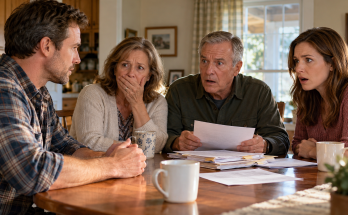
My father didn't answer immediately.
He looked toward my mother, as though he expected her to take over.
She shook her head slightly.
I couldn't tell whether she was asking him to continue or telling him not to say something.
The small movement made me uneasy.
I had spent years watching my family communicate through glances instead of words.
Usually, I ignored it.
That afternoon, I noticed every exchange.
"Can we talk about the amount first?" I asked.
My father looked back at me.
"Your sister can explain what she asked us for."
My sister stiffened.
"I don't think I need to explain every expense."
"I haven't asked about every expense," I said. "I asked what you told our parents."
She looked at my father again.
He didn't help her.
For the first time, she seemed to understand that she would have to answer for herself.
She began by saying that she had been worried about my future.
She had seen me continue working on the farm year after year.
She had seen the old truck.
She had heard me mention repairs and difficult seasons.
From those things, she had concluded that I was barely keeping up.
I listened.
Some of what she said was true.
There had been difficult seasons.
The farm had required money, time, and patience.
I had talked about repairs because repairs were part of the work.
I had complained about the weather because the weather could ruin a perfectly good plan.
None of that meant I couldn't support myself.
But I could see how someone who didn't understand farming might mistake a difficult season for a failing business.
I asked whether she had ever considered that I might be doing better than I let on.
She gave me a tired look.
"You never talked about money."
"Because I didn't want to."
"Exactly."
I shook my head.
"That's privacy, not proof that I'm broke."
She didn't respond.
My father leaned forward.
"Your sister was concerned. That's all."
I turned to him.
"I understand that she was concerned. But you took her concerns as facts."
He looked down at the table.
That seemed to reach him.
For a moment, I felt sorry for him.
He had spent years believing that he could recognize when something was wrong with my life.
He had never considered that he might be looking at the wrong things.
My sister spoke again.
"I wasn't trying to make you look bad."
I looked at her.
"Then why did you tell them I couldn't support myself?"
She shook her head.
"I didn't use those words."
I thought about the conversation I'd heard through the door.
Perhaps she hadn't used that exact sentence.
Perhaps my memory had simplified what she'd said.
I was willing to accept that possibility.
But the meaning had been clear enough for me to stop on the porch.
"You were talking about me as though you knew my financial situation," I said. "And you didn't."
She rubbed her forehead.
"I thought I was helping."
"How?"
She opened her mouth, then closed it.
I waited.
She finally admitted that she had believed our parents should be prepared to help if I needed it.
She said she had not wanted me to end up in a difficult situation without support.
That explanation made more sense than some of the others.
It still left a question unanswered.
"If you were worried about me, why didn't you ask me directly?"
She looked at me for a long time.
"I thought you'd be offended."
I almost smiled, but there was no humor in it.
"So you decided what I needed without asking because you thought I'd be offended if you asked?"
She looked away.
When I put it that way, the logic sounded as strange to her as it did to me.
My mother spoke softly.
"We should have talked to you."
I looked at her.
"Yes."
She nodded.
"I can see that now."
Those words mattered more than I expected.
They weren't a full apology.
They didn't explain everything.
But they acknowledged that the family had made a decision without giving me a chance to speak.
For a moment, I felt some of the tension leave my shoulders.
Then my father returned to the question of the money.
He said that the financial help had been intended to support my sister and the family situation she had described.
He repeated that the money had not been given directly to me.
I told him I understood.
But I asked him again why he had wanted to know how much had already been given for Fay.
He said he wanted to understand what had been paid and what remained.
That answer was clearer.
It suggested that there had been an ongoing arrangement, or at least a series of payments, rather than one isolated act of generosity.
I asked what remained.
My father glanced at my sister.
She shook her head.
"I don't have all the figures in front of me."
"Then we can look at them another time," I said. "But I want everyone to understand something first."
They looked at me.
"I don't want my name used to explain money I never received."
My sister started to object.
I raised my hand, not sharply, just enough to ask her to let me finish.
"If you're worried about me, ask me. If you want to help me, talk to me. If you want to help someone else, that's your decision. But don't mix those things together and assume I won't notice."
My father nodded slowly.
My mother looked relieved that I hadn't raised my voice.
My sister remained quiet.
I wondered whether she understood what I was asking.
I wasn't demanding control over my parents' money.
I wasn't asking them to stop helping her.
I wasn't trying to punish anyone for worrying about me.
I wanted the right to describe my own life.
That seemed like a small request.
Yet it had taken years for me to say it clearly.
My father apologized for not asking me directly about my circumstances.
The apology was brief.
He didn't make excuses.
I accepted it.
My mother followed, saying she should have checked with me rather than relying on what she'd heard.
I thanked her.
My sister didn't apologize.
She said she had only been trying to help.
I didn't argue.
Perhaps she believed that.
Perhaps she couldn't yet see the difference between caring about someone and deciding what was best for them.
I had made similar mistakes in other parts of my life.
It was possible to mean well and still hurt someone.
I knew that much.
The meeting continued for a while longer, but the conversation began to settle.
We agreed that my parents would review the money they'd given and explain the arrangement more clearly.
My father said he wanted everyone to understand the facts before drawing conclusions.
I agreed.
I wasn't satisfied.
But I was willing to wait for the details.
When I stood to leave, my mother walked me to the door.
She asked whether I would visit again soon.
I told her I would.
She looked at me with the same worried expression I'd seen at family dinners.
Only this time, I didn't assume I knew what it meant.
"Are you sure you're all right?" she asked.
I almost told her about the sale.
The words came close.
Instead, I answered honestly.
"I'm all right, Mom. But I need you to ask me questions instead of guessing."
She nodded.
"I'll try."
I stepped outside.
The afternoon air felt cooler than it had when I'd arrived.
I walked down the porch steps and toward my truck.
For years, I had thought the biggest problem in my family was that they didn't respect my choices.
Now I could see that another problem had been growing alongside it.
They had mistaken what they imagined about me for what they actually knew.
And I had allowed that to continue because correcting them seemed harder than staying quiet.
I couldn't change how the past had unfolded.
But I could stop pretending that silence was the same thing as peace.
Click here to continue reading: PART 15: I Left My Parents’ House With an Apology, but I Still Didn’t Know What Fay Had to Do With the Money They Had Given My Sister
My Family Thought I Was Broke, Until I Heard My Father Ask Where the Money for My Sister Had Gone
Part 14 of 20